 Student Placement
The 2025 VET Standards Guide: Moving to Systemic Assurance
The six-month transition period for the Standards for RTOs 2025 has officially ended. The regulator’s focus has now shifted from education to expectation. For many leadership teams in the Australian Vocational Education and Training (VET) sector, the last half of 2025 was spent updating policy and procedure documents. While necessary, this administrative work often missed the fundamental shift in the new regime. Now, ASQA has moved away from prescriptive, input-based regulation toward a model focused on outcomes and self-assurance.
This tells of a fundamental pivot in operational requirements. The contemporary mandate for RTO Principals and CEOs extends beyond reactive compliance verification; it requires the demonstration of forward-looking systemic assurance. Consequently, operational infrastructure that fails to provide real-time visibility over training activities now constitutes an unacceptable governance risk.
The Operational Shift: From Correction to Continuous Assurance
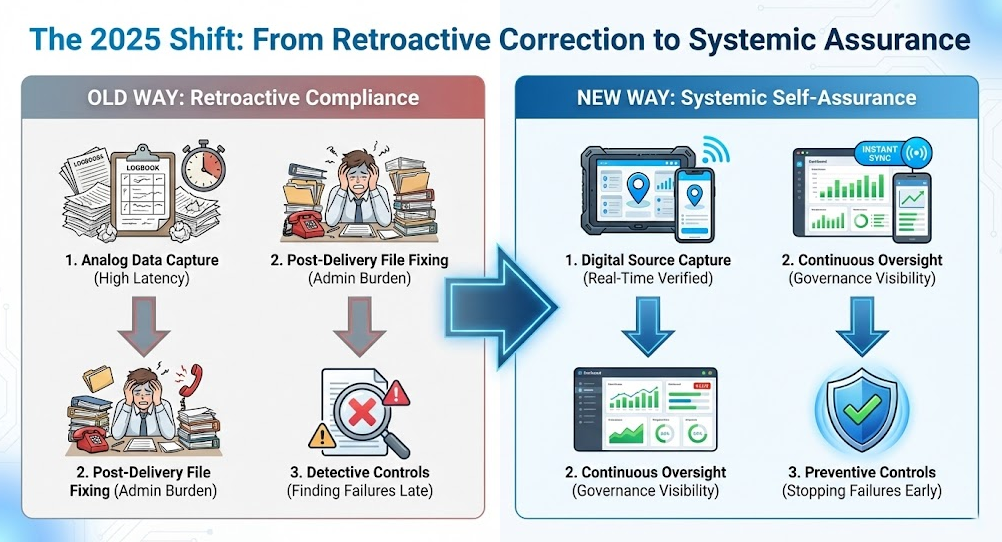
Historically, under previous regulatory frameworks, many training providers operated on a model of retrospective compliance correction. Training delivery occurred, and in the lead-up to regulatory audits or data reporting deadlines, administrative teams would conduct file reviews to identify gaps, locate missing evidence, and rectify paperwork issues post-delivery.
The concept of self-assurance demands that an RTO has continuous, systemic oversight of its operations. It requires systems that identify risks as they happen, not six months later during a file audit. ASQA expects that your organisation’s leadership knows its quality status at any given moment through reliable data streams.
If your governance model relies on fixing errors after the fact, you are already failing the intent of the new standards. The shift requires moving from finding errors to stopping errors before they occur.
The Governance Gap: Visibility Over External Placements
The greatest challenge in achieving true self-assurance lies in the areas where the RTO has the least direct control. For many VET providers, this is work-integrated learning and external placements.
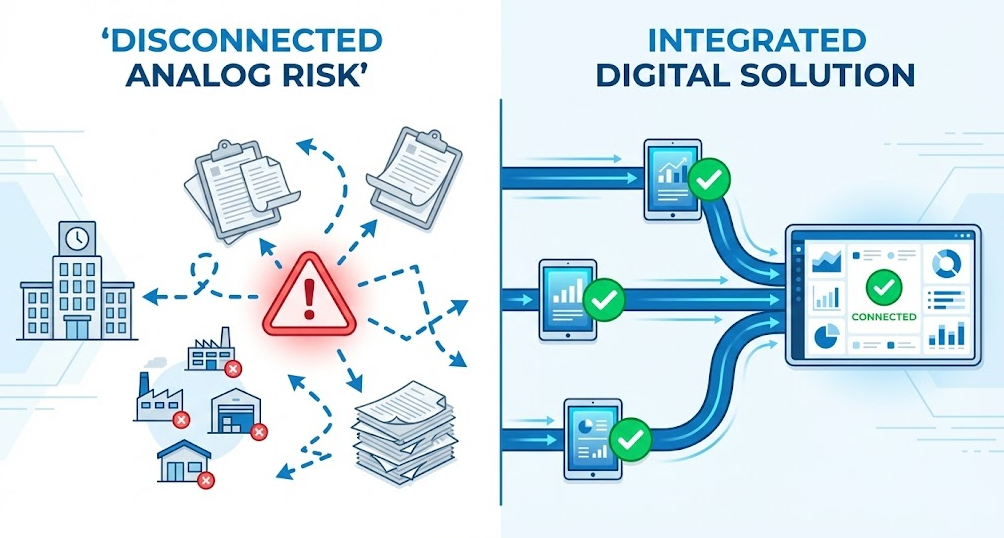
When training delivery moves off-campus to a third-party host employer, visibility often drops to near zero. RTOs have traditionally relied on paper logbooks and supervisor sign-offs, collected weeks or months after the activity occurred, as their primary evidence of progression.
In the context of the 2025 Standards, relying on disconnected, analog evidence for mandatory training components is a systemic governance risk.
How can an RTO leadership team assure the regulator they have oversight of quality when the critical data of student attendance, hours completed, and skills demonstrated in the workplace is trapped in paper documents spread across hundreds of different worksites?
ASQA has made it clear that RTOs are responsible for the quality of all training outcomes, regardless of where they occur. Failing to have robust, verifiable systems for managing off-site Vocational Educational Training (VET) activities is no longer an administrative burden; it is a failure of governance.
See also: The risks of disconnected data are most acute during the reporting season. Read our analysis on why placement data is the biggest AVETMISS struggle.
Moving from Trust to Verification
The new regulatory environment places a heavier emphasis on the authenticity and validity of assessment evidence, consistent with the broader VET Quality Framework.
In the past, the sector operated largely on trust. RTO trusted that a supervisor's signature in a logbook, dated three weeks prior, was an accurate reflection of a student’s competence. Under a self-assurance model, blind trust is not an acceptable control measure.
RTOs need to move toward verification. This means implementing systems that provide irrefutable evidence that the right student was at the right place, at the right time, doing the right tasks.
This is particularly critical when delivering VET in Schools (VETiS) programs, where duty-of-care obligations are enormous. A paper trail is an insufficient defence when things go wrong.
See also: For specific strategies on managing risk for school-based students, review our 2026 VETiS Management Playbook.
Digital Infrastructure is Now a Governance Mandate
To survive under the 2025 Standards, RTOs must accept that digital infrastructure is no longer just about administrative efficiency. It is a fundamental requirement for compliance governance.
You cannot achieve self-assurance using fragmented systems, spreadsheets, and paper. These tools create data lag and silos that make real-time oversight impossible.
VET providers require integrated platforms that capture clean, validated data at the source. Moving away from retrospective data entry at the head office towards systems where evidence is captured digitally in the field, the moment it happens. This shift provides leadership with the dashboards and real-time reporting tools to monitor continuous improvement actively.
The transition to the 2025 Standards is a test of organisational maturity. Those who view it as a paperwork exercise will struggle with increasing regulatory scrutiny. Those who view it as a mandate to modernise their infrastructure will not only ensure their survival but will find themselves operating more efficiently and profitably in the new landscape.
See also: Modernising doesn't just mean compliance. Learn how smart digital systems drive logistical speed in VET operations.
Conclusion
Ideally, self-assurance should not be a burdensome additional layer of administrative overhead; it should be the natural output of robust operational systems.
SkilTrak was designed specifically to address the systemic oversight gap inherent in off-site training delivery. By replacing disconnected paper workflows with verified, real-time digital evidence capture in the field, SkilTrak provides RTO leadership with the continuous visibility required to meet the self-assurance mandate of the 2025 Standards. For RTO boards and CEOs, reviewing whether current systems provide this level of visibility is now an immediate priority.
Share this article