 Student Placement
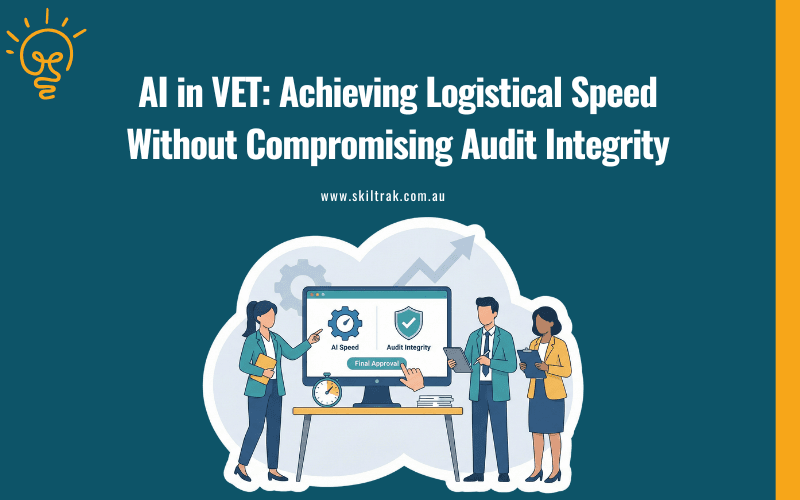
AI in Vocational VET: Achieving Speed Without Compromising Audit Integrity
If you manage work-based learning placements in the Australian Vocational Educational Training (VET) sector right now, you likely know the specific anxiety of staring at a student roster that never seems to get smaller, while the pressure keeps growing.
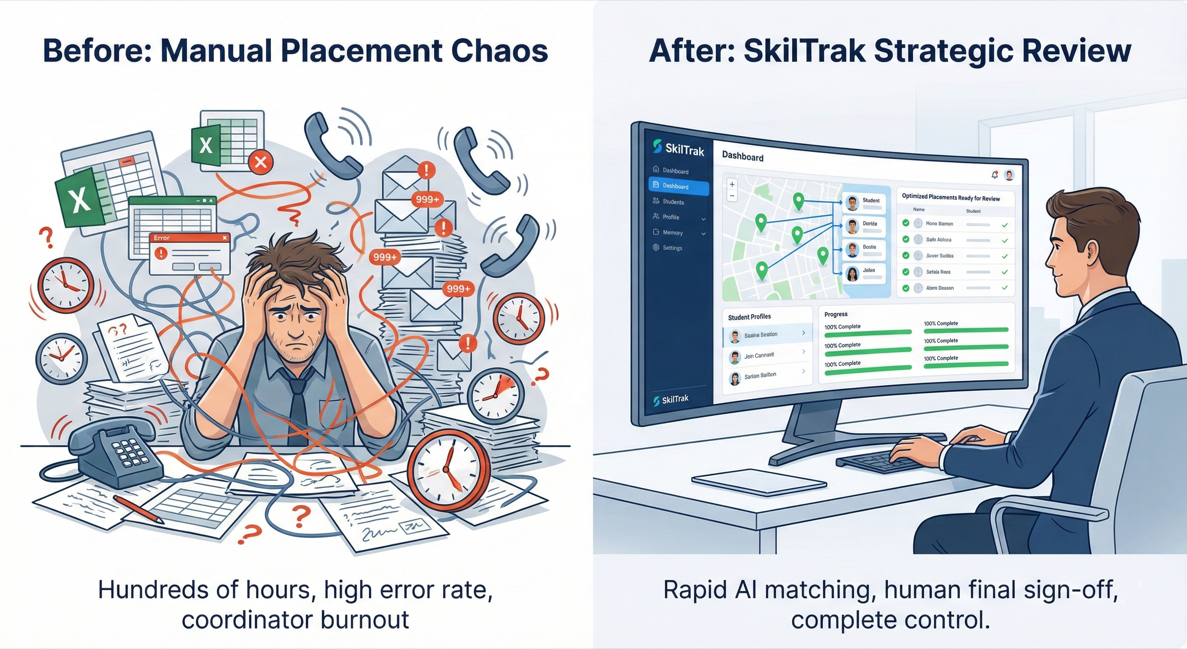
Placement coordinators are currently facing the immense challenge of matching hundreds or perhaps thousands of students to appropriate industry hosts before Semester 1 begins. The huge volume of administrative work required to align student skills, geographic location, host capacity and mandatory requirements is overwhelming.
The traditional methods of relying on complex spreadsheets, endless email chains, and coordinator memory are simply no longer sustainable at this modern scale. The sector recognises that the answer to this logistical challenge lies in technology. Specifically, there is a growing need to adopt artificial intelligence (AI) in Vocational Educational Training (VET) to handle the heavy load of placement matching and data management.
However, a significant hesitation remains among RTO principals and compliance managers. There is a justifiable fear that adopting automated tools could compromise their standing with the regulator. In a regulatory environment increasingly focused on self-assurance and systemic data driven oversight under the Standards for RTOs 2025, the idea of handing critical decisions over to an opaque algorithm is a major risk.
The challenge for the modern RTO is not choosing between technological speed and compliance. It is understanding how to implement Artificial Intelligence (AI) as necessary infrastructure without abdicating human responsibility for the outcomes.
The Regulatory Risk of Opaque Systems
The reluctance to fully embrace AI without guardrails is grounded in a sound understanding of the current VET Quality Framework. The regulatory landscape has shifted fundamentally away from prescriptive input-based auditing toward a model of provider self-assurance.
Under these standards, Training Organisations must demonstrate systemic data-driven oversight of a student's progression across the entire learning journey, including external placements. They must prove that training is structured, paced appropriately and genuinely assessed in the workplace. The legacy model of handing a student a paper logbook and collecting it weeks later fails this requirement as it offers zero real-time visibility into progress.
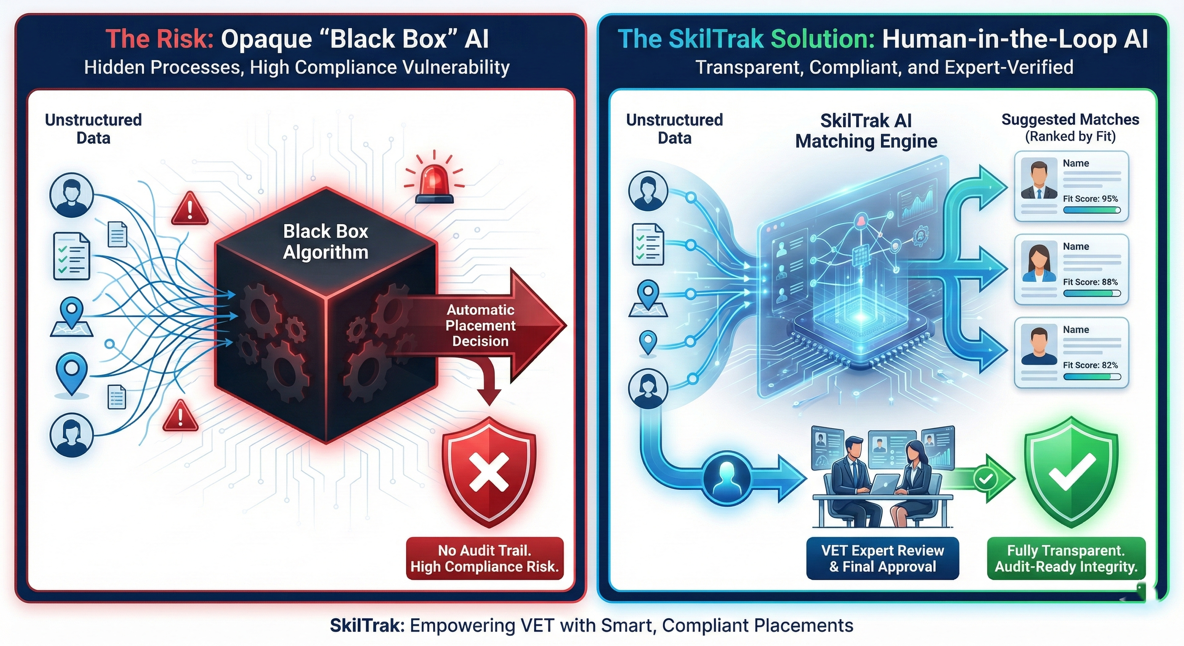
This is where opaque AI creates a critical compliance vacuum. If a Training Organisation utilises a system that automatically places students based on hidden patterns or approves evidence without a clear rationale, that provider has lost control of its quality assurance process.
If an auditor asks why a specific student was matched with a particular host or how competency was determined during a placement, the answer cannot simply be that the system decided it. Opaque technology offers logistical speed, but it removes the transparency required to prove that training is genuine.
Federal bodies have noted this tension surrounding new technologies. The Tertiary Education Quality and Standards Agency has highlighted the necessity of ethical and transparent engagement when using generative AI in education to maintain academic integrity. This principle of transparency applies equally to logistical AI in the Vocational Educational Training (VET) sector. For more details on regulatory views regarding technology in education, check this link: Tertiary Education Quality and Standards Agency website.
The Financial Stakes of Placement Data
Beyond audit compliance, the integrity of placement data now has direct financial implications for students and providers. With initiatives like the Commonwealth Practice Payment designed to alleviate placement poverty, accurately recording attendance and activity is no longer just an academic requirement. It is a financial necessity to ensure eligible students receive their government stipends.
An opaque AI system that cannot definitively verify hours or locations puts these payments at risk. Training Organisations need robust, transparent digital systems that provide undeniable evidence of student attendance and activity to support these financial claims. A complex system cannot provide the necessary level of trust required for government financial reporting.
SkilTrak’s CRM is designed specifically with built-in features to assist you with student attendance, tracking hours, location, & auditing, saving time and relieving your burden of data entry.
A Paradigm Shift: AI as Decision Support
To navigate the current placement rush safely, RTOs must shift their perspective on what Artificial Intelligence (AI) actually does. It should not be viewed as a replacement for the qualified VET coordinator but rather as a powerful tool to support their decision-making. The successful model for the Australian VET sector is a human in the loop approach.
In this framework, the technology is tasked with the complex logistical work that humans find time-consuming and error-prone. It can analyse thousands of variables across student requirements, transport routes, host availability and historical data in seconds. The system then provides insight, such as suggesting the top three appropriate matches for a cohort of nursing students based on their required clinical hours and location.
However, the final approval of those matches remains with the qualified RTO staff member who understands the nuance of the student's needs and the host relationship.
Explainable Efficiency in Practice
This approach provides what industry experts call explainable efficiency. The Training Organisations gain the speed required to handle massive student volumes during peak periods but retain the human oversight necessary for compliance and financial integrity.
When using infrastructure specifically designed for this purpose, such as the platform offered by SkilTrak, the workflow changes from frantic manual data entry to strategic review. Instead of spending hours cross-referencing spreadsheets to find available hosts, coordinators are presented with optimised options instantly. Instead of waiting until the end of a term to discover a student has disengaged, real-time data flags potential risks early, allowing for immediate human intervention.
In every scenario, the technology accelerates the process, but the human expert remains accountable for the final outcome. RTOs must embrace the logistical speed that AI offers to survive peak periods. But they must choose platforms designed specifically for the Australian regulatory context, ensuring they prioritise transparency and keep the human experts firmly in control.
If you are looking for infrastructure designed to navigate this specific regulatory environment, consider exploring how SkilTrak supports Australian Training Organisations.
Here are ways to learn more about our specialised Vocational Educational Training (VET) placement platform. Please review our complete feature set designed for compliance assistance and logistical efficiency. Contact our team to discuss your specific semester one challenges.
Share this article