





AI-PoweredPlacement ManagementSystem

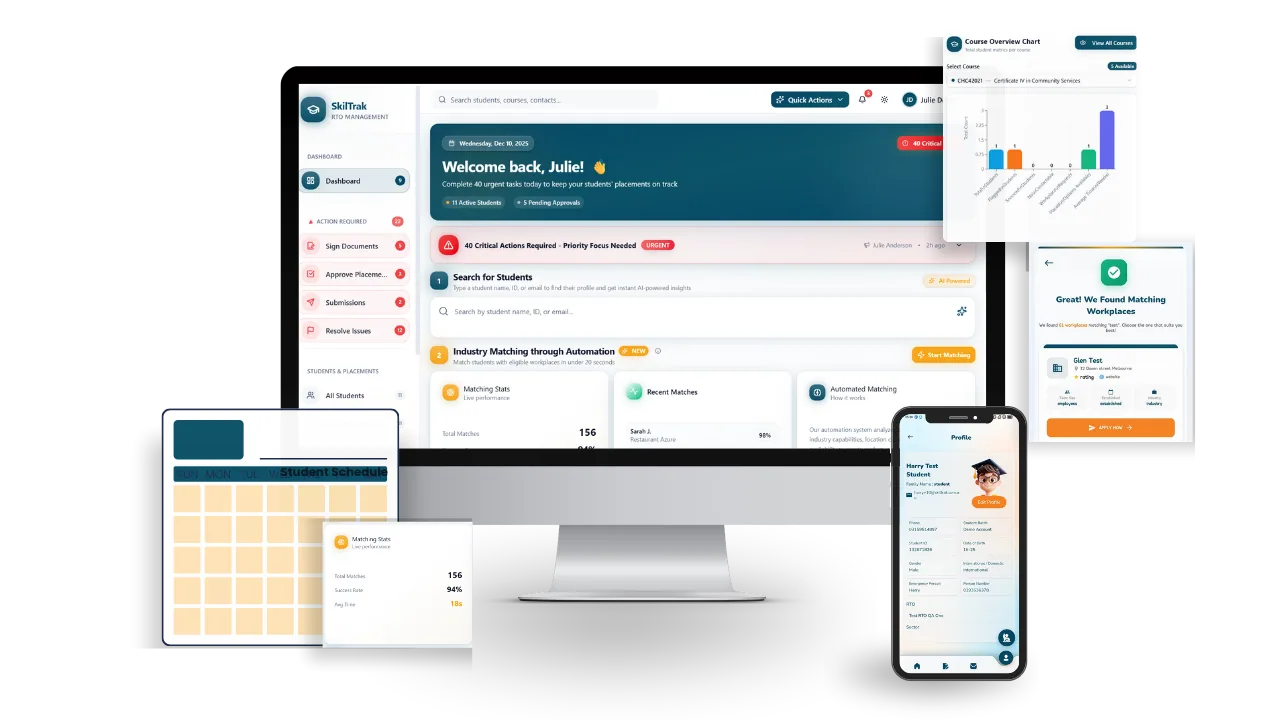
Built by educators, for educators. Manage vocational placements through a single, unified platform. SkilTrak enables training organisations (RTOs) to automate workflows, track student progress, and centralise data for real-time visibility.

6000+
Students Placed
50+
Organisation
90%
Success Rate
Trusted by Leading Organizations
Hader Institute of Education
Swin Burne
Alffie
Open Colleges
Hillshire
Orange
Reach College
ALTEC-College
Kirana-college Logo
AIBT Global

Who we Serve

🎓

Student

We help students find eligible industries that align with their career goals, ensuring their placement is not just a requirement but a starting point for their careers.

Learn More
🏢

RTOs

Simplifying the challenges RTOs face, from quality placements for their students to managing the administrative load of documentation, student tracking, and data transparency.

Learn More
📊

Industry

Our system makes it easy to track, supervise and validate placement evidence. SkilTrak gives industries access to a motivated, job-ready talent pool of graduates in both academic and practical settings.

Learn More

Nationwide Coverage Across Australia

Supporting students and organizations in every major city

50+
Courses
1500+
Active Students
4k+
Industries
60%
Reduce Admin Time

All-in-One Placement Management Software

SkilTrak’s core features transform how organisations manage their student placement from end to end.

Click any feature to explore in depth

Data Control & Security

Role-based access controls restrict visibility by organisational position. Encryption protocols protect data in transit and at rest, with comprehensive audit trails documenting all system interactions and access events.

🔒

App Accessibility

Mobile App across iOS, Android, and web maintain consistent functionality across device types. Push notifications deliver placement updates directly to users while in-app messaging centralises all correspondence within auditable records.

📱

Intelligent Matching & Analytics

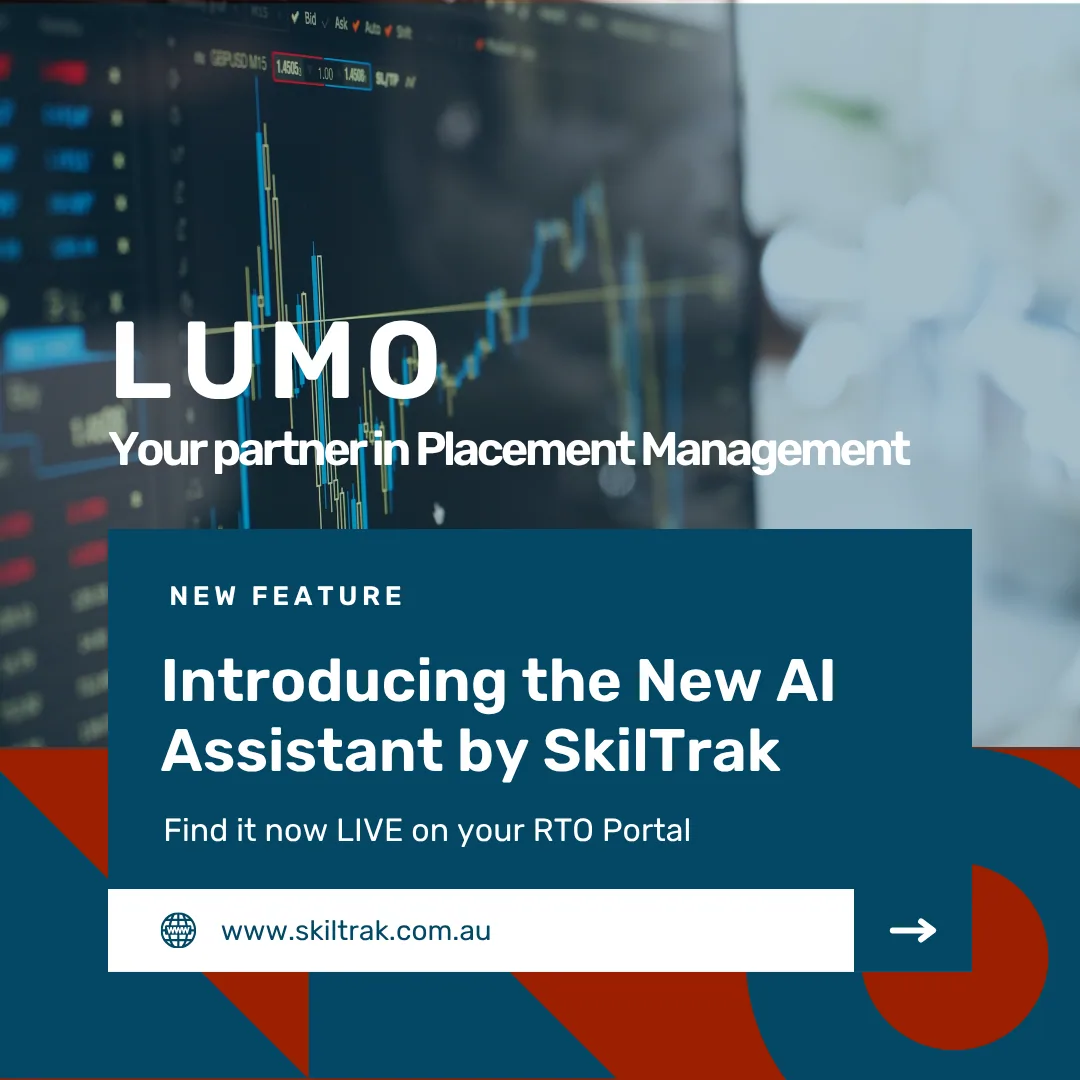
Automated allocation assesses checkpoints against qualification requirements and geographic constraints. Conversational AI provides on-demand access to placement metrics and compliance status through dashboard queries.

🤝

Performance Measurement

Analytics tracks administrative efficiency gains and placement success rates by program. Turnaround time metrics identify coordination constraints while CSV exports enable institutional reporting.

Industry Collaboration Add-Ons

title line

Become a Premium Partner with SkilTrak

📱 Mobile Application

Take SkilTrakEverywhere You Go

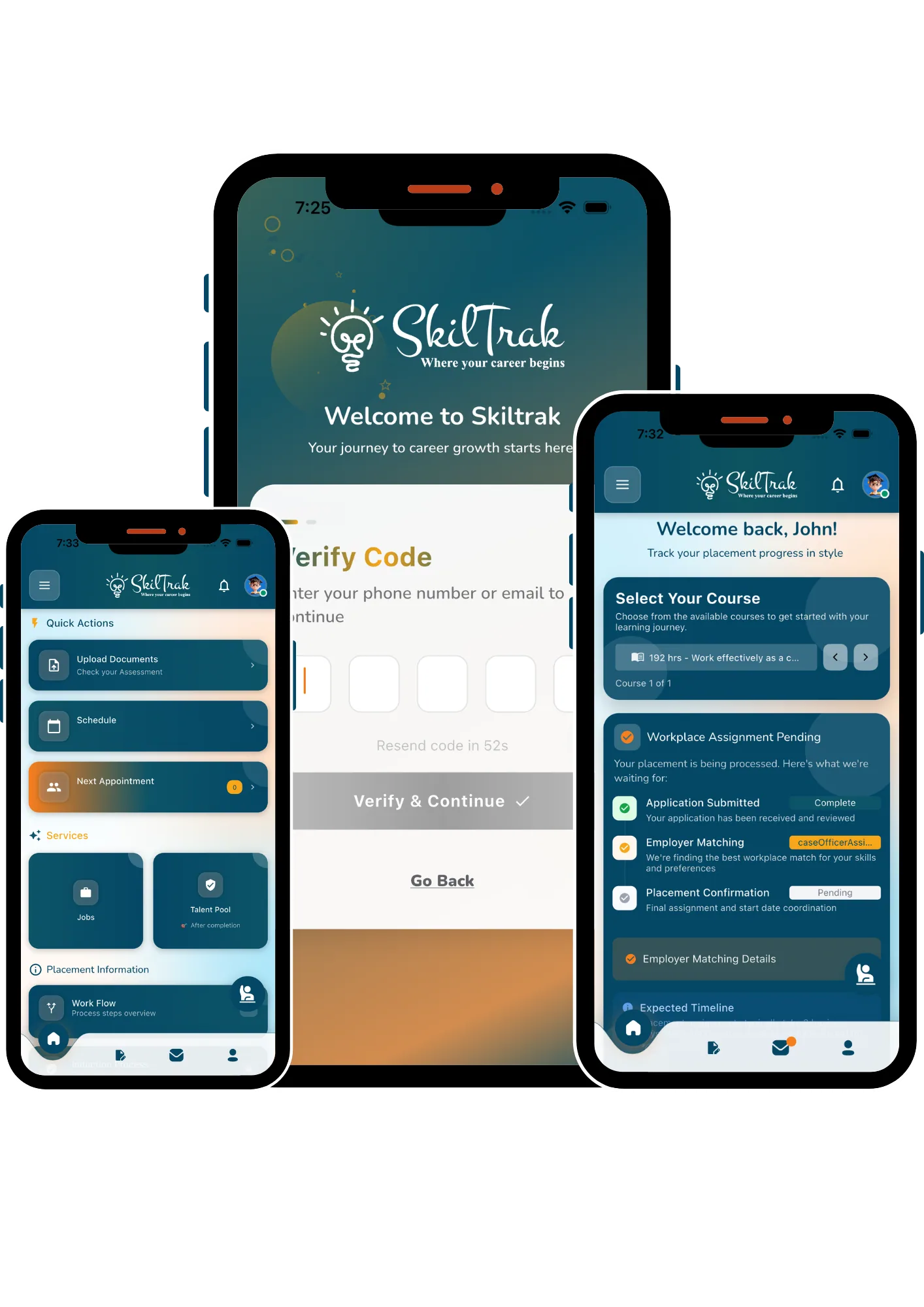
Access placements, training records, workforce opportunities, employer connections and learning pathways directly from your mobile device. Stay connected anytime, anywhere.

SkilTrak mobile app dashboard showing placements and training records

Trusted By Education Leaders

See what our partners say about transforming their placement process

"SkilTrak has been an invaluable partner for our cabinet-making students' vocational placement. SkilTrak has an impressive network of industry partners, which enabled our students to secure suitable placements in cabinet-making businesses through their regular communication and support. We at Orange College highly recommend SkilTrak for any institution seeking high-quality vocational placement services!"

Orange International College Logo
Kamalpreet Waraich
Co-founding Owner/Director of Studies
Orange International College

"Maddison has been working with great passion and enthusiasm, and she’s been learning so much each week. She has become a wonderful asset to the salon, and I truly appreciate her positive attitude and dedication. I also think your organisation’s placement program is excellent; it provides students with such valuable real-world experience. Thank you again for the opportunity to work with such a lovely student."

Kim Stella Logo
Kim Stella
HR Manager
Lumi Nail Bar

"We have been working with SkilTrak for approximately 5 months. It has been a very easy connection for ITHEA to work within the SkilTrak requirements. We have been liaising with the whole team, from the directors, operations manager, down to the accounts managers. They have all been very informative, accepting of our needs and hard working in connecting our students with employers."

ITHEA Logo
Kon Kanellopoulos
CEO
ITHEA

"I would like to commend Simon and Jake from SkilTrak for their excellent work as placement coordinators. They have done a great job in providing us with quality students for placements at Genesis Health Service. They are always reachable and respond promptly to our inquiries, making communication smooth and efficient. I appreciate their hard work and dedication."

Maria-Kristine Logo
Maria Kristine
Program Director
Genesis Health Services

"We have had the pleasure of partnering with SkilTrak for a considerable period, and the experience has been nothing short of exceptional. From Julie to Quandeel, the entire team has consistently demonstrated professionalism, efficiency, and a genuine commitment to our success. The process they have in place is both streamlined and effective, which has greatly benefited our team and learners. We look forward to continuing this valuable partnership."

Hader Institute Rto Logo
Marcus Sellen
CEO
Hader Institute of Education
LATEST INSIGHTS

Featured Blogs

Stay updated with the latest trends, insights, and best practices in student placement and workforce development

ASQA and TEQSA Sign an MOU: What It Means for Training Providers in Australia
ASQA Updates
Yesterday

ASQA and TEQSA Sign an MOU: What It Means for Training Providers in Australia

Running a dual-sector education institution in Australia, especially one that provides both vocational training and university-level education, came with a high administration burden. For years, providers like TAFEs and dual-sector universities have had to satisfy two separate regulators, submit similar paperwork twice, and ensure compliance that was designed independently of each other. The administrative load has been significant, and the sector has been speaking about it. ASQA and TEQSA have signed a Memorandum of Understanding MOU to support better collaboration and improve the efficiency of regulatory processes in the vocational education and training and higher education sectors. Alongside this, both regulators have jointly released a Dual Sector Regulatory Strategy, a three-year plan that responds directly to what the sector has been asking for. In this article, we will discuss what is changing after the MOU, what it all means and why it matters. Who Are ASQA and TEQSA? Before getting into the detail, it helps to understand what each regulator actually does and why having two of them has created complexity in the first place. ASQA, the Australian Skills Quality Authority, is the national regulator for vocational education and training. If you are an RTO, a TAFE delivering nationally recognised training, or a provider teaching overseas students on student visas in Australia, ASQA is the agency you answer to. It currently oversees approximately 3,843 registered training organisations across the country. TEQSA, the Tertiary Education Quality and Standards Agency, does the same for higher education. Universities, university colleges, and institutes of higher education all fall under TEQSA's authority. It oversees 211 registered higher education providers. For most organisations, dealing with a single regulator is straightforward enough. The complexity arises for the 57 providers in Australia that work under both providers delivering VET qualifications and university-level courses simultaneously. These are dual-sector providers, and they must satisfy both ASQA and TEQSA. What It Has Been Like for Dual Sector Providers Imagine having to file essentially the same paperwork with two different government regulatory bodies, formatted differently for each, because each regulator has its own application structure built around its own standards framework. That is the difficult part for dual sector providers in Australia. When a dual sector institution applies for CRICOS registration, renews its compliance status, or submits annual declarations, it often provides similar evidence to both ASQA.

By Yasir Ahmed
What is a USI? And Its Importance in VET Australia 2026
RTOs
Jul 21

What is a USI? And Its Importance in VET Australia 2026

If you are enrolling in a VET course in Australia, one of the first things your RTO will ask for is your USI (Unique Student Identifier). A lot of students have heard the term but are not entirely sure what it is, why it matters, or what happens if they do not have one. This article covers everything you need to know. What Does USI Stand For? USI stands for Unique Student Identifier. It is a reference number issued by the Australian Government to every student enrolled in nationally recognised training in Australia. Your USI gives you access to a government-authenticated record of all your vocational education and training achievements since 2015. Think of it as your personal education ID one number that follows you throughout your entire training journey in Australia, no matter how many courses you do or how many training organisations you study with. When Did the USI Start? Introduced under the Student Identifiers Act 2014, the USI became mandatory for anyone seeking a qualification or statement of attainment from a Registered Training Organisation from 1 January 2015. As of 2026, over 15.6 million USIs have been issued since inception, supporting more than 4 million annual VET students across approximately 5,000 RTOs. If you have studied any nationally recognised VET course since 2015, including while you were at school, you already have a USI. What Does a USI Actually Do? A USI does two main things. First, it creates a permanent record of every VET qualification and statement of attainment you complete in Australia. All your training history is in one place, accessible whenever you need it, whether for a job application, enrolling in another course, or proving your qualifications to an employer. Second, it connects your student loan information to your personal details and is required to access Commonwealth financial assistance. If you are applying for a VET Student Loan, you cannot access it without a USI. The USI acts as a centralised identification system, linking your nationally accredited training records. This ensures that no matter where or when you undertake training in Australia, your information is accurately recorded. Yes, without exception. Without a USI, VET students cannot receive their qualification or statements of attainment upon course completion unless a formal exemption is in place. This means if you complete your.

By Yasir Ahmed
Student Rights During a Work Placement in Australia - Guide
Student Placement
Jul 6

Student Rights During a Work Placement in Australia - Guide

For students, starting placement is one of the most exciting parts of a vocational course. But before starting, a student must understand that he has rights and protections. Even though it is not a proper employment. Knowing these rights helps the students to focus on their learning, give their best, and know exactly what to do if something does not feel right. This guide explains what rights a student has and who to report in case the rights are violated. Is Your Work Placement Legally Unpaid? Under the Fair Work Act 2009, a VET work placement is classified as a "vocational placement." This means it is lawfully unpaid, but only when all four of these conditions are met: Placement is mandatory work that students have to do, it’s not volunteer work or work that students choose to do. The course should be delivered by an institution authorised under Australian law, including all RTOs, TAFEs and training providers. There is no contract or agreement entitling students to be paid for their work. Placements are not covered by an industrial award or registered agreement. When all four conditions are met, the host employer is not required to pay the student under the Fair Work Act. Students are not considered employees during placement, meaning minimum wage rules and standard employment entitlements do not apply to placement hours. What if the conditions are not met? If the placement does not satisfy all four conditions, it no longer qualifies as a vocational placement under the Fair Work Act. At that point, it may be considered employment, meaning the host employer could be legally required to pay. Students who are unsure about their specific situation can contact the Fair Work Ombudsman at fairwork.gov.au. These Safety Rights Always Apply Even though Fair Work employment entitlements do not apply to vocational placements, Work Health and Safety rights absolutely do. The WHS Act 2011 applies to everyone in a workplace, including students on placement, with no exceptions. Meaning host employers are obliged to provide a safe environment to students: Host employers are expected to perform a risk assessment of the workplace before the students start and address any identified hazards. Students should be provided a proper induction before they begin to do any task, covering emergency procedures, safety equipment and who to contact if.

By Yasir Ahmed

Latest Updates

title line
Accelerate Career dashboard
Lumo AI dashboard
Compliance dashboard
Accelerate Career dashboard
Lumo AI dashboard
Compliance dashboard

Our Technical Partners