 career goals
Understanding Registered Training Organisations (RTOs) in Australia
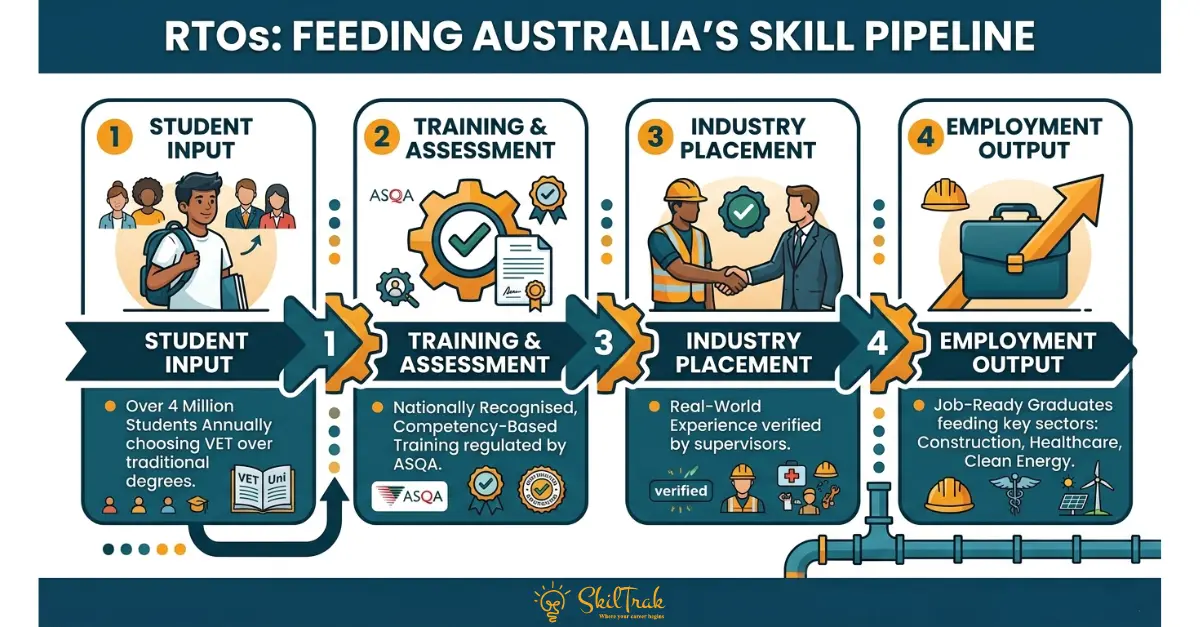
Australia's workforce runs on skills, not degrees. That's where Registered Training Organisations come in. RTOs form the core of our vocational education training system, delivering practical, job-ready qualifications to over 4 million students annually. In 2026, with construction flourishing, aged care desperate, and clean energy roles exploding, training institutes aren't just training providers: they're the critical channel feeding industries that keep the economy moving.
Experts advise that training quality across RTOs in Australia is world-class, but employment outcomes remain frustratingly inconsistent. Employers receive floods of Certificate III graduates, yet struggle to identify who's genuinely workplace-ready. This gap isn't about training; it's about placement verification and industry connection.
This guide cuts through the noise. Whether you're an RTO director planning your funding strategy, a compliance officer preparing for ASQA audits, or a trainer wanting better student outcomes, here's exactly what defines leading training organisations, why placements matter more than ever, and how platforms like SkilTrak solve the problems keeping you frustrated.
The Unique Value of RTOs in Australia's Economy
Think of a VET student in regional Queensland. No uni degree in sight, but they completed a Certificate III in Carpentry through a local RTO provider. Six months later, they're earning $65,000 as a second-year apprentice with a major builder. Meanwhile, their high school classmate with an ATAR of 85 is still figuring out uni electives.
That's the Vocational Education Training power: direct pathways from training room to paycheque. RTOs deliver nationally recognised training that carries identical weight whether in Queensland, NSW or anywhere. This portability creates genuine career mobility in a way that generic training certificates never could.
The numbers tell the story. Over 4,000 RTOs in Australia operate nationwide, regulated primarily by the Australian Skills Quality Authority (ASQA). They issue 1.2 million qualifications annually across construction, healthcare, hospitality, manufacturing, IT, automotive, early childhood education, and emerging clean energy sectors. Government programmes like NSW's Smart and Skilled, Victoria's Free TAFE, and national User Choice funding inject over $3 billion yearly into this system, making high-quality training accessible regardless of postcode or background.
What sets training institutes in Australia apart from other training providers? Rigorous competency-based assessment. Students don't pass by memorising theory; they demonstrate actual workplace skills under qualified supervision. A Certificate III in Individual Support (Aged Care) means that graduates can handle medication assistance, personal care, and documentation exactly as required in real facilities. Employers trust this because ASQA deregisters training organisations that cut corners.
Understanding the Vocational Education Training Qualification Ladder
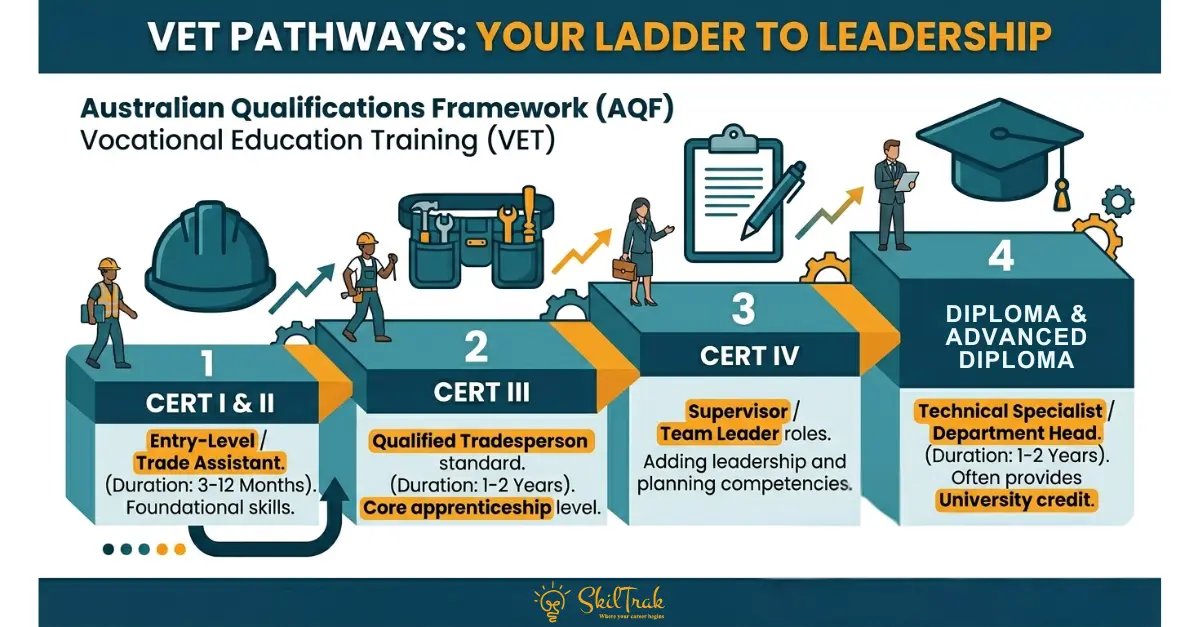
The strength of vocational education training lies in its structured progression. Every qualification maps to the Australian Qualifications Framework (AQF), creating clear steps from entry-level to management:
Entry-level workers start with Certificate I or II, think basic safety induction or trade assistant roles. These 3-12 month programmes build foundational skills. Certificate III represents the standard for qualified tradespeople, typically requiring 1-2 years and including significant workplace hours. This is where most apprenticeships culminate.
Certificate IV targets supervisor roles, adding leadership and planning competencies. Diplomas (1-2 years) prepare coordinators and technical specialists, while Advanced Diplomas position graduates for department head responsibilities. Vocational Graduate Certificates offer specialisation for experienced professionals.
Consider nursing pathways: Certificate III in Individual Support opens aged care roles at $28/hour. Upgrade to a Diploma of Nursing (18 months later), and you're earning $38/hour as an enrolled nurse. Many universities grant full first-year credit towards a Bachelor of Nursing, creating seamless progression.
This ladder works because RTOs consult directly with industry when designing training packages. Sector Skills Organisations like the Australasian Institute of Training and Development ensure curricula reflect genuine workplace needs, not academic theory.
ASQA Regulation: The Standard Protecting Training Organisations
Nobody regulates training providers like ASQA. Every RTO in Australia must maintain a current scope of registration, ensuring trainers hold recent industry experience (typically within two years). Assessment tools undergo mandatory validation: 50% are reviewed annually across student cohorts.
The Unique Student Identifier (USI) system creates national transparency, preventing duplicate funding claims. RTOs must verify student identity, track engagement, and report completions accurately. Marketing materials face strict scrutiny; no fast-track promises are allowed.
2026 brings a heightened focus on work placement supervision. The Regulation Authority now requires detailed records showing adequate supervisor-to-student ratios, workplace risk assessments, and competency sign-offs. Platforms struggling with manual Excel tracking face audit nightmares.
Industry currency represents another cornerstone. Your carpentry trainer must have practical experience of commercial work in the past two years. Healthcare assessors need current AHPRA registration or hospital experience. This keeps vocational education training relevant when technologies shift rapidly.
Government Funding Empowering Training Institutes
Smart policymakers recognise that skilled tradespeople prevent recessions. That's why states invest heavily:
Victoria's Free TAFE covers 50 priority occupations completely. NSW's Smart and Skilled provides entitlement funding up to AQF level 5. National User Choice subsidises apprenticeships, while JobTrainer targets short courses in high-demand fields.
The catch? Training institutes must demonstrate outcomes. Completion rates above 80%, employment evidence, and industry satisfaction surveys to determine future funding allocations. This pressure elevates placement services from nice-to-have to mission-critical.
Why Placement Gaps Hurt RTOs
Here's the brutal reality: Across dozens of training institutes, training excellence collides with employment reality. Certificate III Commercial Cookery graduates flood hospitality job boards, but restaurants reject 70% for lacking verified kitchen experience. Construction firms advertise apprentice roles but struggle to verify which Certificate II students genuinely understand site safety protocols.
The root cause? Verification gaps. Employers receive resumes listing qualifications, but lack supervisor-confirmed evidence of workplace performance. Manual reference checks waste time. Competing training organisations promise placements but deliver generic job boards.
This disconnect damages everyone. Students delay careers. Employers face skills shortages. RTOs risk declining enrolments when employment stats lag competitors. ASQA funding applications put increasing demand on placement evidence.
SkilTrak: Intelligent Solution Transforming Training Outcomes
After years of consulting with training organisations' managers, there has been a flood of management systems that come and then disappear. SkilTrak stands out because it solves the verification-to-employment pipeline comprehensively.
Nursing students complete Certificate III in Individual Support. SkilTrak extracts competencies from its training management system, medication assistance, mobility support, and documentation. Supervisors verify via mobile app during work experience. The platform matches verified profiles against aged care provider vacancies, prioritising regional needs.
Result? Aged care facilities receive pre-vetted graduates with supervisor-confirmed capabilities. Depending on skills and demand, students secure roles within desired industries. Training providers generate ASQA-ready placement reports. In childcare, Certificate III Early Childhood Education students are matched against centre vacancies, and Construction Certificate II learners feed directly into apprenticeship pipelines.
What makes SkilTrak different? Immutable audit trails. Every supervisor sign-off, every shift logged, and every competency verified is stored securely for ASQA inspections. No more Excel chaos or missing paperwork.
Beyond Training: The Six Pillars of Leading RTOs
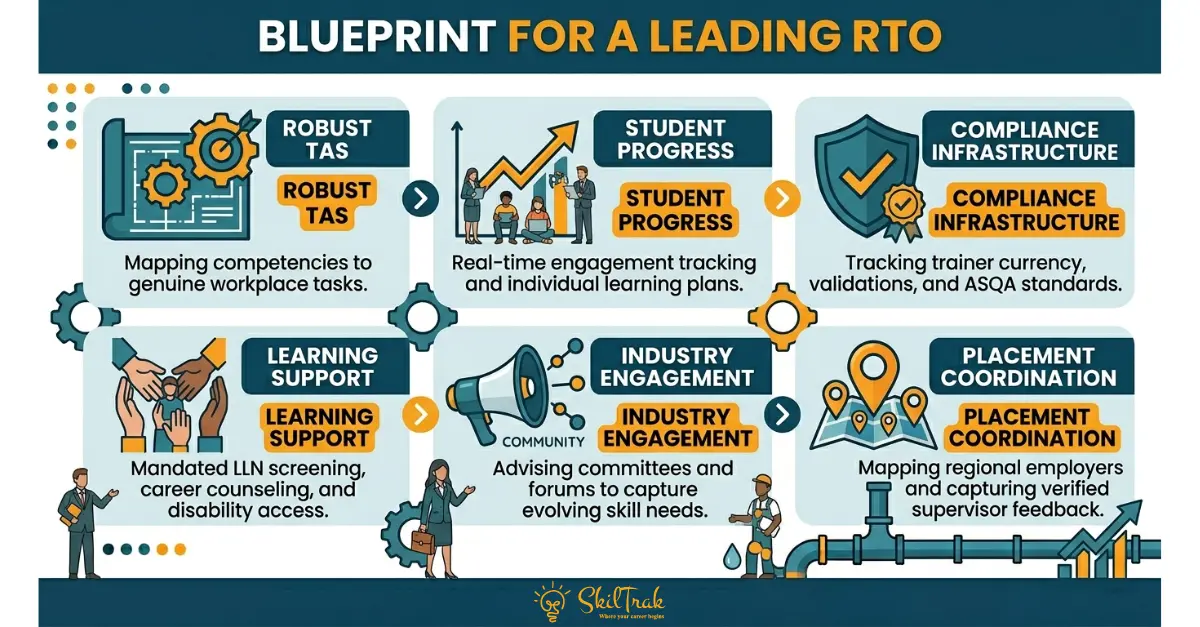
Excellent training institutes deliver far more than classroom instruction. Forward-thinking providers build comprehensive ecosystems:
- First, sophisticated training and assessment strategies map every competency to genuine workplace tasks. A Certificate III Electrotechnology unit covering circuit testing requires actual multimeter use under supervision, not theoretical questions. Leading training organisations maintain 100% unit currency through training.gov.au monitoring and industry secondments.
- Second, robust student progress management. Weekly engagement tracking identifies at-risk learners early. Individual learning plans adjust for diverse needs, English language support, dyslexia accommodations, or accelerated RPL for experienced workers. Mid-point reviews ensure timely interventions.
- Third, robust compliance infrastructure. ASQA audit dashboards track trainer currency, assessment validation cycles, USI compliance, and marketing approvals. Automated systems flag expiring registrations or overdue validations before they become audit findings.
- Fourth, comprehensive learning support services. Mandatory language, literacy, and numeracy screening on enrolment identifies support needs. Career counselling guides students towards university articulation, apprenticeships, or specialisation pathways. Disability action plans ensure equitable access.
- Fifth, strategic industry engagement. Top training organisations maintain advisory committees with genuine employer representation. Regular employer forums capture evolving skill needs, electric vehicle maintenance, net-zero construction practices, and telehealth nursing competencies.
- Finally, and increasingly critical, placement coordination. Forward-thinking training institutes invest in dedicated placement teams mapping regional employers, negotiating supervision agreements, auditing workplace suitability, and collecting post-placement feedback. This closes the training-to-employment loop.
Navigating Career Progression Through Vocational Education Training
Training organisations create multiple pathways addressing diverse ambitions. Trade-focused learners progress Certificate II → III → IV → Diploma, gaining increasing responsibility and salary. Management aspirants follow Certificate III → Diploma → Advanced Diploma routes towards department leadership.
University articulation offers another compelling option. Most Diploma of Nursing holders receive full first-year credit towards bachelor's programmes. The Advanced Diploma of Building and Construction typically grants 50% Bachelor's credit. This creates flexible entry points, avoiding redundant study.
Apprenticeships offer Certificate III/IV qualifications with salaries starting at $35k, reaching $50k+ by 2-3 years. User Choice funding covers 75-90% of typical coverage.
Countless students are paralysed by choice. Industry choice remains consistent: identify your three-year destination, then work backwards. Want to supervise construction sites? Diploma Building → site manager track. Dream of aged care leadership? Certificate III → Diploma → facility manager.
The 2026: What Lies Ahead for Training Providers
Vocational education faces an exciting evolution. National Skills Passport development promises digital credential portability across VET and higher education. Micro-credentials gain traction for rapidly evolving skills like carbon accounting and AI prompt engineering.
The climate transition is accelerating demand for green skills, solar installation, energy auditing, and sustainable construction. ASQA fast-track training package approvals in these priority areas.
Assessment innovation addresses generative AI challenges. Leading RTOs implement staged verification, capturing supervisor feedback, progressive milestones, and workplace valuables rather than end-point reports vulnerable to fabrication.
Conclusion: From Training to Transformation
If you're leading a training organisation. Training excellence establishes your reputation. Placement outcomes will determine your funding trajectory.
Vocational (VET) leaders recognise strategic partnerships as force multipliers. Platforms connecting verified skills to verified vacancies don't just improve statistics; they transform lives. SkilTrak delivers these outcomes weekly across Australia. Their platform scales from 10 students to 10,000 without missing execution quality. Regional networks ensure metro bias doesn't disadvantage rural learners. Compliance-based documentation and early data collection eliminate compliance anxiety.
For more information, contact (skiltrakmarketing@skiltrak.com.au)
Share this article
FAQ's
01
Q. What is an RTO?
An organisation that is registered in the national training register as a registered training organisation.
02
Q. How many RTOs are registered in Australia?
Around 4000 to 5000 RTOs are working in Australia.
03
Q. What is the full form of RTO?
RTO stands for Registered Training Organisation.