 career goals
Vocational Careers That AI Won't Replace and Why?
As Artificial Intelligence moves from being a futuristic concept to a daily coworker. Many headlines focus on displacement, recent data from Jobs and Skills Australia (JSA) and various 2026 industry reports suggest a different reality. AI is far more likely to serve as a supportive tool than a total replacement for most Australian roles.
The following information summarises the latest research on careers that remain highly resilient, with a focus on the vital Vocational Education and Training (VET) sector.
Why AI Won’t Replace Some Roles
Research from the JSA and Victoria University highlights that roles least exposed to automation are those requiring high levels of human touch and physical adaptability. AI excels in digital and predictable environments but lacks three critical attributes that define the Australian labour market today:
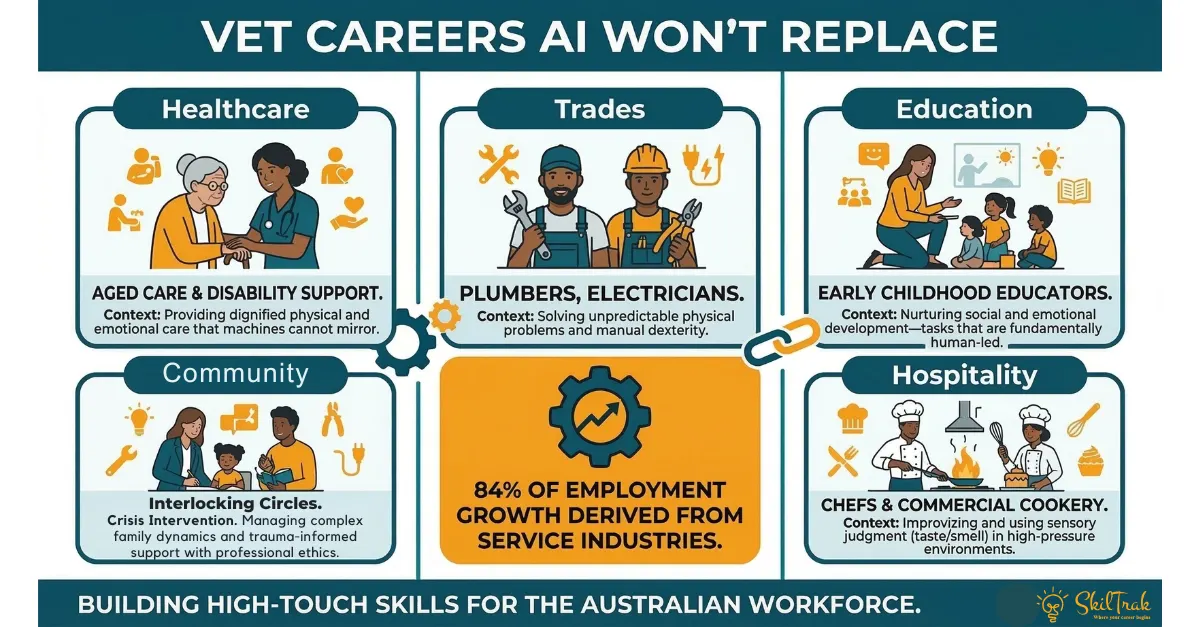
- Addaptiveness to Complexity: Digital systems cannot yet navigate the physical complexity of a messy building site or a domestic kitchen.
- Complex Human Empathy: The trust between a doctor or certified professional and a client is something Artificial Intelligence (AI) cannot just replicate.
- Risk Ownership and Accountability: Sectors like healthcare or child protection, where a human must exercise professional decision making and take responsibility for the outcome.
VET Careers AI Won’t Replace
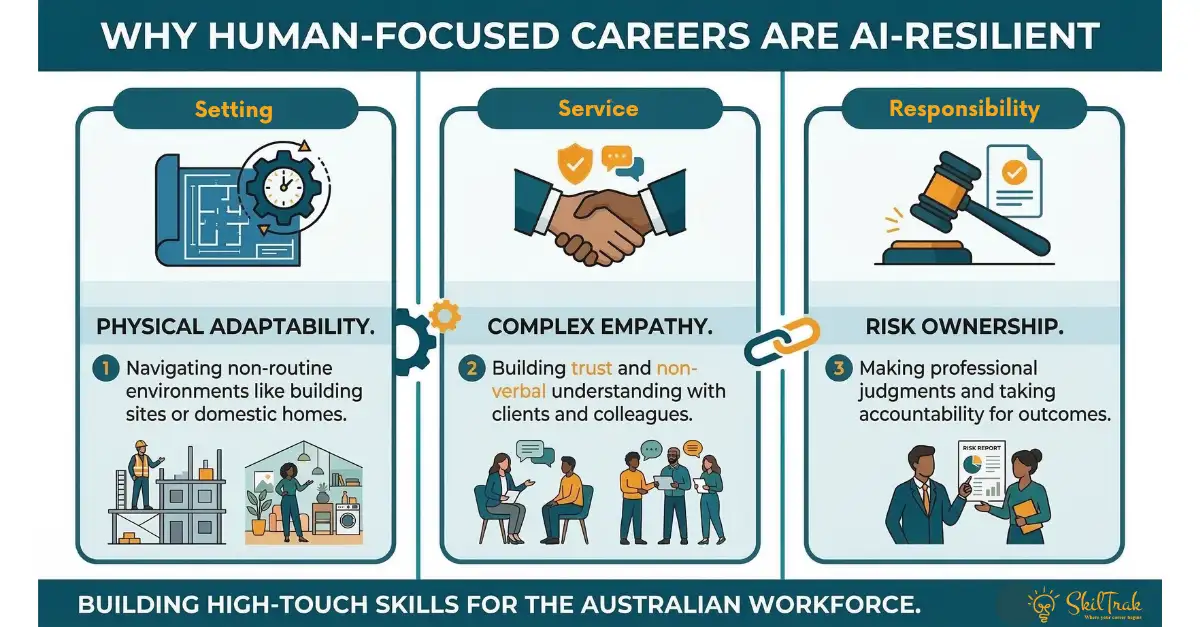
According to the 2025-26 Jobs and Skills Report, service-related industries have driven nearly 84% of employment growth. The Vocational Educational Training (VET) sector is uniquely positioned because it trains Australians for the exact roles AI cannot replace.
1. Healthcare and Community Services
With an aging population, the demand for human-centric care has reached an all-time high. While AI can assist with medical diagnostics, it cannot replace the physical and emotional support provided by qualified professionals.
- Aged Care and Disability Support: These roles require physical presence and dignified care that machines cannot mirror.
- Mental Health Workers: Rely on reading subtle non-verbal cues and providing trauma-informed care which remains human-led.
2. Skilled Trades and Infrastructure
The construction sector is projected to require a massive influx of workers to meet housing and infrastructure goals. AI cannot physically build the homes Australia needs.
- Plumbers, Electricians, and Carpenters: These roles demand on-the-spot problem-solving and manual expertise. AI can help with a digital blueprint, but a human must execute the installation of that blueprint and ensure everything progresses smoothly.
- Mechanical and Avionics Technicians: High-level manual skills are required to maintain the physical machinery that powers our transport and logistics networks.
3. Commercial Cookery and Hospitality
Commercial cookery remains one of the few fields where physical production is high-speed and sensory-dependent.
- Chefs and Kitchen Managers: Beyond a recipe, these roles require managing team dynamics, sensory judgment like taste and smell, and the ability to improvise in a pressure-driven environment.
Collaboration Between AI and Human Intelligence
It is a misconception to think these jobs will not change. Instead of substitution, we are seeing augmentation. According to the latest JSA Transition study, while 87% of the workforce is in roles where AI will act as a co-pilot, only a small fraction of occupations face a high risk of total automation.
 pressure-driven
Future Proofing Your Career
The strategy for staying relevant is clear: choose a pathway where human judgment is the primary value. Organisations like SkilTrak are assisting this transition by ensuring students do not just learn theory but gain the work-integrated learning experience necessary to dominate these resilient fields. By using the SkilTrak LMS Portal, students can track their progress in real-time, ensuring their human skills like teamwork and professional conduct are verified and ready for the workforce.
Key Recommendations for Workers:
- Prioritise Human Skills: Focus on learning agility, critical thinking, and empathy.
- Lean into Regulated Sectors: Roles in Allied Health and Education require human-in-the-loop accountability due to strict Australian standards.
- Utilise Technology: Learn how to use AI for administrative tasks so you can spend more time on the high-value human aspects of your role.
Final Thoughts: The Human Advantage
Australia is currently seeing a workforce reset. Job security and financial confidence are top priorities for workers. The jobs that offer the most security are not necessarily the most tech-heavy; they are the most human-heavy. By pursuing qualified roles in trades, healthcare, and community services via National VET workforce strategy, Australians are not competing with AI; they are leading it. The future of work is about leading the technology to enhance human outcomes.
Share this article