 Student Placement
Financial Risk of Manual Vocational Educational (VET) Administration
Budgets in secondary education are always tight and force business managers to examine every recurring subscription. In this situation, it is easy to view specialised Vocational Educational Training (VET) software as a non-compulsory purchase rather than a core infrastructure requirement, leading many schools to rely on free tools like spreadsheets. However, this line of reasoning frequently overlooks the hidden non-linear costs associated with manual administration. When the financial risk of a single compliance failure outweighs the annual investment in digital infrastructure, the free option quickly becomes the most expensive choice.
This analysis explores the financial economics of VET administration specifically comparing the steady cost of software prevention against the volatile price of audit rectification.
The 20-Day Rectification Deadline
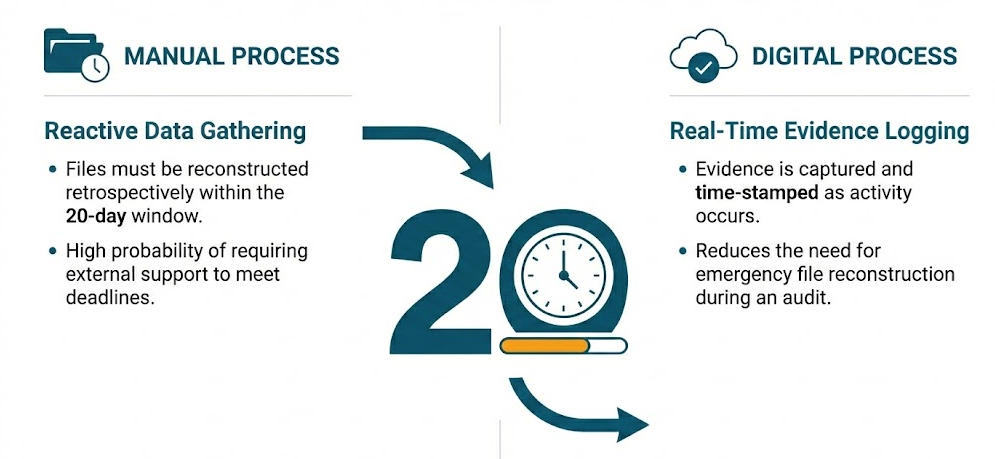
The single biggest financial risk in VET is not the daily administration, but the audit timeline. When a regulator such as ASQA identifies critical non-compliance during an audit, the window for rectification is notoriously tight.
Schools are typically granted just 20 working days to provide evidence of rectification. This specific timeline changes the economic dynamic completely. If a school had six months to fix a compliance gap, it could do so using existing staff and regular budgets. But with only 20 days to rewrite assessment tools or validate insurance across 50 employers, the school loses the luxury of time.
This urgency creates a seller's market for external help. To meet the deadline and save the RTO registration, the school is forced to pay whatever is necessary.
The Cost of Panic: Where the Budget Goes
When a manual system fails an audit, the costs spiral quickly. This isn't about paying a small fine. It is about the massive resource injection required to fix years of silent non-compliance in under a month.
The Consultant Premium
You cannot ask a VET Coordinator who is already teaching a full load to fix a systemic compliance failure in 20 days. Schools are forced to engage external training organisation compliance consultants immediately. Due to the urgent nature of this work, these experts charge premium rates. A rectification project often requires 50 to 100 hours of consultant time to audit files and rewrite materials.
Staffing Overheads
The internal ripple effect is equally expensive. To support the consultants, key internal staff must be pulled out of class. This triggers a daily cost for Casual Relief Teachers (CRTs) to cover their load. Furthermore, if the rectification requires contacting past students or employers to re-sign documents, administrative staff often accrue significant overtime.
Regulatory Cost Recovery
It is often overlooked that the audit process itself is a billable service. Regulators operating under cost-recovery models charge the RTO for the auditor's time. If a follow-up audit is required to verify the rectification, the school pays for that too.
SkilTrak as Financial Risk Management
This is where the conversation shifts from software features to budget security. From reactive to continuous compliance.
Implementing SkilTrak is effectively a strategy to flatten this financial volatility. Instead of carrying the risk of a significant emergency rectification bill the school pays a predictable budgeted annual fee.
SkilTrak is built to mitigate the compliance blind spots that lead to these expensive failures. By systematically validating that insurance is current before a placement is generated and assisting staff to collect evidence in real-time, the platform supports the school in maintaining a state of constant audit readiness.
Helps avoid spending money in a panic. When an auditor arrives, the evidence is already organised and time-stamped. There is no need to hire emergency consultants because the system has been enforcing the rules every day of the year.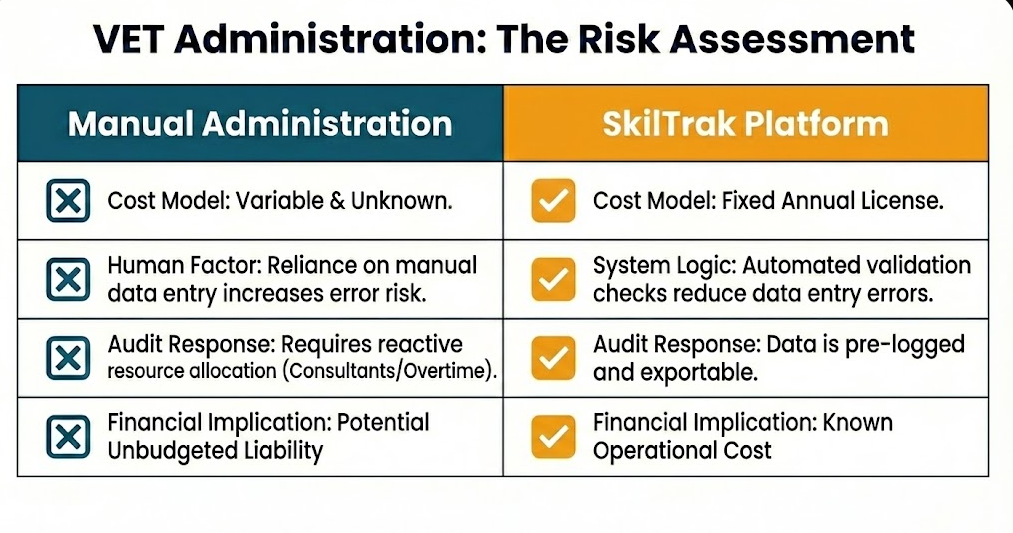
Final Thoughts
Fiscal responsibility in schools is about avoiding unbudgeted shocks. While the spreadsheet method avoids a software invoice today, it exposes the school to a disproportionate financial risk tomorrow.
Investing in SkilTrak is not just about making life easier for the VET Coordinator. It is a financial decision to cap the school’s liability. It replaces the unpredictable high-cost risk of manual failure with the stability of a secure compliant system.
Share this article