 career goals
Skill Assessment Guide For RPL In Australia - SkilTrak
Recognition of Prior Learning RPL in Australia is a formal assessment process that acknowledges the skills you’ve gained through life experience, self-study, and most importantly, being on the job. Many professionals reach a point where their practical skills far outpace their formal qualifications. If you find yourself in a position where you are already performing high-level tasks but lack the certification to back them up, exploring RPL in Australia could be the best move for your career.
In this article, we learn about the RPL certificate framework and how to get a proper qualification for your skills.
Understanding the Framework of RPL in Australia
The Australian Skills Quality Authority (ASQA) defines RPL as an assessment process that evaluates an individual’s non-formal and informal learning. In a professional context, this means your competency is measured against the specific requirements of a national training package or a VET-accredited course.
To understand how your experience fits, it helps to distinguish between the types of learning ASQA recognises:
- Formal Learning: Structured programs leading to an AQF qualification, such as a previous certificate or diploma.
- Non-Formal Learning: Organised professional development, such as in-house corporate training or industry-specific workshops that didn't result in a degree.
- Informal Learning: The most common source for RPL, involving skills picked up through years of employment, social interactions, or even hobbies.
The Evidence Required for a Successful Application
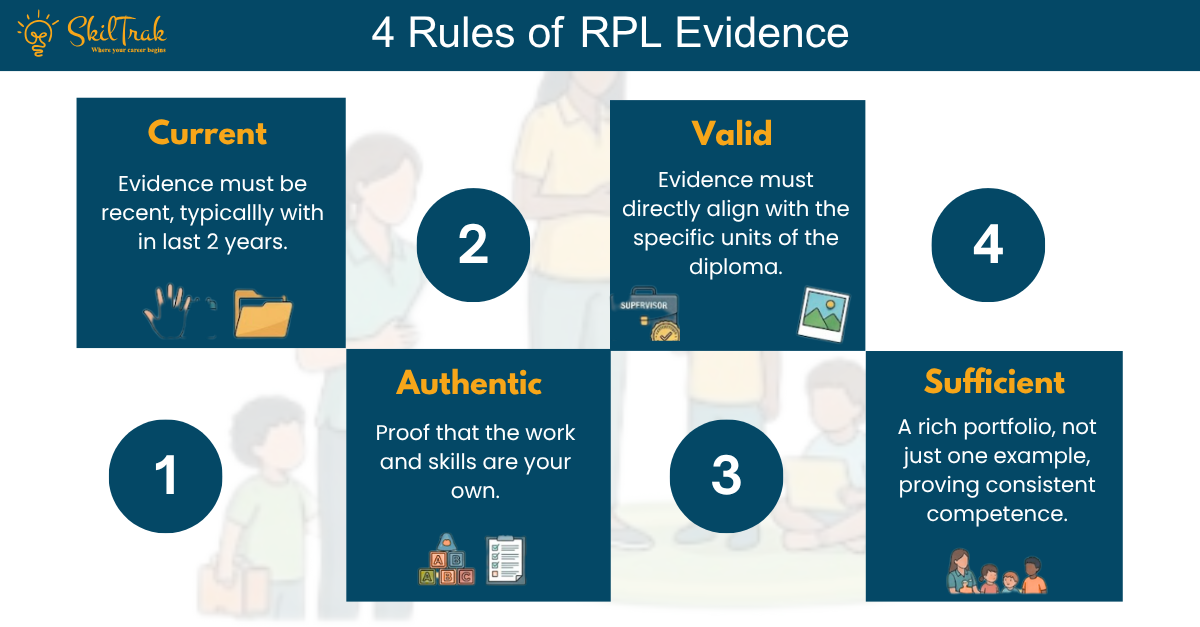
Obtaining a qualification through RPL in Australia is a strict process. Registered Training Organisations (RTOs) can not simply hand out certificates; they require a comprehensive portfolio of evidence to prove you meet industry standards. Generally, a minimum of two years of relevant experience is the baseline for most applicants.
To build a strong case, the following documentation is typically required:
- Comprehensive CV: A professional history detailing specific roles, responsibilities, and key achievements.
- Industry References: Detailed letters from current or past supervisors verifying your technical skills and performance.
- Visual Proof: Practical evidence is essential. This often includes a collection of photos (typically around ten) showing you performing various workplace tasks and short video clips demonstrating your hands-on competence.
- Third-Party Reports: Validation from qualified colleagues or managers who can attest to your daily output.
- Currency: Showcasing your recent work or experience in the desired field.
Why Workplace Assessment
A successful application for RPL in Australia is rarely just a paperwork exercise. Because Australian qualifications carry significant weight, the assessment process often requires a physical demonstration of your skills. For practical industries like commercial cookery or hospitality management, an assessor will typically visit your actual workplace. This allows them to observe your technical competence, safety standards, and ability to work under pressure in a live environment.
Strategic Benefits of Recognition
The primary driver for most applicants is the significant savings in both time and tuition fees. Since you aren't paying to be taught what you already know, the financial burden is often much lower than traditional enrolment.
Beyond the budget, holding a formal qualification often serves as the key to higher pay scales, internal promotions, or meeting mandatory licensing requirements in sectors like construction or healthcare. It transforms your unseen experience into a tangible asset that is recognised by employers nationwide.
A person having Cert III but with enough experience and skillset to get qualified for Cert IV can get a huge increase in their pay scale after clearing RPL for Cert IV.
Specialised Pathways: Hospitality, Community Services, Childcare, and Health
In Australia, the demand for Recognition of Prior Learning (RPL) is particularly high in these sectors. These industries often see seasoned professionals whose practical expertise far exceeds their formal qualifications. Formalising this experience is the most direct way to step into leadership roles or meet the strict regulatory ratios required in modern Australian workplaces.
Hospitality and Culinary Arts
The hospitality sector is a prime candidate for recognition because the skills are visible and measurable.
- Kitchen Leadership: Chefs who have spent years managing high-volume service can achieve a Certificate IV or Diploma in Commercial Cookery by demonstrating mastery in food safety, menu costing, and team coordination.
- Operational Strategy: For those in restaurant or hotel management, a Diploma of Hospitality Management acknowledges your ability to handle guest relations and budgets without needing to repeat introductory theory.
Community Services and Individual Support
With the demand for aged care and disability support at an all-time high, your frontline experience is a massive asset.
- Case Management: If you have been working in advocacy or crisis intervention, RPL in Australia can secure a Diploma of Community Services, recognising your skills in client documentation and support planning.
- Disability Support: Experienced carers can fast-track a Certificate IV in Disability by providing evidence of their daily support routines and their understanding of the NDIS framework.
Early Childhood Education and Care
Tightening government regulations mean that having the right paperwork is essential for a long career in childcare.
- Lead Educator Roles: Long-term educators often use RPL to upgrade to a Diploma of Early Childhood Education and Care, which is essential for meeting the Early Childhood Teacher ratios required by the National Quality Framework (NQF).
- Centre Management: For those running family daycares or managing large centres, RPL allows them to prove compliance through existing daily logs and educational programs.
The Health and Allied Health Sector
In the health sector, where patient safety is most important, recognition ensures your on-the-job knowledge aligns with national clinical standards.
- Allied Health Assistance: If you have spent years supporting physiotherapists or occupational therapists, a Certificate IV in Allied Health Assistance formalises your ability to follow therapeutic plans and manage patient rehabilitation.
- Health Administration: For those managing a busy medical practice, a Diploma of Health Administration acknowledges your mastery of medical terminology, billing systems, and sensitive record-keeping.
- Mental Health and Aged Care: Specialised support workers can secure a Certificate IV in Mental Health by documenting their history of crisis intervention and individualised care plans.
Moving Forward with Your Application
Stepping into an RPL pathway is about valuing the time you have already invested in your career. By aligning your documented history with the Australian Qualifications Framework, you bypass redundant study and focus entirely on your professional trajectory.
If you are ready to stop relearning the basics and start being recognised for your expertise, evaluating your current evidence is the first step. Navigating RPL in Australia is a straightforward process when you have clear documentation and a strong professional track record.
SkilTrak offers a wide network of industries for employers to connect with quality employees. After the successful completion of your assessment for your experience and skill set, joining an industry that values your skills is one of the best perks. A company that rewards you for your work and a role that matches your seniority is something SkilTrak assists you with.
Share this article
FAQ's
01
Q: What are the benefits of applying for RPL?
The main advantages of RPL include accelerating the qualifying process, saving time and money by avoiding subjects you already know well, and maybe improving work opportunities, salary, and career growth options.
02
How to get an RPL certificate in Australia?
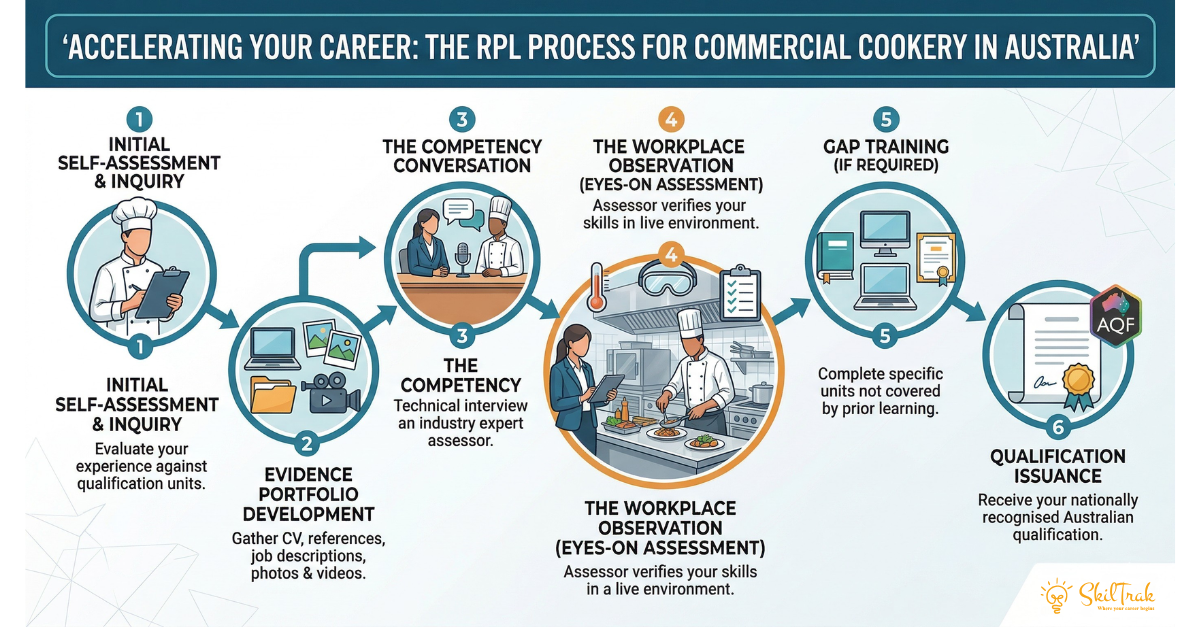
Securing a certificate via RPL in Australia involves partnering with a Registered Training Organisation (RTO) that has your desired qualification. After a preliminary eligibility check, you will build a portfolio of evidence, such as work samples, references, and photos, to prove your competency. Once an industry-expert assessor reviews your documentation and verifies your skills through a technical interview or workplace observation, they can issue a nationally recognised qualification.
03
How long does the RPL process take with Australian service providers?
The process is efficient, typically taking between 2 to 8 weeks from submission to certification. The timeframe depends largely on the quality of your evidence and the responsiveness of your RTO. For more complex migration-linked assessments, processing can take up to 12 weeks, though many providers offer priority processing options for those with urgent career or visa deadlines.
04
What is Recognition of Prior Learning RPL in Australia?
In the Australian vocational education system, RPL is a formal assessment process that acknowledges the skills and knowledge you’ve picked up through years of work, life experience, and previous non-formal training. Instead of requiring you to sit through a full course, an assessor maps your existing expertise against a national qualification. It is a strategic way to bridge the gap between your real-world seniority and the formal certification required by industry standards.
05
How Does RPL process work for trade in Australia?
For trades, the process is inherently practical and focuses on at front validation. It generally starts with an evidence collection phase where you gather videos and photos of yourself performing trade tasks on-site. This is followed by a competency conversation with an assessor who understands the technical nuances of your trade. If further proof is needed, the assessor may visit your job site to observe your skills in a live environment before granting the final qualification.
06
How can I get RPL assessment for my skills in Australia?
The first step is to request a free skills assessment from an accredited RTO to determine if your experience aligns with the Australian Qualifications Framework (AQF). If you are eligible, the provider will give you an RPL kit containing specific checklists for the evidence required. You then systematically gather your documentation, which is assessed against the national standards to ensure you meet all the units of competency for your chosen profession.
07
What is the typical cost for a skills recognition assessment?
While prices vary depending on the level and complexity of the qualification, a typical RPL assessment in Australia generally ranges from $1,200 to $3,800 AUD. For those undergoing formal skills assessments for migration purposes through bodies like VETASSESS, the standard fee is currently around $1,205 AUD. Most providers offer flexible payment plans to help manage the investment throughout the assessment period.