 Aged Care Placement
Aged Care Placements: Hosting Students Without Sacrificing Care Time
The Australian aged care sector is currently facing a staff shortage. By 2050, the shortage will climb to 400,000 workers if it isn't properly dealt with. The only way to ease this shortage is to scale up training spaces. The sector needs thousands of new Registered Nurses and Personal Care Workers. Yet, at the facility level, the very mechanism designed to produce this workforce, the vocational placement, is frequently treated as an operational liability.
For the Facility Manager balancing a tight roster against strict clinical control, a student intake is rarely viewed as a resource. It is viewed as a tax on productivity. A senior staff member supervising a student is a staff member who is distracted, slower, and less efficient. In an industry where time is in high demand, the cost of hosting students often feels too high to pay.
This creates a non-productive loop. Facilities limit placements to protect short-term efficiency, thereby reducing the long-term supply of qualified staff they are looking to hire. The solution to this refusal is not to reduce the number of students, but to review and reconstruct the outdated models of supervision that make placements inefficient in the first place.
The Problem With Traditional Supervision
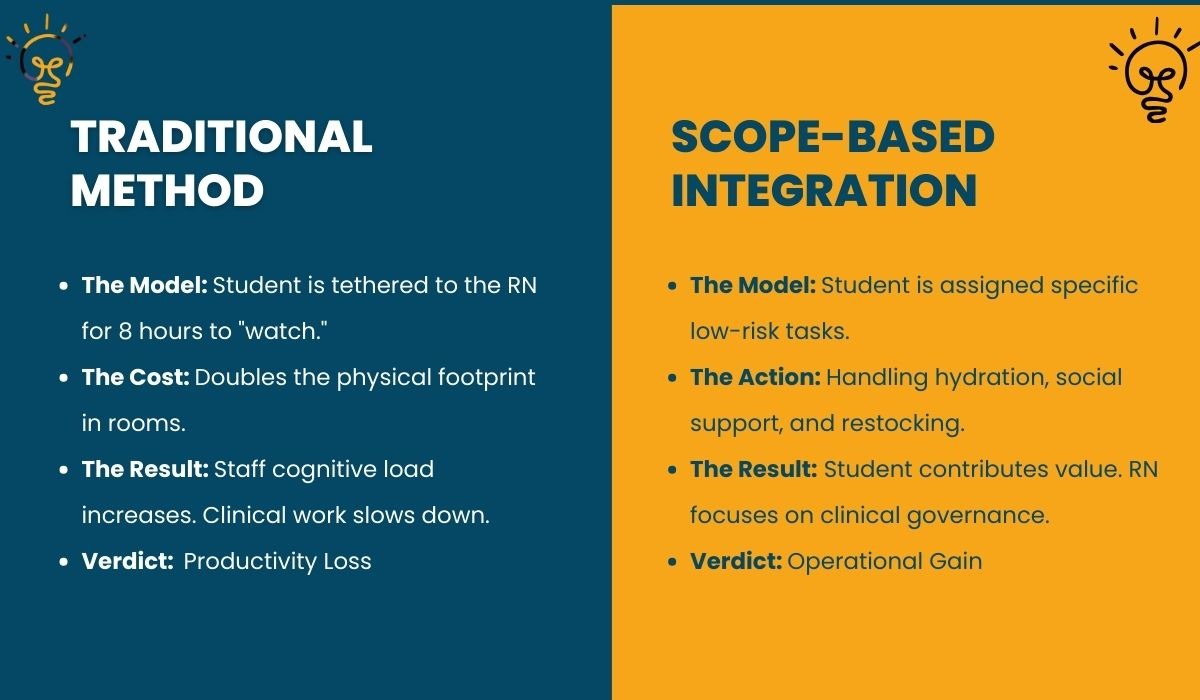
The main reason for the productivity drain is the reliance on traditional training methods. For decades, the default approach to clinical education has been to bind a learner to a senior staff member, expecting them to learn competency through observing.
From an economic perspective, this has flaws. It requires a paid professional to explain their workflow continuously, increasing cognitive load and slowing physical output. The student, reduced to the role of passive observer, becomes a person for observation rather than a participant. Hence, the student is strictly costing the facility, consuming space, time, and attention without offering a tangible return on investment during the placement.
Modern clinical leadership is increasingly recognising that observation is a luxury the sector can no longer afford. The change that needs to occur is not just educational, but structural. We must move from a model of just observing to one of practical integration and implementation.
Practical Implementation of Theoretical Knowledge
The facilities that have successfully aligned the cost/benefit ratio of placements are those that have stopped treating students as visitors and started viewing them as a supplementary workforce tier. This is not about replacing paid labour with unpaid students; it is about recognising the alignment between student competency and operational gaps.
In the current environment of the Aged Care Quality Standards, the consumer experience is the one most difficult to satisfy. Residents require time-intensive, high-touch interactions, social engagement, meal assistance, and emotional support that are often the first affected by observing. These are domains where a student, even in their first week, holds a comparative advantage over a rush-registered nurse because they have time.
- When a facility restructures its supervision to assign these low-risk, high-value tasks, the dynamic on the floor changes.
- A student on hydration rounds or providing 1:1 support to a resident with behavioural needs is not getting in the way; they are absorbing a specific part of the practical work.
- They are providing the emotional labour that assists the needy, allowing clinical staff to focus on high-acuity work.
- In this model, the student becomes a value-added asset, not a supervisory burden.
The Human Capital Risk
However, even the most integrated placement model carries a human cost if not managed with experience. The sector faces a real risk of fatigue, a phenomenon where the burden of supervision falls unequally on a facility’s high-performing staff.
In the absence of a proper strategy, supervision duties are assigned to the staff members who are most approachable and capable. While this ensures a positive learning environment, it burdens the facility’s most capable workers. If the reward for being an excellent nurse is a permanent increase in workload via student supervision, burnout is the resulting outcome.
Operational resilience requires a change toward dividing supervision. Rather than the system where a single staff member carries the weight of a placement, progressive facilities are adopting required frameworks.
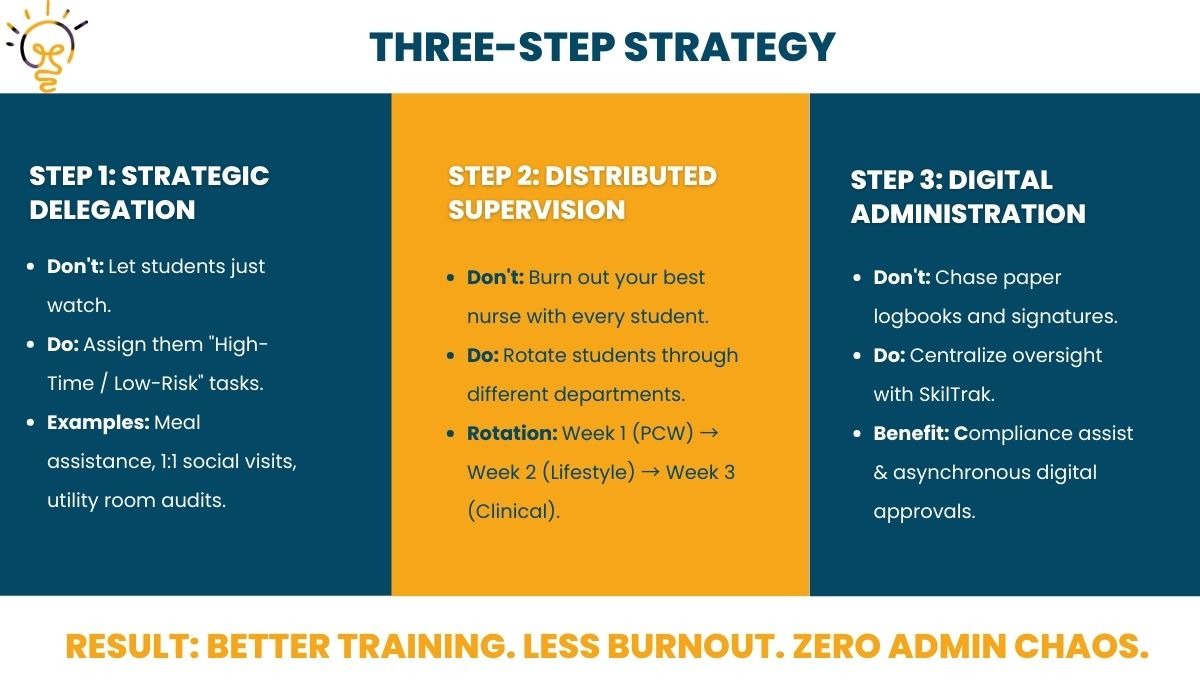
By cycling students through different operational pillars, Lifestyle, Allied Health, and Clinical Care, management reduces the supervisory impact while offering the student a more beneficial view of the business. This reforms the placement supervision from a burdened task into a productive organisational responsibility.
The Administrative Visibility Gap
The administration of vocational placements remains a significant, yet often invisible, drain on facility resources. Managing the intake of students requires handling a complex web of documentation, placement agreements, police checks, NDIS screenings, and immunisation records.
In a digital-first economy, it is an irregularity that a high proportion of the aged care sector still manages this high-stakes documentation via manual processes. This approach creates operational blindness. Without a centralised view, Facility Managers often lack a complete view of every person's documentation, whether their documentation is current, and where the training gaps lie.
This is where the administrative lag becomes a financial issue. Highly qualified Clinical Educators and Managers spending hours per week chasing paper logbooks and cross-checking spreadsheets represents a misuse of specialised talent. The administrative burden does not just cost time; it distracts leadership from overseeing the complete situation.
Digital Maturity as a Strategic Enabler
The evolution of the sector demands that workforce development be treated with the same digital maturity as clinical care planning. This is the operational gap that platforms like SkilTrak are designed to close.
The value of such platforms lies in document centralisation and workflow efficiency. SkilTrak does not replace the human responsibility of verifying compliance, but it removes the chaotic friction of collecting the evidence. By centralising the exchange of information between the Registered Training Organisation (RTO), the Facility, and the Student, the platform eliminates the end-of-date audit struggle.
- Centralised Oversight: Managers can view the status of an entire student cohort on a single dashboard, rather than reviewing through email threads.
- Logbook Efficiency: By moving competency logging to a digital interface, the platform removes the need for physical paperwork on the floor, allowing supervisors to review student progress asynchronously.
When the administrative noise is quieted, the relationship can return to its core purpose: mentorship and recruitment.
Impact On Recruitment
In a labour market defined by shortage, a clinical placement is the most effective recruitment path available. It is a three-week opportunity to assess cultural fit, work ethic, and aptitude before a contract is signed.
Facilities that continue to view students as a burden will find themselves isolated from the talent workforce. Conversely, those that professionalise the experience, balancing supervision with integration and supporting it with a robust management infrastructure, will position themselves as employers of choice. The cost of hosting students is real, but the cost of failing to capture the future workforce is far higher.
Are you an RTO or host industry looking to simplify vocational placement and play your part in this economy by aligning your workflow and reducing staff shortages? Contact us and see how SkilTrak assists you in managing your workflow.
Share this article
FAQ's
01
Why are manual logbooks a risk for aged care facilities?
Paper based systems create compliance blind spots where managers cannot instantly see if a student on the floor has the required legal checks. Digital tools assist by providing a real time audit trail and ensuring that documentation is organised, visible, and easily accessible for validation.
02
What is the business benefit of hosting student placements?
Placements serve as a three-week recruitment pipeline, allowing you to assess work ethic and cultural fit before hiring. Additionally, students provide immediate Social ROI through 1:1 resident interaction and emotional support that time-poor clinical staff often struggle to fit in.
03
How does SkilTrak assist with placement management?
SkilTrak assists by centralising all student data into one digital dashboard, replacing chaotic paper logbooks. It gives managers clear visibility to track attendance and assist compliance readiness, while allowing supervisors to approve competency evidence asynchronously without disrupting their shift.
04
How can facilities host students without losing care time?
Shift from passive observing to competency based delegation. Instead of observing for hours, students should assist with low risk tasks like hydration, social engagement, and restocking. This allows them to contribute immediately within their Scope of Practice, freeing up senior staff for complex clinical duties.