 Student Placement
Vocational Safety: The Critical Gap in Medical Action Plans
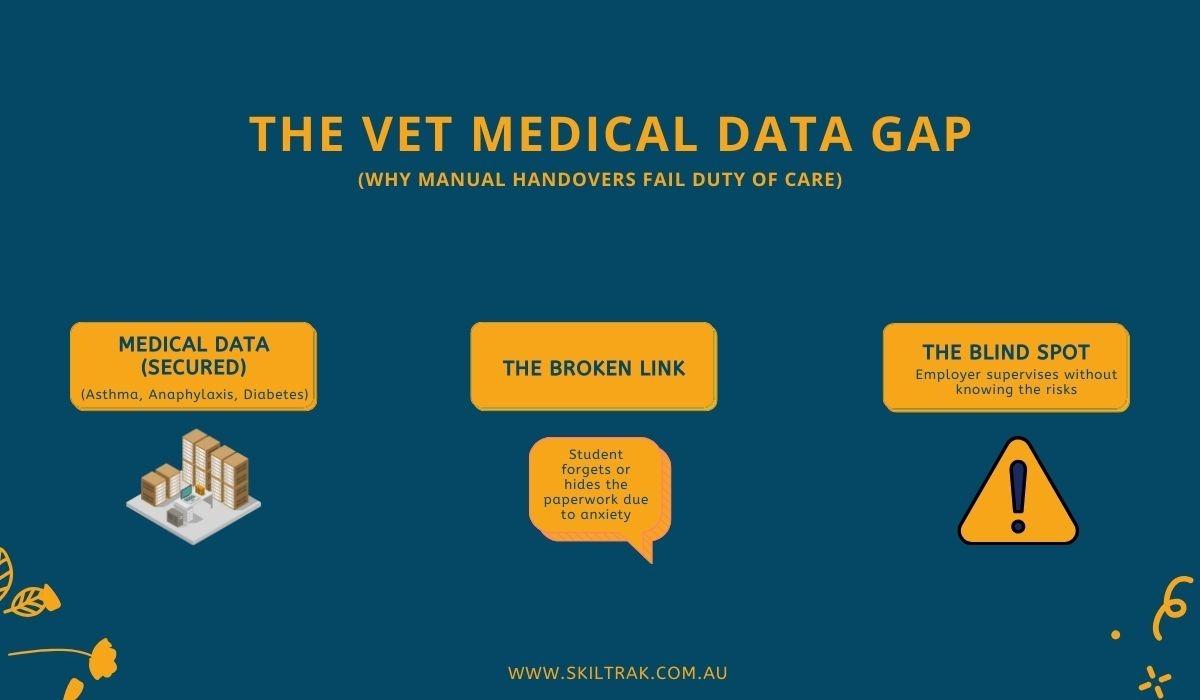
Schools are efficient at managing physical risk, routinely normalising checks for White Cards and machinery guards. Yet, the sector frequently overlooks an equally unstable liability: the administrative gap in medical data. While schools maintain comprehensive medical profiles for students, this intelligence rarely extends to the external host employer. Critical data regarding anaphylaxis or asthma triggers often remains isolated in the school's system, creating a dangerous information gap. This asymmetry leaves minors operating in high-risk environments under supervisors unaware of the biological risks they are legally managing.
This article examines the systemic failure of manual data transfer in Vocational (VET) placements and outlines the necessary shift toward verified, digital audit trails to satisfy Duty of Care.
Risks of Manual Documentation Transfer
The reliance on students to manually transfer sensitive medical documentation is a flawed control measure. Placing the responsibility of disclosure on a minor introduces significant failure points, particularly given the psychological pressures of entering the workforce. Students often perceive medical disclosure as a barrier to employment or a source of stigmatisation, leading to the intentional withholding of information.
This creates a critical disconnect: the employer proceeds under the assumption that no medical risks exist, while the school assumes the documentation has been delivered. This procedural gap creates a clear path to negligence. If a site manager assigns a dangerous task to a vulnerable student, the root cause is not individual error, but the reliance on an unreliable transmission protocol.
Why Delivery Does Not Equal Awareness
Administrative compliance is frequently confused with effective risk management. While emailing a Medical Action Plan creates a record of transmission, it does not equate to a discharge of Duty of Care. Host employers typically operate in dynamic, non-administrative environments where passive digital communication is easily overlooked. If the documentation is not actively reviewed, the risk profile of the placement remains unchanged despite the administrative effort.
It is critical to differentiate between notification and comprehension. Notification is simply the logistical transfer of a file; comprehension is the verification that the supervising party understands the specific medical protocols. From a liability perspective, if an institution cannot demonstrate that the employer has actively engaged with and understood the identified risks, the risk management process is incomplete.
When Data Privacy Compromises Safety
Educational institutions frequently cite privacy legislation as a rationale for limiting the disclosure of medical data. However, this interpretation often conflicts with safety mandates. Workplace Health and Safety (WHS) obligations generally prioritise the mitigation of direct health threats over standard privacy constraints.
Withholding critical medical information creates a supervision deficit for the host employer. This entrapment creates two distinct legal exposures:
- Undermined Duty of Care: Requiring an employer to manage student safety without access to relevant health data make s it impossible for them to fulfill their legislative obligations.
- Reverted Liability: In the event of an incident, the employer’s lack of awareness regarding specific medical risks serves as a robust defense, potentially reverting full liability to the school for failing to disclose material safety information.
Establishing a Defensible Audit Trail
Reliance on unverified communication channels constitutes a significant gap in risk control. To mitigate liability effectively, the transfer of critical safety data requires a verifiable audit trail. Contemporary placement management systems address this by mandating positive acknowledgement from the host employer.
A robust defense against negligence claims requires a system that:
- Restricts Commencement: Prevents the placement from going Active until receipt of the Medical Action Plan is digitally confirmed.
- Validates Comprehension: Replaces the assumption of delivery with objective evidence of receipt.
- Creates an Audit Log: Provides a timestamped record that the employer accepted the medical information prior to the student entering the site.
The Role of Digital Tools
Digital platforms, such as SkilTrak, are designed to bridge this operational gap by automating the secure transfer and verification of sensitive data. By moving away from fragmented paper and email workflows, SkilTrak ensures student employment readiness requirements are completed, verified, and auditable. Training can only commence once verification is confirmed by both industry partners and educational institutions.
Conclusion
The management of medical data in vocational settings is a critical component of institutional governance. As the complexity of student needs increases, the reliance on manual or passive handover methods becomes increasingly untenable. Moving beyond assumption-based workflows to verified, auditable processes is necessary to protect both student safety and organisational liability. Closing the information gap between the school and the workplace is not merely an operational improvement, but a fundamental requirement of modern duty of care.
Share this article