 Aged Care Placement
Student Placement In Aged Care Sector Of Australia
Australia's aged care sector is one of the fastest-growing industries in the country. With an ageing population and a government actively reforming how care is delivered, the demand for trained, work-ready aged care professionals has been increasing.
For students completing a qualification in aged care, community services, or allied health, a vocational placement is not just a course requirement. It is the part of your training that actually prepares you for the job.
This blog covers what aged care work placement involves, what you need to have in place before you start, what the sector looks like right now, and how SkilTrak connects students with quality host employers across Australia.
What Has Changed in Aged Care
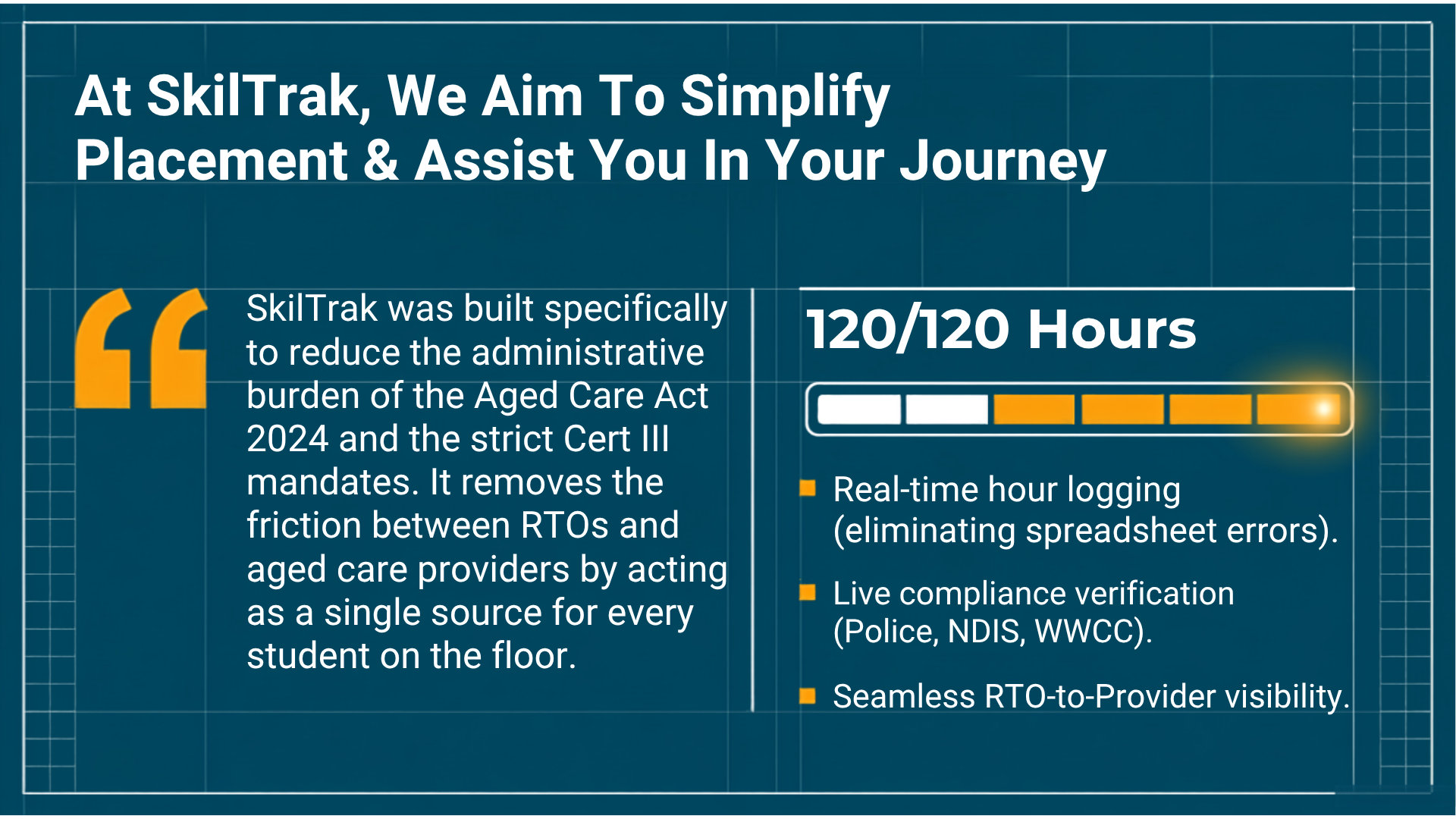
Before stepping into a work placement, it helps to understand the environment you are walking into. Aged care in Australia has gone through great change in recent years, and students who understand these changes will get more out of their placement experience.
The Aged Care Act 2024 introduced a framework for how care is delivered and regulated across Australia. It brought clearer rights for older Australians, stronger obligations for providers, and updated expectations around the quality of care delivered in both residential and home-based settings.
As a student completing placement in aged care, you will be working within facilities and organisations that operate under this legislation, and understanding what it expects helps you make sense of what you observe and do on placement.
Alongside this, the Support at Home Program launched in 2025, replacing the old Home Care Packages system. It changed how government funding flows to older Australians receiving care at home, and it has directly increased demand for aged care workers across home-based care settings. Students placed in home care environments will be working within this new structure, so it is worth having a basic understanding of how it works before you arrive.
The Aged Care Quality and Safety Commission oversees compliance across the sector and enforces the Aged Care Quality Standards, eight standards that every approved aged care provider must meet. These standards shape how facilities operate, how residents are treated, and what the day-to-day environment looks like. As a placement student, you are expected to understand and work within these standards. They cover areas like dignity and choice, personal and clinical care, the living environment, and the overall experience of the person receiving care.
When you are in your placement, you will see these in practice from day one.
What Qualifications Require an Aged Care Placement
Not every aged care course requires the same number of placement hours, and the requirements vary depending on what you are studying. The most common qualifications that include an aged care vocational placement are:
Certificate III in Individual Support (Ageing): This is the entry-level qualification for aged care work in Australia. It requires a minimum of 120 hours of placement in an aged care setting. This is the most common starting point for students entering the sector.
Certificate IV in Ageing Support: A more advanced qualification for students moving into supervisory or specialist roles. Placement requirements are set by the registered training organisation delivering the course and assessed against ASQA standards.
Diploma of Nursing: Enrolled nurse students complete clinical placement hours across multiple settings, including aged care facilities. The Australian Nursing and Midwifery Accreditation Council sets the requirements for nursing placements, and aged care is one of the key environments where this is completed.
Certificate III in Health Services Assistance and Certificate IV in Allied Health Assistance: Students in these qualifications can complete placement in aged care contexts depending on their specialisation, including physiotherapy assistance and occupational therapy assistance in residential care settings.
If you are not sure what your placement requirements are, your RTO's placement coordinator is the right person to ask. They will have the specific hours and documentation requirements for your course.
What You Need Before You Start: Eligibility Requirements
Aged care placement has some of the most specific eligibility requirements of any vocational sector in Australia. These are not optional; host organisations will not accept students who haven't met them. Getting these sorted early saves a lot of last-minute stress.
Police clearance check: A National Police Certificate is required for aged care placements across Australia. Processing times vary, so apply as early as possible, sometimes weeks before your placement start date.
Working With Children Check (WWCC): Required in placements involving environments where children may be present, including some aged care facilities that run intergenerational programmes. Requirements vary by state and territory.
NDIS Worker Screening Check: Required for students placed in environments that serve people with disability, which includes many aged care settings that support residents with both age-related and disability-related needs.
Vaccination record: Most aged care facilities require evidence of COVID-19 vaccination and, in many cases, influenza vaccination as well. Some facilities have additional requirements. Check with your placement coordinator before you start.
First aid certificate: Not always mandatory, but many host organisations prefer students who have a current first aid qualification. It is worth having regardless.
Have all of these documented and ready before your placement begins. Arriving on day one without the paperwork is one of the most common reasons placements are delayed.
Aged Care Placement Tips
Getting through the hours is the minimum. Getting something meaningful out of your placement is the actual goal. Here is what makes the difference:
Curiosity is important: The students who ask questions - why is this done this way, what happens next in this situation, what does this resident usually prefer learn significantly more than those who just follow instructions and wait to be told what to do. It should also be noted what to ask and when to ask; it helps you in your overall career, not just placement.
Watch how experienced workers communicate: Relationships are as valuable as assigned tasks. The way a skilled support worker speaks to a resident the patience, the attentiveness, the way they adapt to each person's preferences- is something you absorb by watching carefully over time.
Take the difficult moments seriously: Aged care involves grief, loss of cognitive ability, difficult family dynamics, and end-of-life situations. These are not things you can fully prepare for in a classroom. When they come up on placement, sit with them rather than avoiding them to understand how to handle such situations. They are parts of the job that shape the kind of worker you become and instil emotional intelligence.
Keep your documentation current: Complete documentation saves you from the end-of-placement struggle, where you have to juggle to complete all your documents.
Ask your supervisor for feedback: At times, you should ask your supervisor about your task. If there is any way to improve, you can perform it better.
How Aged Care Placement Works Through SkilTrak
SkilTrak works with RTOs and students across Australia to match students with aged care host employers that are the right fit, based on the specific requirements of your course.
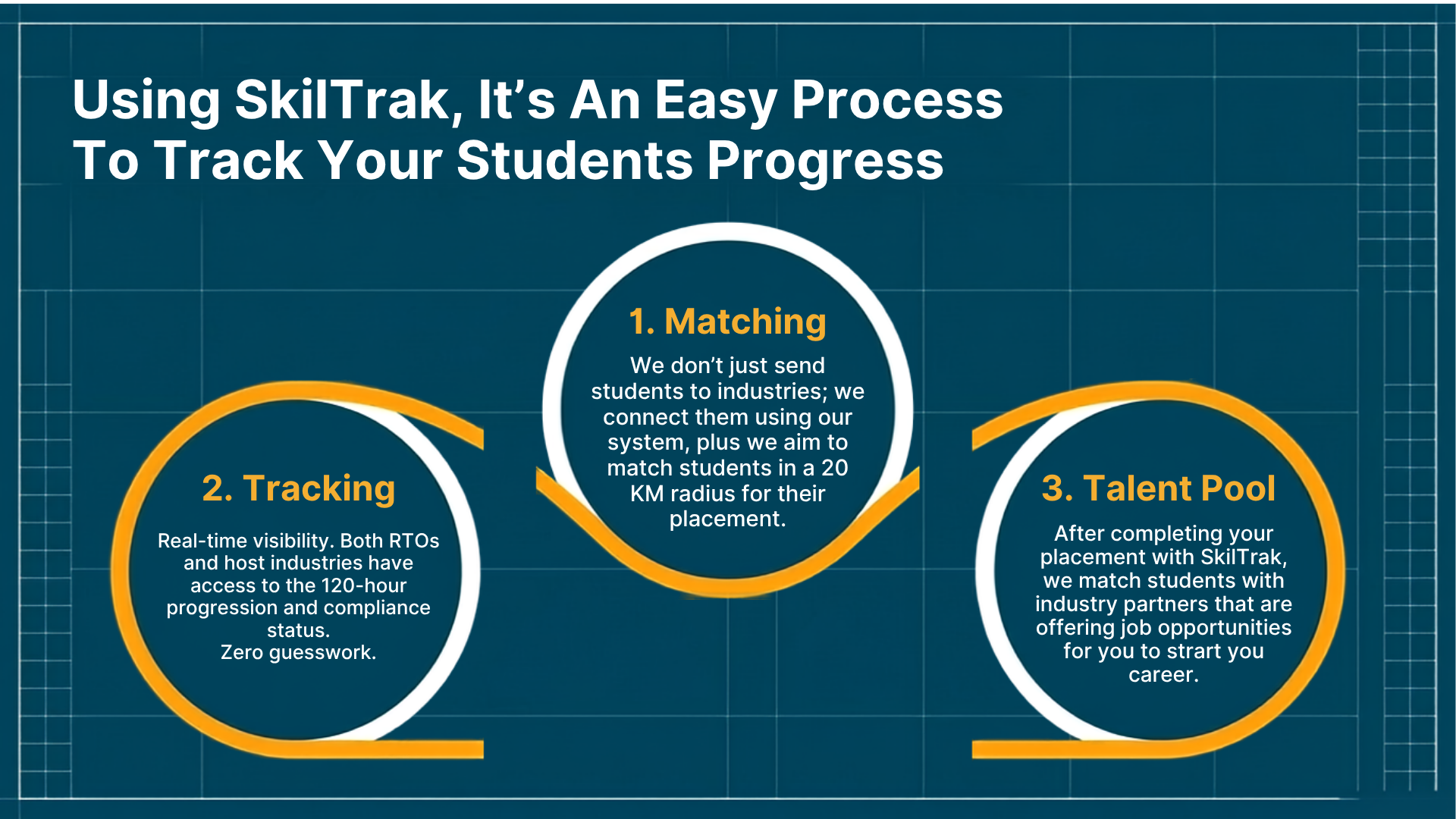
The matching process takes into account your location, your qualification, the hours you need to complete, and the eligibility documentation you have in place. Once a match is made, the placement is managed through SkilTrak's platform, where you can schedule your timing, upload evidence and track your progress.
This matters for both students and RTOs. Students have a clear record of their progress throughout the placement. RTOs have visibility over where their students are placed and how the hours are tracking. Host organisations have a structured, reliable process rather than complex coordination.
SkilTrak works with industry partners across the aged care sector home care providers, residential aged care facilities, and community-based aged care services. This network spans metropolitan and regional areas across multiple states. Having a broad industry network means students are not limited to a small pool of options, and placements can be arranged closer to where students actually live.
How To Apply For Placements In Aged Care
You can directly sign up on our student page, fill in the form, provide proper details and follow the steps mentioned in the form. We will match you with industry partners offering placement opportunities close to your location.
From Placement to Employment
Completing your aged care placement is not just a checklist for your certificate. It is often the starting point for your actual career.
SkilTrak's talent pool connects students who have completed their placement with aged care industry partners actively looking to hire. Once you have finished your placement hours and are job-ready, your profile can be made available to organisations across SkilTrak's partner network, allowing them to find you rather than you having to start a cold job search from scratch.
For aged care in particular, this matters. The sector has a genuine and ongoing workforce shortage. Organisations are actively looking for people who have completed their training and have real placement experience behind them. Being connected directly to those organisations through a placement provider network puts you in a significantly better position than applying through general job boards.
The connection between placement and employment is something SkilTrak is deliberately building, because finishing a qualification and then not being able to find work in the sector is a failure of the entire system, not just for the student.
Share this article
FAQ's
01
What is an aged care placement?
A mandatory practical component of a VET qualification where students complete set hours working in a real aged care environment, residential, home care, or community-based, as part of their course.
02
What are the 8 Quality Standards in aged care?
Eight standards enforced by the Aged Care Quality and Safety Commission that every aged care provider must meet, covering dignity, personal and clinical care, the living environment, and governance.
03
Is aged care placement paid?
No. Aged care vocational placement is unpaid. Under the Fair Work Act 2009, it is classified as training, not employment.
04
Can aged care placement lead to a job?
Yes. The sector has an active workforce shortage, and providers regularly hire from students who have completed their placement. SkilTrak's talent pool connects placement graduates directly with aged care industry partners who are hiring.
05
What qualifications require an aged care placement?
Certificate III in Individual Support (Ageing), Certificate IV in Ageing Support, Diploma of Nursing, Certificate III in Health Services Assistance, and Certificate IV in Allied Health Assistance all include aged care placement requirements.