 Community Services
Community Services Case Manager and Their Role - SkilTrak
Community Services Placement often works with non-profit, community, or public organisations. The placements are often called voluntary placements, student placements, or community participation. Some placements are for the post of Case Manager. To become a Case Manager, every student must undergo a required course which is offered by the Registered Training Organisations (RTOs).
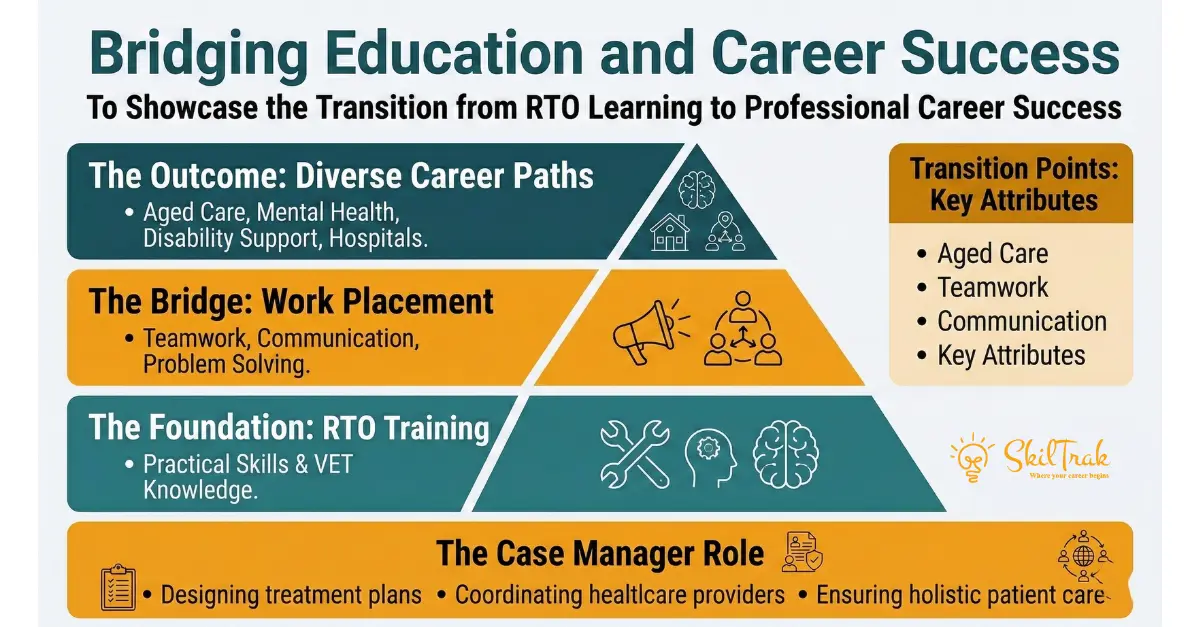
The RTOs are training organisations and are known for delivering Vocational Education and Training (VET). This course provides students with practical skills and knowledge to contribute to the workforce. However, Community Service students are trained to handle multiple tasks while working as case managers.
What Does a Case Manager Do in Community Services?
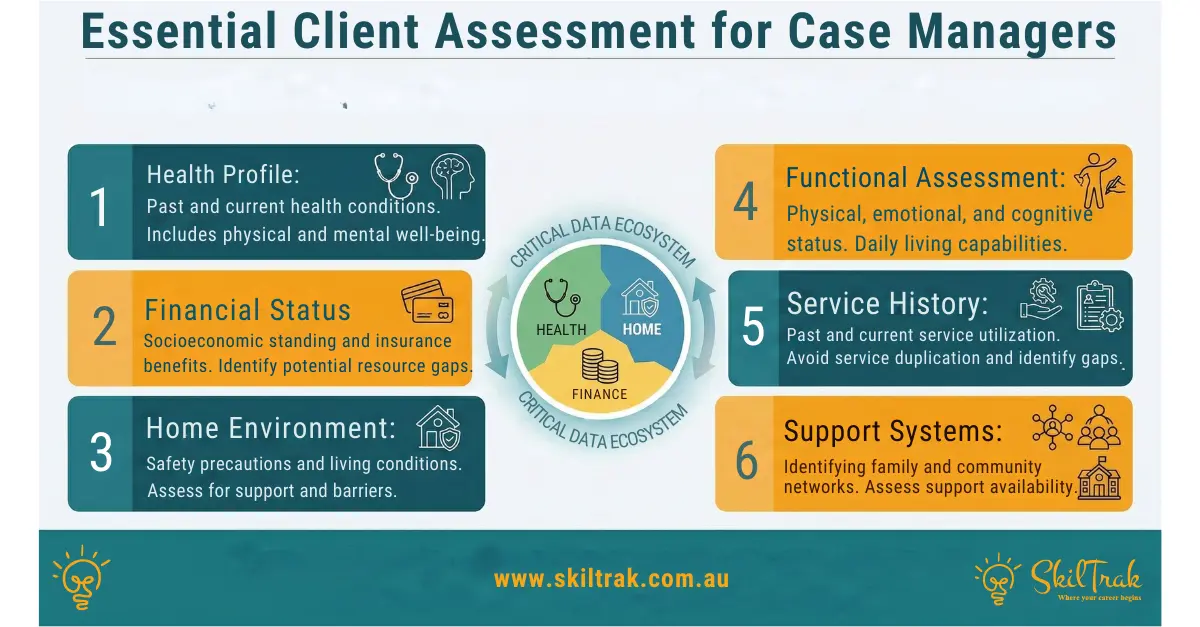
In the community services sector, case managers work with individuals and families who may be facing challenges such as housing instability, disability, financial hardship, mental health concerns, or family violence. The role is not primarily clinical or medical. Instead, it focuses on coordination and support.
A case manager may:
- Assess a client’s needs
- Develop support plans
- Connect clients with appropriate services
- Monitor progress and outcomes
- Advocate for access to community resources
- Maintain accurate documentation and case notes
The goal is to provide person-centred support that helps clients move toward stability, independence, and improved well-being.
Why Placement Is So Important
Community Services is a practical field. While classroom learning builds knowledge of legislation, ethics, communication, and case management frameworks, placement helps students understand how those concepts are applied in real situations. During placement, students may:
- Observe client interactions
- Assist with intake processes
- Support documentation and case files
- Participate in team meetings
- Learn how agencies coordinate with other services
This experience builds confidence. It also helps students understand workplace expectations, boundaries, and professional standards.
Professional Skills Developed Through Placement
Beyond technical knowledge, placements develop essential soft skills that are critical in community services roles:
- Communication and active listening
- Professional boundaries
- Cultural awareness
- Documentation accuracy
- Time management
- Team collaboration
These skills are difficult to develop in a classroom. Placement allows students to experience real client interactions and real workplace environments. It also gives students exposure to different sectors within community services — such as disability support, youth services, aged care support, or family services.
Understanding the Placement Process
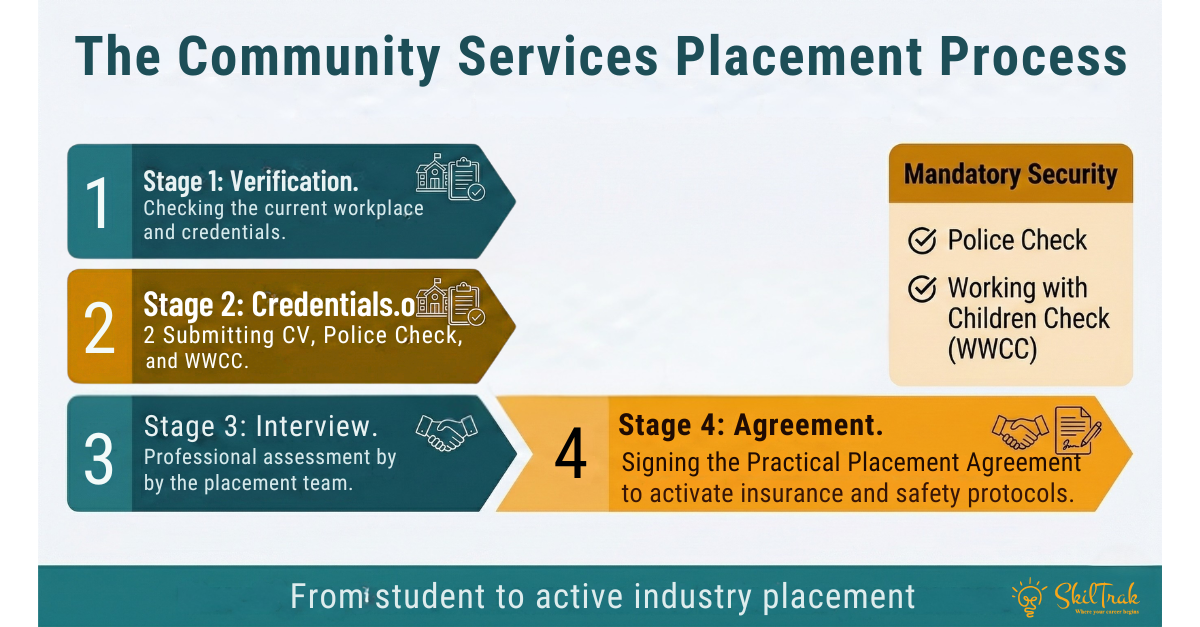
Community Services placements usually involve several formal steps to ensure compliance and safety. Students are typically required to provide:
- Working With Children Check (WWCC), where applicable
- Police Check
- Any industry-specific compliance documents required by the host organisation
There is also usually a placement agreement between the RTO and the host organisation. This ensures:
- Clear responsibilities
- Defined supervision arrangements
- Insurance coverage
- Compliance with regulatory requirements
These agreements protect both students and organisations and ensure that placements meet training package standards.
Matching Students to the Right Placement
Finding the right placement matters. Students often have preferences based on:
- Career interests
- Availability
- Location
- Sector focus (disability, youth, family support, community support worker, etc.)
A structured placement process helps ensure that students are placed in environments that align with their goals and training requirements.
When placement is done properly, it benefits everyone:
- Students gain meaningful experience
- Host organisations receive support
- RTOs meet compliance requirements
Transitioning Into Employment
Placement is often the bridge between study and employment. Many students build professional relationships during placement that later support job opportunities. Even when direct employment does not follow immediately, placement experience strengthens a student’s resume and interview confidence.
Employers in the community services sector value candidates who:
- Understand case documentation
- Demonstrate ethical awareness
- Show initiative
- Have real workplace exposure
Placement helps students demonstrate these qualities.
Practical placement agreement
We will send the overarching practical placement agreement directly to your organisation via email. This will cover all students attending your organisation for the current year. Please read over the agreement and return it to the Placement Coordinator at your earliest convenience. This agreement is in place and does not commit your organisation to take on a set number of students per year.
We will also arrange for the student and us to sign an agreement, so all parties agree to the same standards. Without the practical placement agreement, a student who incurs an injury whilst on a placement may not be entitled to compensation under the Department of Education and Training's (DET) insurance policy. The practical placement agreement is essential and is designed to:
Activate the DET insurance and be a safeguard if a problem occurs during the placement. Formalise the arrangements and conditions between the placement host and the training organisation, define the placement so that all parties involved understand their responsibilities and rights, and keep a permanent copy on file in case any legal or insurance proceedings arise. We will keep a secure copy on file for seven years.
When You Join Industries As Case Managers that helps
Our placement coordinators clearly explain every step for the Community Services Placement. We will get you onboard with a suitable industry that matches your CV and given preferences. Placing the right student in the right job is our main goal as we plan to give you a place that suits you best. The job opportunities in this field have increased significantly, as many people are approaching retirement age and need specialised health care services. However, having more opportunities is a plus for Individuals aspiring to work in this field, with case management jobs involving patients enduring mental health or substance abuse challenges.
Our Success Stories
At SkilTrak, we are proud to say that we place more than 30-40 students on average every week. And the numbers are increasing each week. This week, sixteen students were placed in the Commercial Cookery and Hospitality, five dedicated students were placed in Community Services; one student is pursuing a career in the Ageing Care Sector with success, ten students are making a positive impact in the Disability Sector, and three more bright lights are shining in Individual Support.
Furthermore, our placement coordinators make the process easy for you; you have to relax on your couch, and they will handle every step. From handling documentation to scheduling interviews with the industry, managing the agreement, and whatnot. Our dedicated placement coordinators do everything.
Conclusion: Building a Career in Community Services
Community Services is a growing sector in Australia, driven by ongoing demand for social support, disability services, aged care support, and community programs.
Starting as a student on placement provides a realistic introduction to the responsibilities of case management and related roles. It allows individuals to confirm whether the field aligns with their strengths and long-term career goals.
Rather than focusing solely on theory, placement allows students to experience the human side of the profession by working with real people, real challenges, and real outcomes.
For anyone studying Community Services, placement is not just a requirement. It is a practical foundation for building a sustainable and meaningful career.
Share this article
FAQ's
01
Q. Why is Placement Important?
A student having a good placement experience automatically increases his chances of securing a graduate job.
02
Q. What is a community placement?
In Community services placement, we provide services to patients who require treatment support, intensive supervision, and counseling.
03
Q. What are placement students?
A student who takes a year out of his degree and works as a permanent employee for a company.
04
What does the Community Services Directorate do?
The Community Services Directorate is a government body responsible for delivering and managing social support services such as child protection, housing, and community programs within a state or territory. It is not a training provider.
05
What is the definition of Community Services?
Community Services refers to organised support programs that help individuals and communities improve wellbeing, stability, and independence through coordinated social services and professional support.