 Community Services
Everything You Want to Know About Work Placement for Community Services
Work placement in community services is one of the most practical steps a student can take toward building a real career in the sector. It connects what you learn in the classroom and what the industry actually expects from you, and for most community services courses, completing a structured placement isn't optional; it's a requirement.
In this article, we discuss the necessity of a placement in your career and how SkilTrak can assist you with it.
What is the Meaning of Vocational Placement?
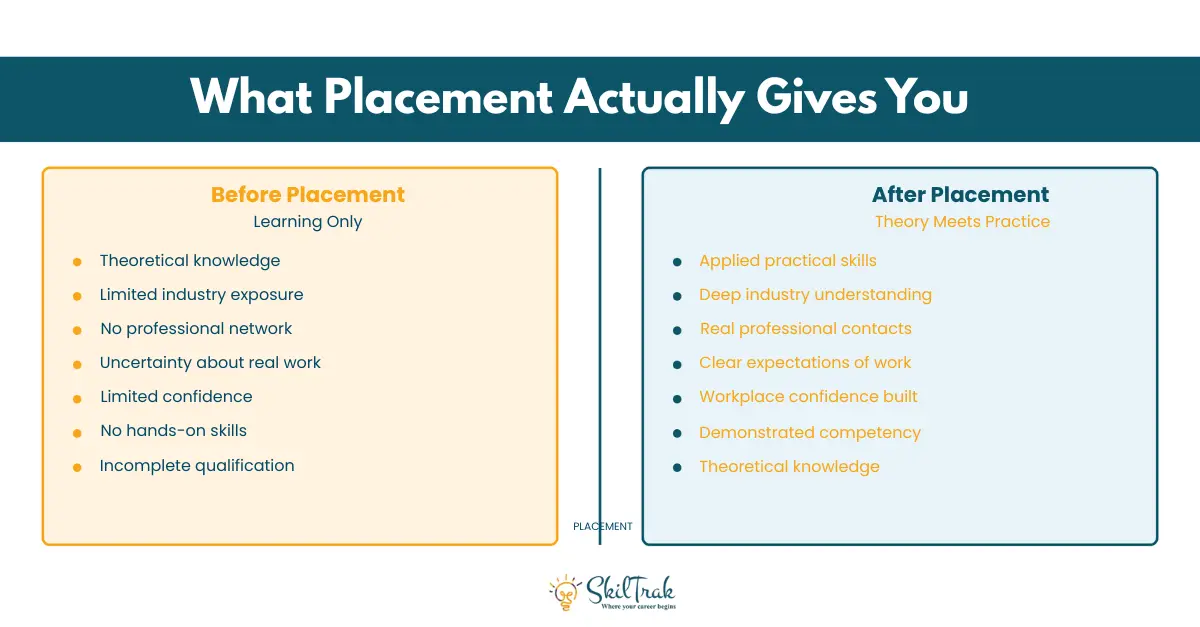
Vocational placement meaning in words, describes a scheduled training period in which students implement theoretical knowledge in a practical environment. Vocational placement is indeed part of many education and training courses, such that students might have the capability to gain experiential settings within their specific domains. It closes the gap between classroom learning and real-world work environments, where a student gains hands-on skills, industry exposure, and confidence in their profession.
Vocational placement is a kind of structured training period, under close supervision, where the student applies theoretical knowledge learned in a professional environment.
This is usually added to courses like:
- Community services placement
- Childcare work placement
- Aged care placement for students
- Disability placement opportunities
Is Vocational Placement Paid?
Most vocational placements are unpaid as part of their formal training. However, a student can achieve the following with a vocational placement:
- Industry networking opportunities
- Work in real-life experience
- Completion of required hours to get certification
- Development of confidence and employability skills
Some industries have paid childcare placements or paid internships. However, it remains an exception to the general scenario.
Advantages of Vocational Placement
1. Course concepts are implemented in the work environment.
2. Professional growth: knowledge of industry perspectives and skills
3. Practical experience enhances self-confidence and preparedness in the work environment.
4. Networking increases personal contacts with other professionals and employers
5. Mandatory hours of practical work ensure qualification for health and related work
 Social Work & Community Services Work Placement
Social work or community services students should ensure that they participate in placements, which will help them acquire experience in real-life client interactions.
- Learn how to assess and support people in need.
- Develop ethical and legal considerations within their field.
- Acquire knowledge in crisis management and intervention.
Practice Placement for Students
During the practice placement, students should be able to;
- Work with other professionals who have exposure.
- Undergo hands-on activities in their field.
- Supported with guidance and feedback on their skills development.
- Hours and activities recorded for accreditation.
- Equipped with a sense of confidence and experience for the workplace.
Importance of Work Placement
Finishing up a work placement for the students ensures that real-world experience is acquired in a specific field of choice. No matter whether it is a 120-hour work placement in childcare or some experience in a social work placement opportunity.
Community Services Work Placement
Community services work placement is an important part for students who aspire to work in careers in social work, disability support, and community development. Generally, the nature of the placements is working with diverse populations like vulnerable people, families, and communities.
Among the key tasks undertaken are case management, advocacy, and direct support to clients.
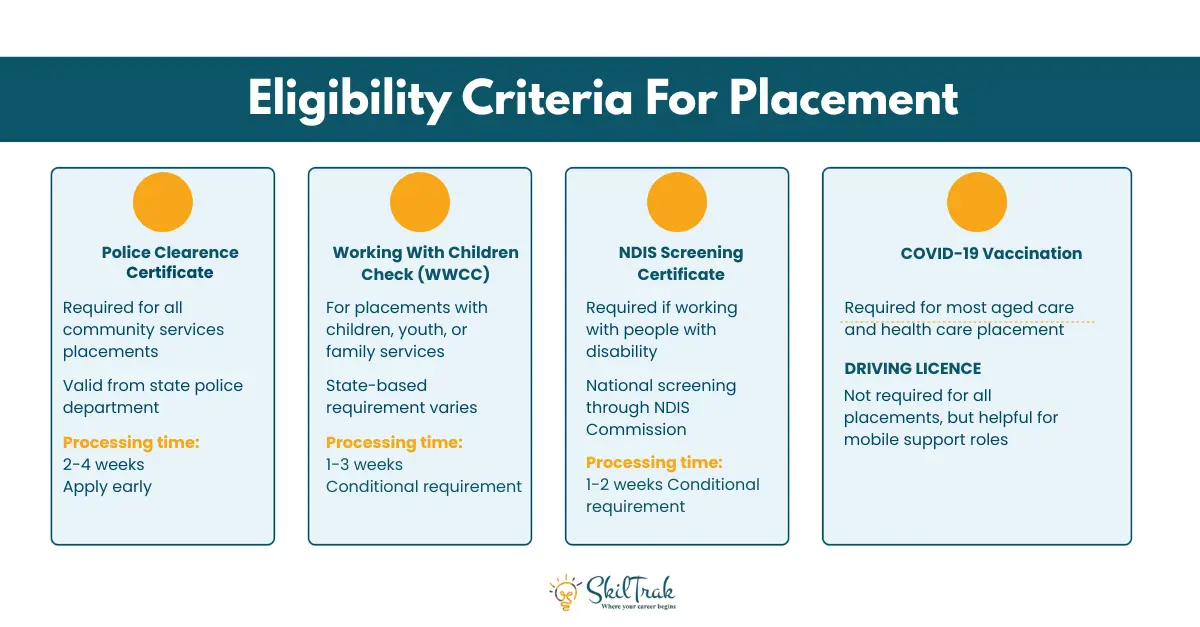
Before starting your placement, there are eligibility requirements you need to meet:
- Police clearance certificate
- WWCC - required for placements involving children, youth, or family services
- NDIS screening certificate
- COVID-19 vaccination certificate
- Driving licence (not required for all placements)
Careers In Community Services:
Mostly, community service professionals gain employment in the government-funded sector, NGOs, and charitable organisations. The roles or positions associated with the qualification are
- Mental health
- Alcohol and drug intervention
- Disability services
- Health promotion
- Child, youth and family welfare
- Social housing
- Aged care
- Welfare support
- Community Services Worker
- Program Coordinator
- Team Leader
- Case Coordinator
- Case Management Supervisor
- Community Care Worker
- Residential Carer (Child Protection)
- Social Housing Coordinator
- Community Services Case Manager or Case Worker
Your career may lead you in various ways, including administering programmes and services directly, working under the guidance and supervision of others, or offering support, advocacy, or interventions to individuals, groups, or communities. You can also look for work in community development or education initiatives.
- Pastoral care counsellor or manager
- Senior youth officer or chaplain
- Welfare worker.
- Early intervention worker
- Family support worker
- Community Support Worker
- Assessor
Community services roles are in high demand across the non-government and charity sector, making work placement a critical first step toward employment in this field.
Types of Industries and Sectors SkilTrak Offers:
SkilTrak has recently partnered with many new industries and community service platforms to provide a valuable learning experience for students trying to build their careers through work placements.
We are offering the following types of work placements as a great addition to your academic and professional journey.
- Commercial Cookery And Hospitality
- Disability
- Ageing Support
- Early Childhood Education And Care
- Individual Support
- Mental Health
- Allied Health Assistance
- School-Based Education Support
- Nursing
- Youth Work
- Business
- Traffic Management
You can learn more about our services by visiting the SkilTrak website. I am sure it will contribute a lot to making the right decision for choosing the right career. If you don’t find your desired sector or course, you can directly contact our team, and they will inform you about the placement opportunities in your respective sector.
Introducing Jia Hu, a China-based International student of Community Services. Let's hear his thoughts about his journey with SkilTrak:
“I'm writing this testimonial to thank SkilTrak from the bottom of my heart for all of their help and support during my professional work placement in Burwood Neighbourhood House. I'm a Chinese student named Jia Hu, and I had the honour of being connected to SkilTrak.
SkilTrak played a pivotal role in not just educating me in the nuances of Community Services but also in ensuring a seamless path into the industry. The journey from signing up with SkilTrak to the Burwood Neighbourhood House was remarkably smooth, and I owe this success to the dedicated efforts of the entire team.
The meticulous handling of paperwork, from visa processes to industry placements, was a significant burden lifted off my shoulders. SkilTrak completely took charge of all documentation and requirements, while I was focused on developing and polishing my skills.
Harry, the placement coordinator from SkilTrak, deserves special recognition. Harry provided essential information and assistance during the placement process. He arranged my interview twice and also helped me contact the manager. Harry’s commitment to making sure that students like me have a positive experience is admirable. He went above and beyond to answer every question and concern I had, offering not only expert advice but also consolation.
I am currently doing well in my work placement just because of SkilTrak. During this time, I was exposed to new things and gained experience that helped shape my future job goals. SkilTrak has shown itself to be more than just a learning environment; it is a community of people who care about each other's success.
Finally, I would like to express my gratitude to SkilTrak and the entire team, especially Harry, for their dedication to offering accurate instructions and seeing to it that students are placed successfully in the workforce. I do not doubt that SkilTrak will help aspiring professionals in their quest for success going forward.
Best Regards,
Jia Hu”
For real-time testimonials of students pursuing their successful work placements in industries, you must follow SkilTrak on Facebook.
Conclusion
In community services, work placement is a practical and necessary step toward building a career in one of Australia's most in-demand sectors. Whether you're working toward a role in mental health, disability support, social housing, or case management, the experience you gain during placement shapes how ready you are for the real work ahead.
Beyond the mandatory hours required for certification, placement gives you professional networks, industry exposure, and the confidence that classroom learning alone can't provide. Finding the right placement provider makes that process significantly easier one that understands the sector, matches you with a suitable host organisation, and supports you throughout.
If you're approaching your community services placement, treat it as the career foundation it is, not just a course requirement to get through.
If you are a student looking for a placement, sign up to SkilTrak and complete the necessary steps to find your desired work placement. Or you have completed your placement and are looking for career opportunities. Contact our team, and our coordinator will assist you with both placement and career opportunities.
Share this article
FAQ's
01
How does vocational placement differ from an internship?
Vocational placement is usually an unpaid course component, but the students put into practice the skills learned during a real-life application. An internship is typically either paid or unpaid and does not have to be a part of a course.
02
Is aged care placement paid?
Most placements in aged care are unpaid, but some employers may offer paid internships.
03
What are the requirements for a community services work placement?
Generally, requirements include relevant coursework, appropriate clearances such as WWCC, and understanding sector-specific regulations, such as child protection or safety practices.