 Courses
Certificate 4 in Allied Health Assistance - HLT43021
Certificate IV in Allied Health Assistance is a nationally recognised qualification that prepares students to support allied health professionals, including physiotherapists and occupational therapists, across hospitals, rehabilitation centres, aged care facilities, and community health settings.
Students pursuing this pathway are trained to assist with rehabilitation exercises, therapeutic programs, and day-to-day patient support, always working under the direct supervision of a qualified allied health professional.
Because this qualification covers several specialisations, the pathway you choose physiotherapy, occupational therapy, or general allied health assistance shapes the specific skills and elective units you'll complete.
In this article, you'll learn about the different paths you can take after completing your Certificate IV in Allied Health Assistance.
Career Opportunities After Certificate IV in Allied Health Assistance
Graduates of this qualification can pursue a range of roles across the health and community sector, including:
- Physiotherapy Assistant
- Occupational Therapy Assistant
- Therapy Assistant
- Community Rehabilitation Assistant
- Allied Health Worker
These roles are available in acute care and hospitals, rehabilitation centres, community and primary health care, aged care facilities, and schools supporting children with additional needs in both public and private settings. Allied health assistants often work with people across a wide age range, supporting recovery from physical disabilities, mental health conditions, communication difficulties, and developmental delays.
Certificate IV in Allied Health Assistance - Physiotherapy Pathway
For those interested in supporting physiotherapists directly, this pathway focuses on therapeutic interventions, manual therapy support, and rehabilitation assistance for patients recovering from injury, surgery, or illness.
Course Structure and Content:
Typically, the course covers a variety of topics, such as:
- Anatomy and Physiology: An AHA must have a thorough understanding of the human body and its functions. The body systems' structure and operation are covered in this module, which is crucial for supporting physiotherapy treatments.
- Therapeutic Interventions: Candidates gain knowledge of the many treatment approaches utilised in physical therapy, such as electrotherapy, manual therapy, and exercise therapy.
- Communication Skills: In the healthcare industry, communication is crucial. The development of interpersonal skills for communication with patients, families, and healthcare providers is the main goal of this module.
- Workplace Health and Safety: It is critical to guarantee a safe working environment. This topic addresses safety practices and methods to reduce hazards at work.
- Patient Care and Rehabilitation: Students gain knowledge about how to support patients during their recovery from illnesses, surgeries, and injuries.
- Clinical Practice: A vital part of this training is practical experience. Students engage in clinical placements as a means of applying their acquired knowledge in practical environments.
Physiotherapy pathway duration:
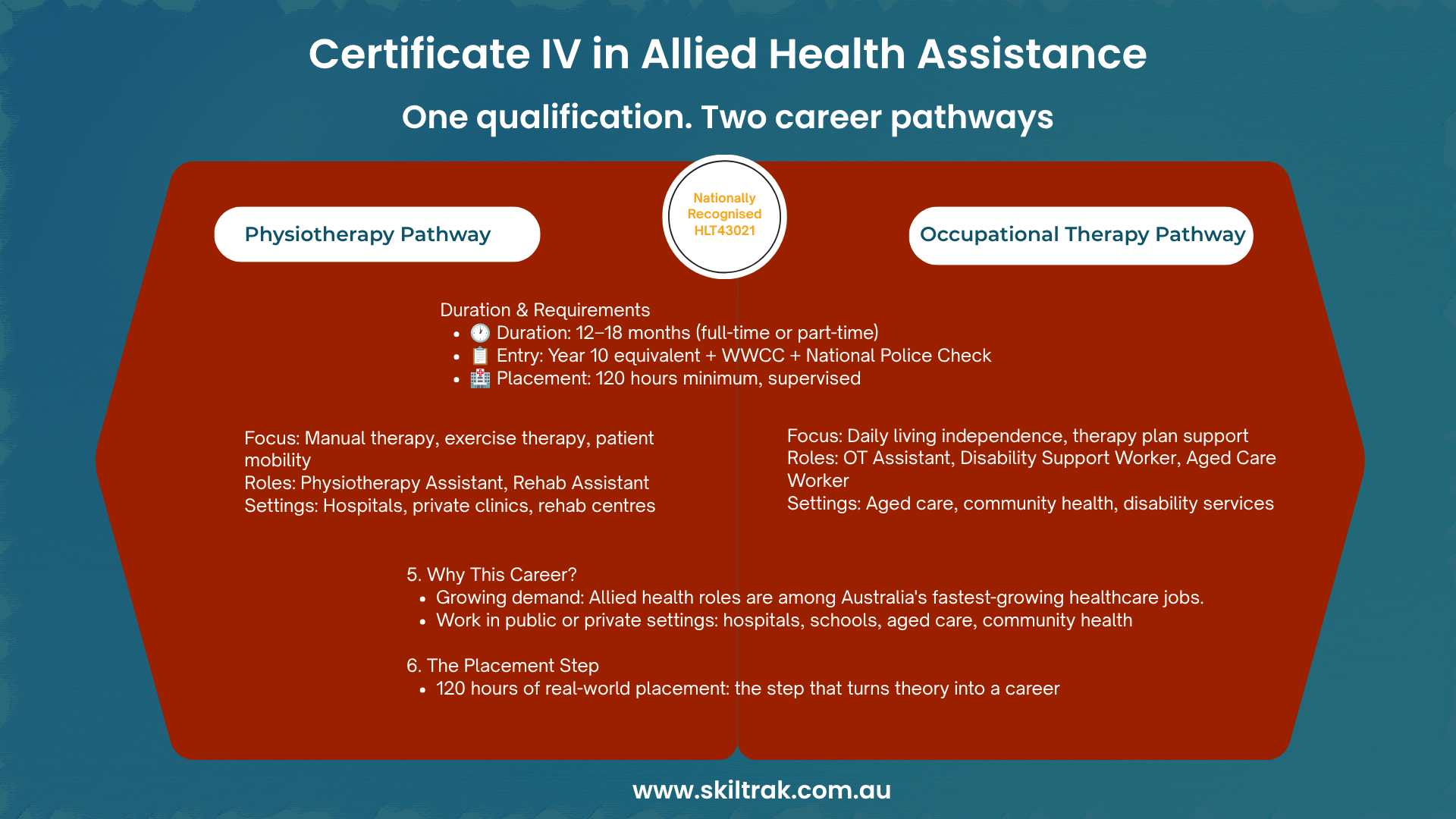
This pathway is typically delivered over 12–18 months, depending on the RTO and study mode (full-time or part-time). Contact your RTO for the specific duration.
Entry requirements:
Entry requirements vary by RTO but generally include completion of Year 10 (or equivalent), along with a Working with Children Check and National Police Check, which some providers require before commencing placement. Confirm specific entry criteria with your chosen provider before applying.
Career outcomes specific to this pathway:
Physiotherapy Assistant, Rehabilitation Assistant, Community Health Worker.
Certificate IV in Allied Health Assistance - Occupational Therapy Pathway
For those drawn to helping clients regain independence in daily life, this path focuses on supporting occupational therapists with mobility, therapy plan implementation, and rehabilitation across physical, mental, and developmental needs.
Career Opportunities
After completing your Certificate IV in Allied Health Assistance (Occupational Therapy), a wide range of career opportunities will be available to you. Here are some of the roles you could pursue.
- Allied Health Assistant (Occupational Therapy): Work alongside occupational therapists in hospitals, rehabilitation centres, aged care facilities, and community health organisations.
- Rehabilitation Assistant: Assist clients in their rehabilitation journey, helping them regain their independence after illness or injury.
- Disability Support Worker: Provide support to individuals with disabilities, helping them to lead fulfilling lives and achieve their personal goals.
- Aged Care Worker: Work in aged care facilities, assisting elderly clients with their daily activities and providing companionship and support.
- Community Health Worker: Work in community health settings, supporting clients with various health and wellness needs.
Occupational therapy pathway duration:
This pathway is typically delivered over 12–18 months, depending on the RTO and study mode (full-time or part-time).
Entry requirements:
Entry requirements vary by RTO but generally include completion of Year 10 (or equivalent), along with a Working with Children Check and National Police Check. Some providers may also accept relevant work experience in place of formal prerequisites. Confirm specific entry criteria with your chosen provider before applying.
Work Placement Requirements
To complete this qualification, students must undertake a minimum of 120 hours of supervised clinical placement in a setting where allied health services are delivered. This hands-on component is where classroom learning becomes practical skill, working alongside professional medical staff, applying therapy techniques, and supporting real patient care.
How SkilTrak Helps You Find the Right Placement
Securing the right placement is often the hardest part of completing this qualification, and it's where SkilTrak comes in. We're not the training provider; we work alongside RTO partners to connect students with placement opportunities that match their location, schedule, and specialisation, whether that's physiotherapy, occupational therapy, or general allied health support.
Our placement coordinators manage the process end-to-end: sourcing suitable host organisations, handling documentation, and keeping students updated at every step through our placement management system. If you're enrolled or about to enrol in a Certificate IV in Allied Health Assistance and need help securing your placement, get in touch, and we'll connect you with the right opportunity.
Conclusion
A Certificate IV in Allied Health Assistance opens the door to a rewarding career supporting physiotherapists, occupational therapists, and allied health teams across Australia's health and community sector. Whichever specialisation you choose, completing your placement is the step that turns your qualification into real, practical experience, and that's where our placement support can make the process easier.
If you are looking for a placement in AHA, join us, and we’ll help you find a placement where you won’t just be completing placement hours, but will gain actual hands-on experience required to secure a job in a renowned industry.
Share this article
FAQ's
01
Q. What is the expected salary of an allied health worker?
The expected salary of an allied health worker in Australia is around 70,693 AUD annually.
02
Q. Are Allied Health Assistants in demand in Australia?
Demand for skilled, dedicated professionals in allied health is booming across the health, aged care, mental health, and disability sectors.
03
Q. Can I move to Australia as a health care professional?
Yes, you can shift to Australia as a health care professional but first you need to have a working visa permit for Australia.