 Student Placement
Modernising TAFE Placement Workflows & Budget Control
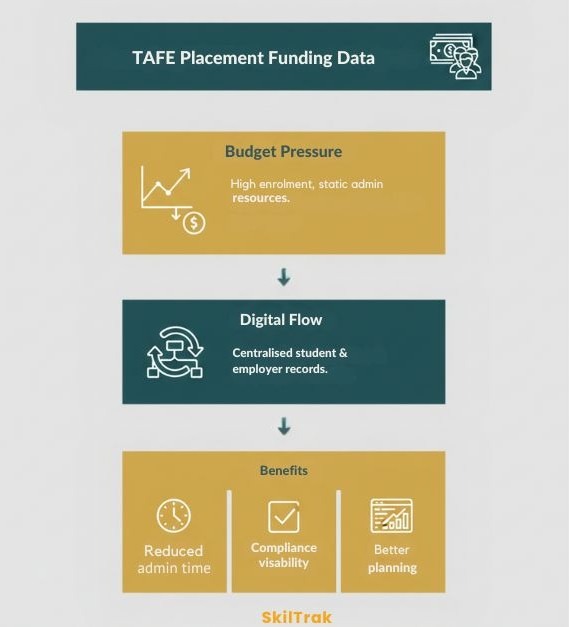
Australian TAFE institutions are operating in a funding environment where enrolment growth and public investment are increasingly tied to measurable accountability. Expansion of Fee-Free programs and vocational placements has significantly increased operational demand across health, community services, and vocational education. While public funding for training delivery has increased, administrative resourcing and placement systems have not grown proportionally to manage the resulting workload and compliance obligations.
Modernising information flow in work placements is therefore emerging as a necessary response to budget pressure rather than a discretionary upgrade. Persistent TAFE placement management challenges now have tangible financial consequences. Inefficient placement coordination translates into additional labour costs, compliance exposure, and operational strain. Structured digital placement infrastructure, such as SkilTrak, provides a framework for stabilising these pressures through centralised recordkeeping and workflow support.
The Financial Impact of Fragmented Placement Processes
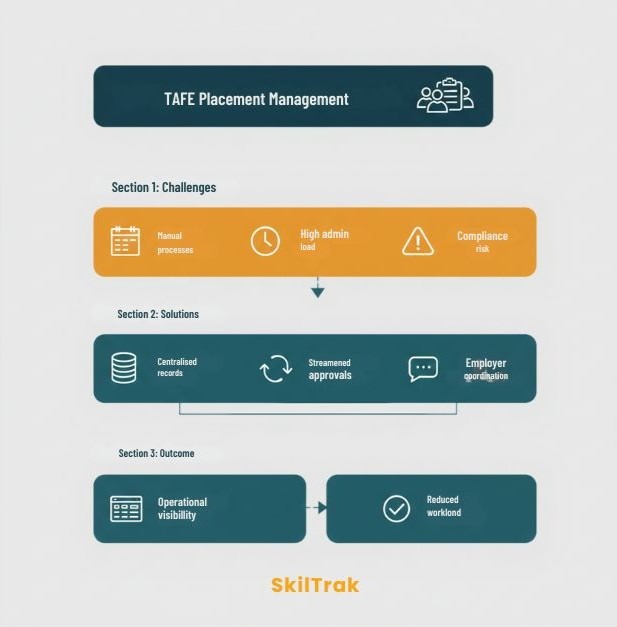
Manual placement coordination carries hidden operational costs. Managing TAFE vocational placements through spreadsheets, email chains, and paper documentation multiplies administrative effort as enrolments grow. Activities such as verifying vaccination records, confirming student safety profiles, and tracking placement hours demand significant staff time.
This workload contributes to workplace learning coordinator fatigue and increases the risk of incomplete records during audits. Maintaining the duty of care for TAFE students across hundreds of placements requires systems that ensure consistent documentation and reliable host employer communication.
Platforms such as SkilTrak support these requirements by centralising placement records and maintaining continuous digital audit trails. Evidence can be reviewed efficiently, reducing time spent on routine administrative verification and assisting in data driven decision making.
Streamlining Placements as a Budget Strategy
Efforts to streamline TAFE student placements are increasingly tied to financial sustainability. Standardising student logbooks, placement documentation, and assessment records within a single system reduces repetitive administrative tasks and supports reduced administrative load.
In practice based programs such as nursing and primary health care, centralised tracking of placement details and mandatory documentation improves coordination with placement providers and workplace supervisors. Clearer workflows benefit students and employers while helping institutions manage operational costs associated with high-volume placement programs.
Industry Engagement Under Budget Constraints
TAFE industry engagement strategies must balance relationship-building with financial considerations. As institutions expand TAFE industry partnerships, the cost of managing employer networks becomes more visible. Effective engagement relies on predictable communication and reliable scheduling rather than ad hoc processes.
SkilTrak provides a shared framework for host employers and placement teams, improving transparency around placement allocations, shift times, and assessment requirements. Efficiently sharing information supports consistent coordination.
Compliance as Financial Risk Management
TAFE compliance management is closely linked to funding security. Regulatory requirements evolve continuously, and gaps in documentation can create risk. Embedding compliance checks into everyday workflows is more sustainable than relying on periodic audit preparation.
Digital recordkeeping supports verification of additional requirements, including blue card checks, NDIS worker screening, and vaccination documentation. Structured evidence capture and accessible audit trails help institutions maintain alignment with ASQA compliance standards while reducing operational disruption.
Data Visibility and Operational Planning
Modern placement systems generate information beyond basic compliance reporting. Consolidated records of placement capacity, employer participation, and student progression allow institutions to plan more effectively across campuses and service regions.
Platforms such as SkilTrak provide the visibility needed for regional teams to identify administrative bottlenecks and manage workload pressures. The resulting placement records serve as a verifiable evidence base, ensuring a clear connection between institutional activity and the documentation required for funding acquittal.
Final Thoughts
Modernising information flow in TAFE placements is no longer simply a matter of operational efficiency. It is part of a broader strategy to manage budget pressures while maintaining educational standards and regulatory confidence.
Institutions that invest in structured placement infrastructure gain improved oversight of administrative costs, stronger compliance assurance, and support for consistent industry engagement. As vocational education expands, the systems that underpin placements will play an increasingly central role in ensuring that growth is manageable and sustainable.
Share this article