 Industries
Ethical AI in Education: Governance & Integrity Frameworks 2026
Why the need for ethical AI? As the adoption of advanced digital systems in Australia’s Vocational Education and Training (VET) sector has moved from simple administrative convenience. As these systems begin to affect high-stakes areas such as student competency, placement verification, and professional readiness, a formal focus on ethical standards is no longer optional. It is the primary safeguard for protecting the integrity of national qualifications.
Establishing a clear ethical framework ensures that technological efficiency never undermines the human-centred values of vocational training.
Why a Focus on Ethical AI Standards is Necessary
In a sector where qualifications lead directly to safety-critical roles, such as in nursing, electrical trades, and disability support, the trust placed in a certificate is absolute. Ethical oversight is required to ensure that automated processes do not compromise this trust.
Protecting Competency Validity
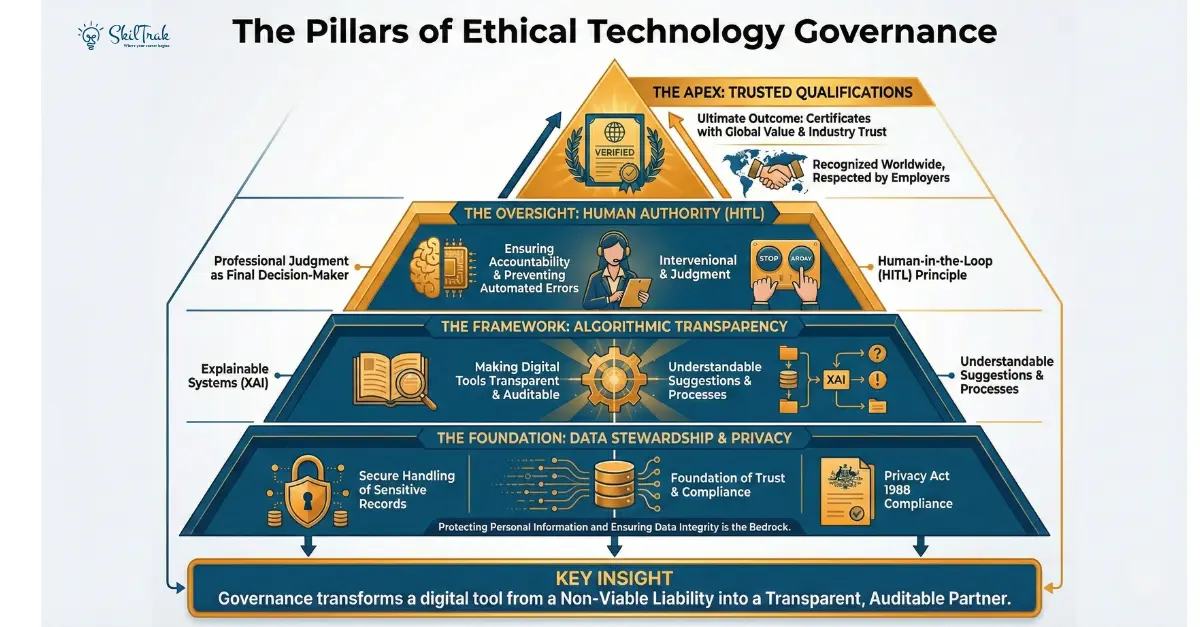
Automated systems must support, not substitute, the stringent validation of skills. Ethics ensures that a student’s work ready status is based on actual performance rather than data driven assumptions.
Preventing Algorithmic Discrimination
Automated systems can unconsciously perpetuate past biases. A structured ethical governance is required to ensure that placement matching and student screening remain fair and do not disadvantage individuals based on their background or location.
Legal and Regulatory Certainty
As per the 2025 Standards for RTOs and the Updated AI Policy for Government (2026), training providers are expected to maintain transparency statements for their digital workflows.
Upholding Human Authority Using Ethical AI
Ethical AI maintains a Human-in-the-Loop (HITL) mandate. No system should have the final say in a student’s career path without professional human verification.
The Importance and Value of Professional Supervision
Moving toward a standardised ethical approach provides measurable advantages for the vocational sector. It transforms digital tools from complex systems to transparent, auditable partners in education.-
Transparency and Trust
When a regional placement team can explain exactly how a tool works, it helps to instil confidence in host employers who are accepting students into their workplaces.
Data Governance
Ethical protocols ensure that sensitive personal records, such as medical terms and vaccination status, are handled according to the Privacy Act 1988.
Auditability
During a regulatory review, an ethical web AI framework enables training organisations to demonstrate that their digital processes were designed for fairness and accuracy, rather than just speed.
Maintaining a Steady Flow in Training Environments
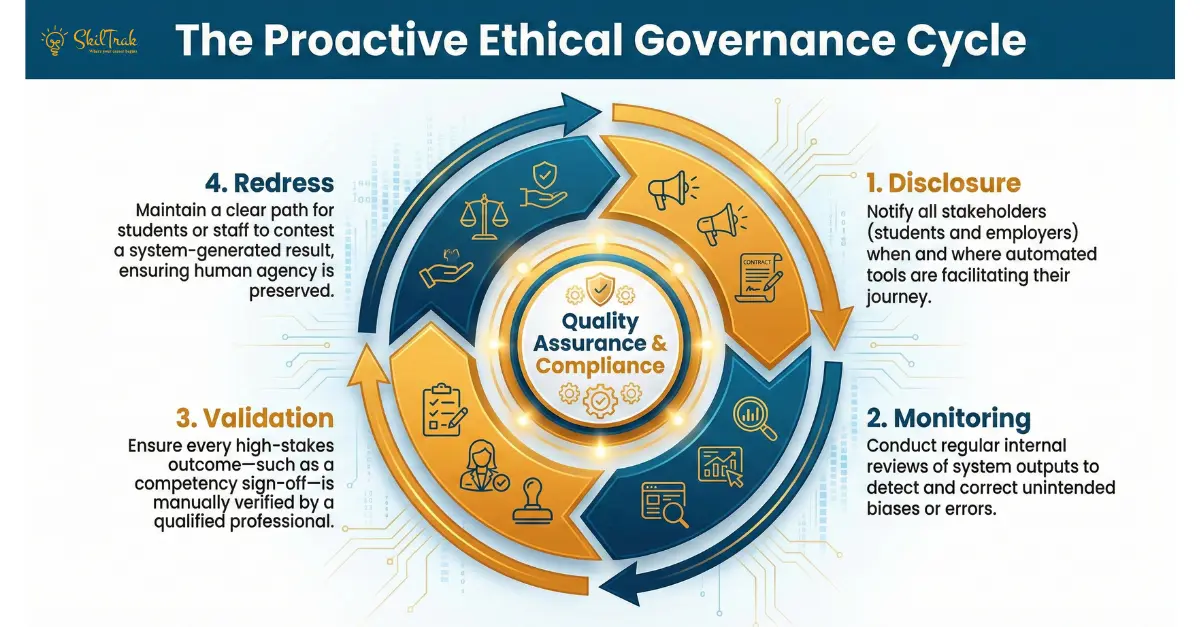
To maintain a steady, ethical flow of information in high-volume placement environments, institutions must move from reactive troubleshooting to proactive governance. This involves:
Continuous Monitoring For Ethical AI
Regularly reviewing system outputs to identify and correct any emerging errors or unintended biases.
Clear Disclosure
Notifying students and industry partners when automated tools are used to facilitate their placement or assessment.
Human Verification
Ethical AI ensures that final sign-offs and competency judgments always remain the responsibility of a qualified human professional.
Ethical Foundations in Practice
A good digital platform is founded on the idea that technology should aid and not replace professional judgment. Platforms such as SkilTrak are founded on these ethical AI principles, which include the emphasis on data protection and auditable workflows. The system is able to automate repetitive documentation while ensuring that the workplace supervisor remains the final authority, thus upholding the ethical standards of the Australian vocational education sector.
Conclusion
Modernisation of the vocational education sector is not just about the implementation of new technology; it requires a strong commitment to the basic values that will ensure the international recognition of Australian qualifications. Through a focus on transparency, human involvement, and a high degree of professional integrity, the VET sector can successfully cope with technological advancement while safeguarding the interests of students and industries.
Share this article
FAQ's
01
Can these digital systems cause bias in student placements?
Without ethical oversight, they can. Automated systems often rely on historical data which may contain unintended biases. Ethical governance involves regular red-teaming and monitoring to ensure that tools used for matching students to employers do not unfairly disadvantage individuals based on age, gender, background, or geographic location.
02
How does an ethical approach help with regulatory audits?
Adopting a clear ethical framework creates a defensible audit trail. Instead of an opaque complex process, an ethically governed system provides timestamped, transparent records of how decisions were made and who verified them. This makes it much easier to prove compliance during ASQA performance assessments or industry reviews.
03
Why is there a specific focus on ethical AI for digital tools in VET?
Vocational education directly prepares individuals for safety-critical roles (e.g., electrical, nursing, construction). Because these qualifications imply a license to practice, any automated system used in training must be ethically governed to ensure that competency is genuinely earned and verified. Without an ethical framework, there is a risk that technology could bypass the rigorous standards required for workplace safety.
04
Does ASQA have specific AI ethics for using automated systems?
Under the 2025 Standards for RTOs and the 2026 ASQA Transparency Statement, providers must be able to explain how digital tools are used in their delivery and assessment. The regulator emphasises Human-in-the-Loop (HITL) oversight, meaning that final decisions regarding a student’s competency or the validation of training evidence must always involve a qualified professional.
05
How do ethical AI standards protect student data?
In the VET sector, institutions often handle sensitive information, including medical records for placement clearances and vaccination statuses. Ethical standards ensure these are managed according to the Privacy Act 1988, guaranteeing that data is only used for its stated purpose (e.g., securing a placement) and is never shared or utilized by third-party systems without explicit transparency.
06
What are the core principles guiding responsible AI development?
The core principles of responsible AI centre on Fairness, Transparency, and Accountability. Developers must ensure systems are non-discriminatory, provide human-readable logic for their outputs, and maintain clear human oversight to prevent unintended harm or safety risks.
07
Which software platforms provide for ethical AI tools for development?
For development, enterprise platforms like IBM WatsonX, Google Vertex AI, and Azure Machine Learning provide specialised toolkits for bias mitigation. Developers also use open-source libraries like SHAP and LIME to ensure model decisions remain transparent and explainable.