 skills
Essential Strategies For Manual Handling In Aged Care
Summary:
("In aged care, manual handling training and equipment are critical for both caregivers and residents. Non-compliance with the no-lift policy can result in injury to both the caregiver and the elderly. These are essential for a long and successful career. And complete your course if you want to upskill.")
In the aged care sector, manual handling is the most frequent physical task performed by caregivers. This includes every instance where physical strength is used to move, support, or stabilise a resident or an object. Because the work is repetitive and often involves unpredictable movements from residents, poor execution can lead to serious injury for both the caregiver and the client.
Professional manual handling training focuses on much more than just physical strength; it teaches the strategic use of equipment and technique to avoid manual lifting altogether. By adhering to current safety standards, caregivers protect their own health and career longevity while ensuring that residents feel secure, comfortable, and respected.
In this article, we understand the strategies of professional manual handling training and how to avoid potential injuries that can occur in case of negligence.
What is Manual Handling in Aged Care?
What is manual handling in aged care at its core? It is the process of assisting residents with their daily mobility needs while minimising physical strain. It encompasses a wide range of daily activities:
- Direct Resident Support: Assisting with walking, helping a resident stand from a chair, or repositioning them in bed to prevent discomfort.
- Hygiene Assistance: Supporting a resident during showering or toileting. This often involves working in cramped, wet environments where being mindful of slips is critical.
- Managing Equipment: Pushing wheelchairs and commodes, adjusting heavy electric beds, and carrying laundry or meal trays.
- Unexpected Actions: Reacting quickly when a resident loses their balance or becomes unsteady during a transfer.
Australia’s No Lift Policy
The modern standard in Australian aged care is the No Lift or Zero Lift policy. Under this policy, staff should not be required to manually lift the full weight of a resident. This standard exists because the human body is not designed to handle the vertical load of another person, especially when that person is dead weight or moving unexpectedly.
If a resident cannot support their own weight, it is necessary to use specialised manual handling equipment in aged care. Complying with this policy is a professional requirement that protects caregivers from long-term disability and ensures resident safety.
Essential Steps and Precautions
A safe move starts before any physical contact is made. Pausing to observe the environment is the most important first step, as rushing is the primary cause of accidents.
1. Assess the Resident’s Current State
Mobility is not constant. A resident’s strength can fluctuate based on medication, energy levels, or cognitive state at that specific hour. While checking a Care Plan is necessary to see the classified mobility level, a quick verbal check-in is also vital. If a resident seems unusually weak or confused, the assistance level may need to be upgraded from a one-person assist to a mechanical hoist.
2. Prepare the Environment
The work area must be clear of obstacles.
- Clear the Path: Move over-bed tables, chairs, or power cords.
- Floor Check: Ensure there are no spills or loose rugs that could cause a loss of balance.
- Bed Height: Adjust the electric bed so the resident’s hips are at mid-thigh level for a transfer, or at waist height for repositioning tasks.
3. Check Personal Capability
Caregivers must stay aware of their own physical limits. If fatigue or a minor strain is present, attempting a complex move alone is a high risk. Waiting for assistance is always preferable to risking a long-term injury.
The T.I.L.E Risk Assessment
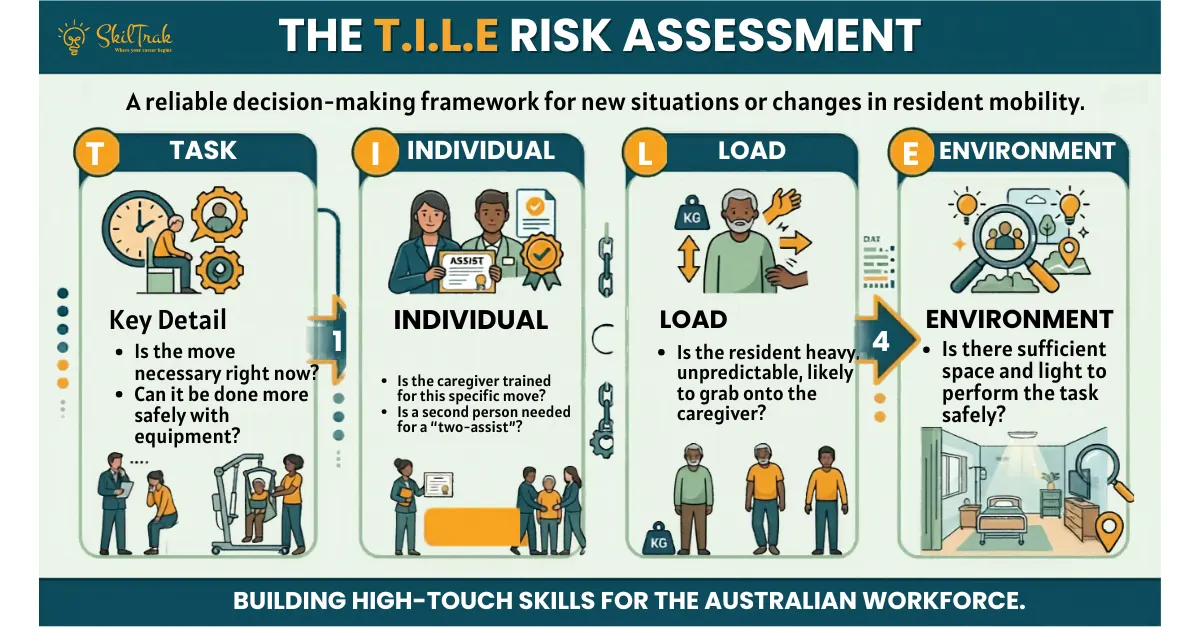
When encountering a new situation or a change in a resident’s mobility, the T.I.L.E method provides a reliable decision-making framework:
- T (Task): Is the move necessary right now? Can it be done more safely with equipment?
- I (Individual): Is the caregiver trained for this specific move? Is a second person needed for a "two-person assist"?
- L (Load): Is the resident heavy, unpredictable, or likely to grab onto the caregiver?
- E (Environment): Is there sufficient space and light to perform the task safely?
Types of Manual Handling Equipment in Aged Care
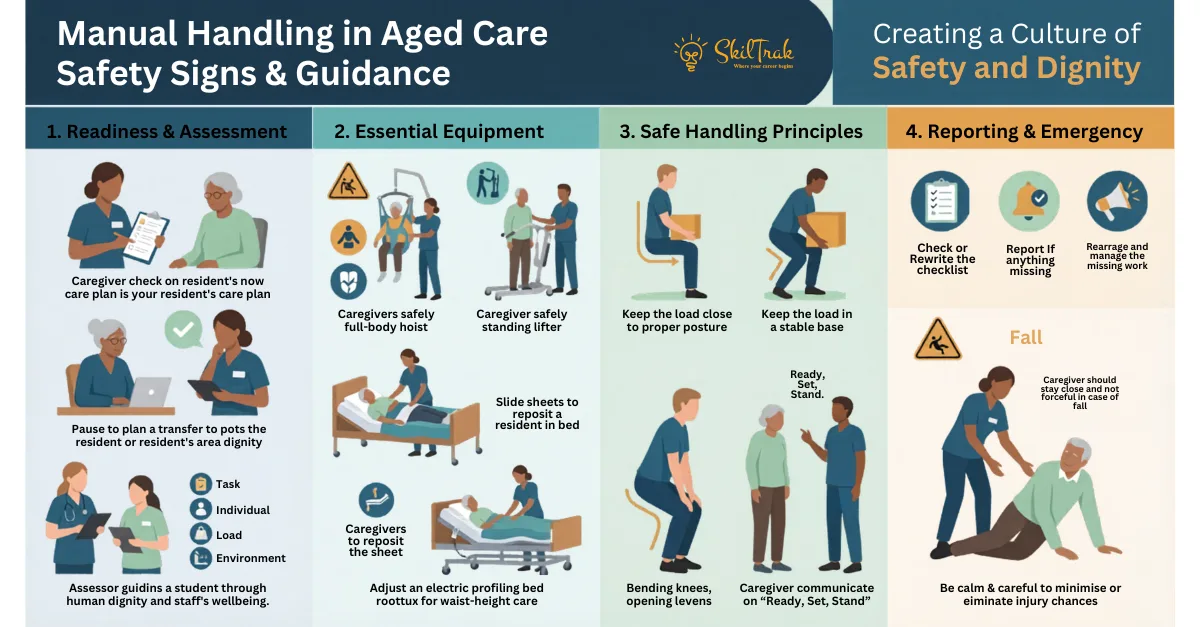
Modern equipment is specifically designed to take the strain off a caregiver's joints. Technical proficiency is shown through the correct use of these tools:
- Slide Sheets: These are essential for bed-based work. They reduce friction, allowing a resident to be turned or slid with minimal force.
- Mechanical Hoists: Whether a standing lifter or a full sling hoist, these are the only safe way to move a resident who cannot bear their own weight.
- Transfer Belts: These provide a secure point to guide a resident’s centre of gravity. A caregiver should never pull on a resident’s arms or clothing, as this can cause shoulder dislocations or skin tears.
Handling Emergency Situations
One of the most dangerous moments occurs when a resident begins to fall. While the natural instinct is to grab them and pull them back up, this can be extremely demanding.
Do not try to catch a falling resident. Attempting to catch a significant falling weight while in an awkward position will almost certainly result in a serious spinal injury. Instead, stay close and guide the resident as slowly as possible to the floor to protect their head, then call for assistance once they are down. Trying to reduce the force instead of forcefully pulling back can prevent major injuries to both caretaker and resident.
SkilTrak
SkilTrak plays a key role here by providing specialised aged care placements in individual support. These placements act as a bridge between the classroom and the workplace, allowing students to apply their manual handling training for aged care workers in real-world environments under expert supervision.
By managing the placement process, SkilTrak ensures that the next generation of caregivers is not only technically proficient but also confident in their ability to maintain safety and dignity for every resident they support.
Benefits of Starting with SkilTrak
A professional caregiver who wants to upskill or get their prior skills recognised (RPL) can join using the SkilTrak Career Acceleration Program (CAP). This program is delivered in collaboration with our partners in training institutes.
By joining CAP via SkilTrak, they will be exempt from the $300 fee on both the Manual Handling and Infection Control short courses. They will also get 6 months of free membership access to the Support Worker Association Program. You will have the opportunity to connect with an expert trainer while enhancing your career.
(The first 11 joiners will have this opportunity. Join now; it's never too late.)
Final Thoughts
Safe manual handling in aged care is a combination of technical skill and professional judgment. Utilising the right equipment, following the No Lift policy, and taking the time to assess the environment creates a safe workplace and a dignified experience for residents. In this industry, the best care providers are those who prioritise safety over speed.
Contact: collaborations@skiltrak.com.au
Share this article
FAQ's
01
What are the 5 P’s of Manual Handling?
The 5 P's serve as a quick mental checklist before any move: Plan: Start by assessing the task and the resident's needs. Position: Get as close to the resident as possible with a stable base. Pick: Use proper manual handling techniques, engaging the legs rather than the back. Proceed: Move smoothly without twisting the torso. Place: Carefully lower the resident or object into the final position.
02
Where can I find manual handling training in Perth?
For those seeking a manual handling training Perth based course, several RTOs offer specialised workshops for aged care workers. It is recommended to choose a manual handling course that includes practical, hands-on training with hoists and slide sheets to ensure compliance with the latest safety standards. It's also possible to join SkilTrak's Career Acceleration Program (CAP).
03
What are the common types of manual handling tasks?
In healthcare, tasks are generally categorised as lifting, supporting, pushing, pulling, or carrying. Common examples include transferring a resident from a bed to a wheelchair, assisting with showering, and maneuvering heavy medical equipment.
04
What are the 5 key principles of manual handling?
The core principles focus on: Avoidance: Avoiding the need for manual handling where possible. Assessment: Evaluating the risk of injury. Reduction: Using mechanical aids to reduce the load. Technique: Keeping the back straight and feet apart. Review: Updating the resident’s care plan as their mobility changes.