 Courses
A Deep Dive into Supply Chain Operations and Management
Australia's supply chain management market reached USD 949 million in 2025 and is projected to grow to USD 2.28 billion by 2034, a compound annual growth rate of over 10%. Behind those numbers is a vast, interconnected system of people, processes, and technology that keeps goods moving in the country. That system is what supply chain operations and management is all about.
Whether the goal is to understand how supply chains function, solve operational challenges inside a business, or build a career in logistics and procurement, this blog covers everything in detail, from the foundational steps to emerging trends reshaping how Australian businesses compete on the global stage.
What Are Supply Chain Operations?
‘Supply chain operations refer to all the activities involved in getting a product or service from its origin to the end customer, reliably, efficiently, and at the right cost.’
This spans sourcing raw materials, managing suppliers, overseeing manufacturing, controlling inventory, coordinating logistics and transport, fulfilling orders, and managing returns. In Practice, supply chain operations connect every link in a business network, from a cattle station supplying wool to a Melbourne manufacturer, to a 3PL warehouse distributing to a national retailer.
Operations and supply chain management bring these individual links together under a strategic framework. The goal is to keep things moving while reducing waste, minimising cost, and consistently meeting customer expectations.
The 5 Basic Steps of Supply Chain Operations
In most supply chains, regardless of industry, follow five core operational steps. Understanding these steps is the foundation of any supply chain operations role.
1. Planning
Supply chain planners use historical sales data, market trends, and demand signals to forecast how much of a product will be needed, when, and where. This informs procurement quantities, production schedules, and inventory positioning.
For Australian retailers like Coles or Woolworths, demand planning is not just a paper exercise; it accounts for seasonal shifts, promotional campaigns, supply disruptions, and the increasing unpredictability of global logistics networks.
2. Sourcing
Sourcing covers the procurement of raw materials, components, and finished goods. It involves selecting suppliers, negotiating contracts, managing supplier relationships, and ensuring quality and compliance standards are consistently met.
In Australia, sourcing increasingly involves decisions around ethical procurement, local versus offshore suppliers, and the traceability of materials across industries like food, pharmaceuticals, and construction.
3. Manufacturing
This step involves converting raw materials or components into finished products. It covers production scheduling, quality management, assembly line efficiency, and waste reduction. Supply chain operations professionals in manufacturing environments work closely with production teams to ensure output meets demand without overstocking.
Automation is rapidly reshaping this step in Australia, with AI-driven production systems reducing errors and improving throughput across the food processing, mining equipment, and pharmaceutical manufacturing sectors.
4. Delivery and Logistics
Once goods are produced or sourced, they need to reach the customer. Delivery and logistics encompass warehousing, order fulfilment, freight management, last-mile delivery, and returns handling. This is where companies like Toll Group, Linfox, and DHL operate at scale across Australia's vast geography.
Last-mile delivery in Australia is one of the more complex logistics challenges in the world, covering remote communities, dispersed suburban populations, and the growing expectation of same-day or next-day e-commerce fulfilment.
5. Returns and Reverse Logistics
Returns management, sometimes called reverse logistics, handles products flowing back through the chain, such as customer returns, defective goods, recycled materials, and end-of-life product disposal. As sustainability requirements tighten in Australia and globally, reverse logistics is becoming a core competency rather than an afterthought.
Companies investing in circular economy models are finding that well-managed reverse logistics reduces cost, recovers material value, and improves brand reputation with environmentally conscious consumers.
What Are the 4 Types of Supply Chains?
Supply chains are not one-size-fits-all. Different industries and business models require fundamentally different approaches to how goods move through the system.
Supply Chain Type | How It Works & Where It's Used |
Continuous Flow | Stable, predictable demand with minimal product variation. Best suited to commodity industries, fuel, chemicals, and basic food staples. Production runs constantly with little changeover. |
Fast Chain | Designed for short product life cycles and rapid trend response. Common in fashion, consumer electronics, and seasonal retail. Speed to market is the priority. |
Efficient Chain | Cost optimisation above all else. Used in highly competitive markets where margins are thin and product demand is predictable. Automotive parts and household goods are typical examples. |
Agile Chain | Built for volatile demand and unpredictable order volumes. Prioritises flexibility and responsiveness. Healthcare, defence, and disaster response supply chains rely on agile models. |
Understanding the Supply Chain Operations Reference Model (SCOR)
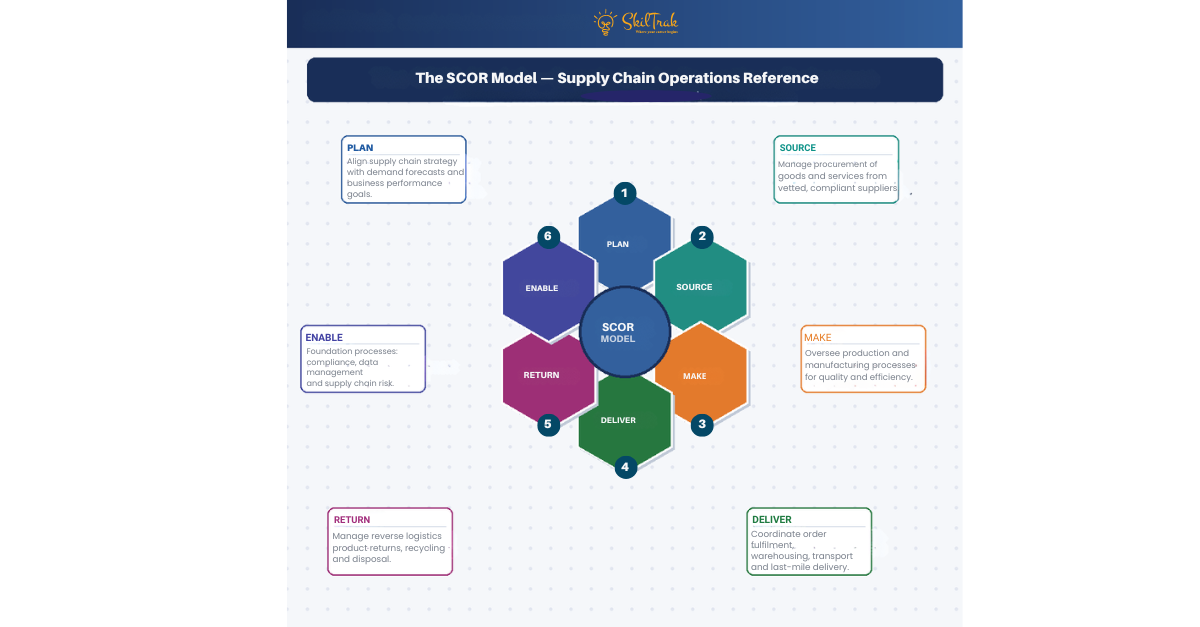
The Supply Chain Operations Reference model, commonly known as SCOR, is a globally recognised framework used to evaluate and improve supply chain performance. Developed by the Association for Supply Chain Management (ASCM), it gives businesses a common language and structure for analysing every part of their operations.
SCOR is built around six core management processes:
- Plan — aligning supply chain strategy with business goals and forecasting demand
- Source — managing procurement of goods and services from suppliers
- Make — overseeing production and manufacturing processes
- Deliver — coordinating order fulfilment, warehousing, and transportation
- Return — managing reverse logistics and product returns
- Enable — the foundational processes that support the other five, including compliance, data management, and risk management
For Australian businesses, SCOR provides a practical lens for benchmarking performance against industry standards, identifying inefficiencies, and communicating supply chain priorities across departments. Many large Australian organisations, including those in mining, retail, and defence, use SCOR as the foundation for their supply chain improvement programmes.
What Are the 7 C's of Supply Chain Management?
The 7 C's framework is a widely taught model that summarises the core principles underpinning effective supply chain management. Each principle addresses a different dimension of how a supply chain should operate.
- Connect: Integrating systems, data, and partners across the supply chain
- Create: Building value through efficient product design and procurement
- Customise: Tailoring supply chain processes to specific customer or market requirements
- Coordinate: Aligning activities across internal teams and external partners
- Consolidate: Combining shipments, suppliers, or processes to reduce cost and complexity
- Collaborate: Sharing data and working jointly with suppliers, distributors, and logistics providers
- Contribute: Ensuring the supply chain adds measurable value to the business and its customers
These principles appear daily in supply chain operations roles. A logistics coordinator consolidating freight across multiple warehouses is applying the Consolidate principle. A procurement officer sharing demand forecasts with a supplier is applying Collaborate. Understanding the 7 C's gives supply chain professionals a framework for making decisions that align with broader business goals.
Supply Chain Management and Logistics: How They Work Together
Logistics and supply chain management are closely related but not the same thing. Logistics is one component within the broader supply chain; it specifically covers the physical movement and storage of goods.
Supply chain management and logistics interact across three main areas:
- Warehousing and inventory management — ensuring stock is stored efficiently and is accessible when needed
- Transportation and freight — selecting carriers, routing shipments, and managing delivery timelines
- Order fulfilment and last-mile delivery — picking, packing, and getting orders to the customer on time
While logistics focuses on execution, supply chain management and logistics together form the strategic and operational backbone of how a business delivers value. A supply chain manager might be negotiating a new carrier contract or redesigning a distribution network, while a logistics coordinator is tracking inbound freight in real time; both functions are interdependent.
In Australia, the logistics sector is under significant pressure from e-commerce growth, labour shortages, and infrastructure constraints across major port cities. Businesses that integrate strong logistics execution with sound supply chain strategy are consistently outperforming those treating the two as separate functions.
Challenges Facing Supply Chain Operations in Australia 2026
Australian supply chains operate in one of the more demanding environments in the world. Geographic isolation, a small domestic market combined with significant export activity, and exposure to global disruptions create a complex operating context.
Research from TMX Transform's State of the Supply Chain Australia 2025 report, which surveyed over 500 supply chain leaders, identified the most pressing challenges:
Rising Operational Costs
One in three Australian supply chain leaders identified cost reduction as their single biggest challenge. Persistent inflation in fuel, labour, and raw materials has squeezed margins across manufacturing, retail, and logistics. The Australian Industry Group's 2025 Trade and Supply Chain Survey found that 44% of manufacturers plan to increase supply chain investment this year, largely to offset cost pressures through efficiency gains.
Supply Chain Disruptions
Natural disasters, port congestion, geopolitical tensions, and pandemic-era aftershocks continue to affect Australian supply chains. Only 42% of Australian retailers say they have adequate contingency plans for supply chain disruptions, according to KPMG's 2024 research. Businesses are responding by diversifying suppliers, moving to multi-carrier freight agreements, and investing in real-time monitoring tools.
Sustainability and ESG Compliance
Sustainability has moved from a marketing priority to a regulatory and operational one. Mandatory climate disclosures, tougher ESG reporting requirements, and increasing consumer scrutiny of supply chain practices are reshaping how Australian businesses manage sourcing, transport, and packaging.
Linfox, Australia's largest privately owned logistics company, has made this shift tangible — its GreenFox programme has deployed heavy-duty electric trucks, built Green Star-rated facilities, and diverted over 60% of operational waste from landfill. This is the direction the industry is heading, and supply chain professionals who understand sustainability frameworks will be in demand.
Digital Transformation and Cybersecurity
As supply chains become more digitally connected, the attack surface for cyber threats expands. Research from Manhattan Associates shows 81% of Australian supply chain leaders expect new technologies to reduce freight costs and improve efficiency, but digital integration also introduces data security risks that require active management.
How Technology Is Transforming Supply Chain Operations
Technology is no longer an optional upgrade in supply chain management; it is the primary driver of competitive advantage. Across Australia, businesses are deploying a suite of digital tools to increase visibility, reduce waste, and respond faster to market changes.
Artificial Intelligence and Demand Forecasting
AI-driven demand forecasting tools analyse historical sales data, weather patterns, economic indicators, and consumer behaviour to predict future demand with far greater accuracy than traditional methods. Retailers using AI-driven demand forecasting have seen up to a 30% reduction in stockouts, according to IDC research. Coles recently restructured parts of its product range specifically to improve inventory predictability, a decision informed by supply chain analytics.
IoT and Real-Time Tracking
Internet of Things sensors embedded in freight, vehicles, and warehouse equipment give supply chain teams real-time visibility over every movement in the chain. When a shipment is delayed at a port or temperatures in a refrigerated container drift out of range, IoT alerts allow immediate corrective action rather than reactive damage control.
Blockchain for Transparency
Blockchain creates tamper-proof records of transactions and movements across the supply chain. This is particularly valuable in industries where provenance matters, food safety, pharmaceutical compliance, luxury goods authentication, and ethical sourcing verification. Australian Government initiatives, including the 2024 Defence Digital Strategy, have flagged blockchain and AI as core tools for strengthening supply chain resilience.
Key Supply Chain Performance Metrics
Regardless of the technology stack, supply chain performance is measured through a consistent set of KPIs. These are the metrics that supply chain operations managers track daily:
- On-time delivery rate: Percentage of orders delivered within the committed window
- Inventory turnover: How many times does stock cycle through in a given period
- Order fill rate: Percentage of orders fulfilled completely from available stock
- Supply chain cost as a percentage of revenue, total operating cost efficiency
- Perfect order rate: Orders delivered complete, on time, undamaged, and with correct documentation
- Supplier on-time performance: Reliability of the upstream supply base
Supply Chain Operations Careers and Salaries in Australia
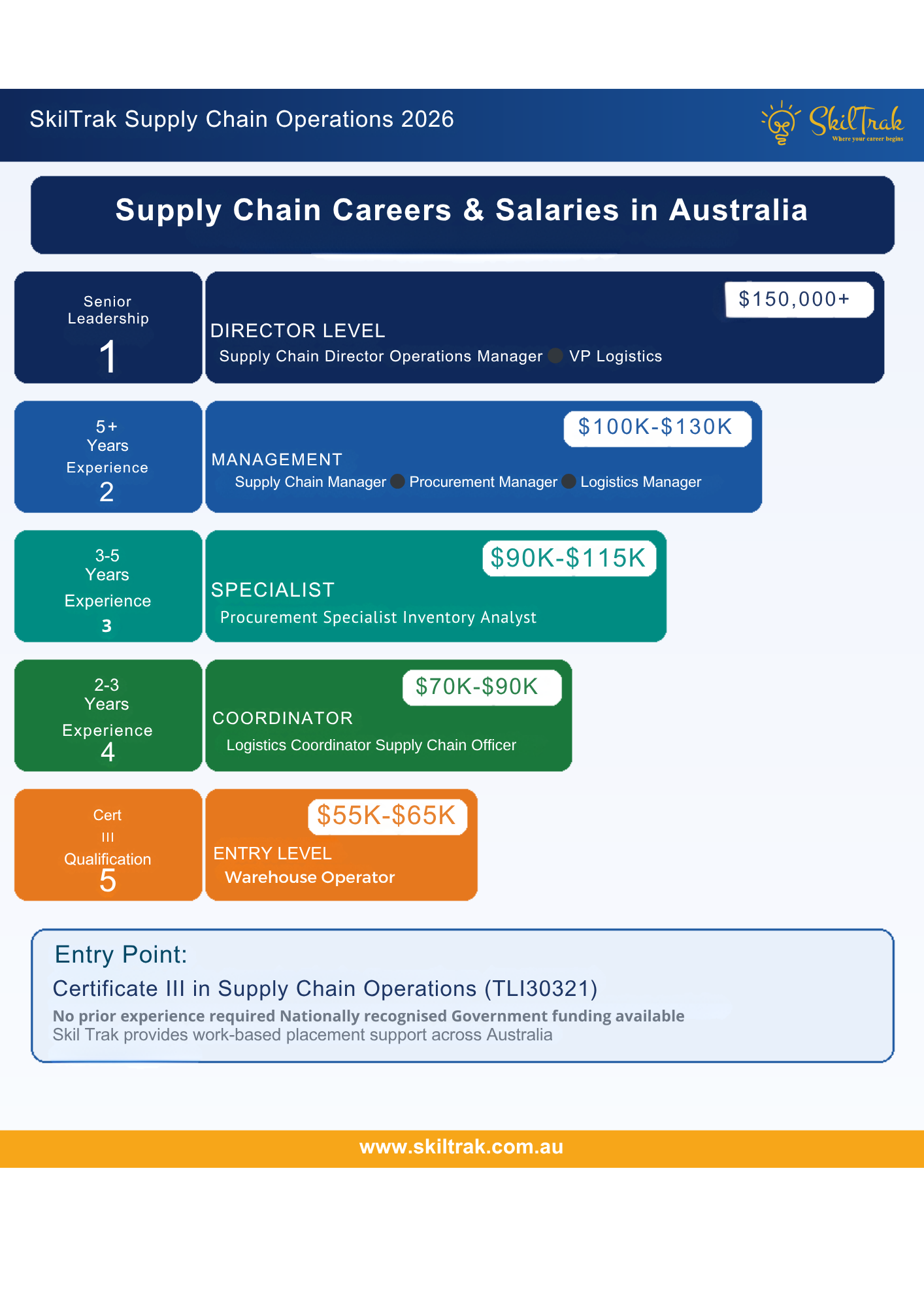
Supply chain and logistics is one of the more accessible professional sectors in Australia; entry-level positions require no degree, salaries are competitive from the start, and career progression is structured and well-defined. The sector's growth is being driven by e-commerce expansion, infrastructure investment, and the complexity of managing modern global supply chains.
Entry Level Roles
Graduates of the Certificate III in Supply Chain Operations typically enter the workforce in the following roles:
- Warehouse Operator: Receiving, storing, and dispatching stock
- Logistics Clerk: Processing orders, maintaining records, coordinating with freight carriers
- Freight Handler: Managing the physical movement of goods in transport hubs
- Supply Chain Administration Officer: Supporting procurement and operations teams.
Salary range: $55,000 to $65,000 per year for entry-level positions, based on the Hays Salary Guide.
Mid-Level Roles
With two to five years of experience, supply chain professionals move into coordination and specialist roles:
- Logistics Coordinator: Managing carrier relationships, shipment tracking, and freight costs
- Supply Chain Officer: Supporting end-to-end process management across procurement and distribution
- Procurement Specialist: Managing supplier negotiations and contract compliance
- Inventory Analyst: optimising stock levels and replenishment cycles
Salary range: $70,000 to $115,000 per year, depending on specialisation and industry.
Senior and Leadership Roles
At the senior level, supply chain professionals move into strategic and leadership positions:
- Supply Chain Manager: Overseeing end-to-end operations, team leadership, and strategic supplier management
- Operations Manager: Responsible for efficiency, cost, and performance across the supply chain function
- Supply Chain Director: Executive-level accountability for global or national supply chain strategy
Salary range: $100,000 to $150,000+ per year for management and director-level roles, according to industry benchmarks from Hays and Seek.
Role | Approximate Salary (AUD) |
Warehouse Operator / Logistics Clerk | $55,000 – $65,000 |
Logistics Coordinator | $70,000 – $90,000 |
Procurement Specialist | $90,000 – $115,000 |
Supply Chain Manager | $100,000 – $130,000 |
Supply Chain Director / Operations Manager | $150,000+ |
Employers hiring in this space include Toll Group, DHL, Coles, Woolworths, Visy, Australia Post, and a growing number of e-commerce and 3PL businesses expanding their fulfilment operations nationally.
How to Start a Career with Certificate III in Supply Chain Operations
The TLI30321 Certificate III in Supply Chain Operations is a nationally recognised vocational qualification designed for people entering or building their career in logistics, warehousing, and supply chain management. It is delivered by Registered Training Organisations (RTOs) across Australia and sits within the Transport and Logistics training package.
What the Course Covers
The Certificate III equips students with practical, job-ready skills across a range of supply chain functions:
- Inventory control and stock management
- Receiving, storing, and dispatching goods
- Logistics coordination and freight documentation
- Workplace health and safety compliance
- Team leadership and communication in operational environments
- Manual handling, cargo securing, and chain of responsibility obligations
Students can specialise in either logistics operations or warehousing operations, depending on their career focus. The course is structured to be completed over 12 to 24 months, with delivery modes that include on-campus, online, blended, and workplace-based traineeships.
Entry Requirements and Funding
The Certificate III in Supply Chain Operations has no formal entry requirements; it is accessible to school leavers, career changers, and workers already in the industry who want a recognised qualification. There is a preference for students to have completed Year 10 or equivalent, but this is not a strict requirement.
Government funding is available
In several states, including New South Wales and South Australia, for eligible students. Fee estimates range from $848 to $10,630, depending on the provider, state, and individual funding eligibility. The Smart and Skilled scheme in NSW and similar programmes in SA can significantly reduce out-of-pocket costs for qualifying students.
Career Outcomes
Research from providers across Australia shows strong graduate outcomes for this qualification:
- Graduates typically qualify for roles as warehouse operators, logistics coordinators, supply chain officers, freight handlers, and transport administrators
- Employment in the logistics sector is projected to grow 9.2% over five years (ABS), meaning demand for qualified workers is outpacing supply in many regions
- 85% of graduates from nationally recognised Certificate III programmes reported career advancement within six months of completing the qualification
SkilTrak and Work-Based Placement
One of the most valuable components of vocational supply chain training is industry placement, the opportunity to apply classroom learning in a real operational environment. SkilTrak supports students completing the Certificate III in Supply Chain Operations with structured work placement connections across Australia's logistics, warehousing, and procurement sectors.
Rather than leaving students to source their own placement independently, SkilTrak connects learners with vetted industry partners, manages the placement agreement process, and provides both the student and the host employer with a clear framework for the placement period. This reduces the administrative burden on employers and gives students a supported, structured introduction to the workforce.
For RTOs delivering supply chain qualifications, SkilTrak's platform streamlines compliance tracking, placement documentation, and student progress monitoring, removing the friction that often makes work placement coordination time-consuming for training coordinators.
Emerging Trends Shaping Supply Chain Operations in 2026
The supply chain landscape in Australia is changing rapidly. The organisations that will lead their sectors over the next five years are already investing in the capabilities and systems that will define operational excellence in 2026 and beyond.
AI and Machine Learning Becoming Mainstream
What was experimental three years ago is now standard practice. AI-powered demand forecasting, intelligent routing algorithms, and machine learning-based supplier risk scoring are being deployed across Australian retail, FMCG, and defence supply chains. According to ASCLA, investment in digital technologies paused in 2025 and is rebounding strongly into 2026 as businesses prioritise visibility and agility.
Sustainability as a Competitive Requirement
Mandatory climate disclosures and stricter ESG reporting requirements are changing how Australian businesses manage their supply chains. Green logistics, electric vehicle fleets, sustainable packaging, and lower-emission routing are no longer differentiators but an expectation. Supply chain professionals with sustainability knowledge are increasingly sought after across all sectors.
Reshoring and Nearshoring
Global supply chain disruptions have prompted a significant rethink of offshore sourcing strategies. Australian manufacturers and retailers are bringing more production closer to home or diversifying to regional suppliers in Southeast Asia and the Pacific. This is creating new domestic logistics and procurement roles and reshaping supplier management requirements.
Digital Control Towers
End-to-end supply chain visibility platforms, often called digital control towers, integrate data from across the chain into a single real-time view. They allow supply chain teams to identify disruptions before they escalate, model alternative scenarios, and make faster decisions. Adoption is accelerating in Australia across retail, mining, and pharmaceutical supply chains.
E-Commerce and Last-Mile Pressure
Online retail continues to grow at a pace that is straining last-mile delivery capacity in Australian urban centres. Last-mile delivery contributes 25% of total transport emissions in cities like Sydney and Melbourne (KPMG, 2024), and the pressure to deliver faster while reducing that environmental footprint is driving significant innovation in fulfilment models, micro-fulfilment centres, and parcel locker networks.
Conclusion
Supply chain operations sit at the heart of how modern businesses function. From forecasting demand and sourcing materials to delivering orders and managing returns, every step in the chain has a direct impact on profitability, customer satisfaction, and competitive positioning.
Australia's supply chain sector is growing, evolving, and investing heavily in technology, sustainability, and talent. For businesses, that means greater complexity but also greater opportunity for those who invest in capability. For individuals, it means one of the more accessible and well-compensated career paths in the Australian economy, with genuine scope for progression from entry-level operations roles through to senior management.
The Certificate III in Supply Chain Operations is the standard starting point for building that career, and with SkilTrak's work placement support, students can move from qualification to employment with industry experience already behind them.
Enquire about supply chain placement with SkilTrak → skiltrak.com.au
Share this article
FAQ's
01
What are the 7 C's of supply chain management?
The 7 C's are Connect, Create, Customise, Coordinate, Consolidate, Collaborate, and Contribute. Each principle addresses a different dimension of how a supply chain should be designed and managed, from integrating systems and data (Connect) to ensuring the supply chain adds measurable business value (Contribute).
02
What are the 5 basic steps of supply chain management?
The five basic steps are Planning (demand forecasting and resource allocation), Sourcing (procurement and supplier management), Manufacturing (production and quality control), Delivery and Logistics (warehousing, transport, and order fulfilment), and Returns (reverse logistics and product disposal). These steps form the operational cycle that moves goods from the origin to the customer.
03
What are the 4 types of supply chains?
The four main types are the Continuous Flow chain (stable, high-volume commodity production), the Fast Chain (short product life cycles, rapid market response), the Efficient Chain (cost-optimised for competitive, predictable markets), and the Agile Chain (flexible and responsive to volatile demand). Most businesses use elements of more than one type depending on their product mix.
04
What is the Supply Chain Operations Reference Model?
The SCOR model is a globally recognised framework developed by the Association for Supply Chain Management. It structures supply chain analysis around six management processes: Plan, Source, Make, Deliver, Return, and Enable. Businesses use SCOR to benchmark performance, communicate across departments, and identify improvement opportunities in a consistent, structured way.
05
What qualifications are needed for supply chain operations roles in Australia?
The Certificate III in Supply Chain Operations (TLI30321) is the standard entry-level vocational qualification for the sector. It has no formal entry requirements and is nationally recognised across all states and territories. For mid-level and senior roles, a Certificate IV in Logistics, Diploma of Supply Chain Management, or a degree in logistics and supply chain management can support career progression. Industry certifications from the SCLAA and CIPS are also valued by employers.
06
What is the difference between supply chain management and operations management?
Supply chain management focuses on the movement of goods, services, and information between organisations. It is outward-facing and spans multiple businesses. Operations management focuses on optimising internal processes within a single organisation, including production efficiency, quality control, and resource allocation. In practice, the two disciplines overlap significantly, and most senior supply chain professionals need competency in both.