 career goals
Difference Between Internship, Apprenticeship, & Vocational Placement
If you've been looking around job boards for opportunities, you've probably come across these three terms more than once. Sometimes they're used interchangeably, which doesn't help anyone trying to make a real decision about their career path. They may sound like opportunities, but they are not the same and understanding the difference could save you from signing up for something that doesn't match what you're actually after.
In this guide, we go through the differences between an internship, apprenticeship, and a vocational placement, and which one you should choose and why.
Internships: Work Experience With Industry Exposure
An internship is a short-term work placement, usually in a professional or corporate environment. It's most common among university students or recent graduates who want hands-on exposure to an industry before committing to a full-time role.
Internships in Australia typically run anywhere from a few weeks to six months. Some are paid, many still aren't, which is a topic that's drawn considerable attention from the Fair Work Ombudsman in recent years, particularly around whether unpaid arrangements meet lawful employment conditions.
What an intern actually does:
The work varies depending on the employer, but the idea is that you're contributing to real projects while learning how the organisation operates. You might be sitting in on client meetings at a marketing agency, supporting research for ideas, or assisting a legal team with case preparation. It's largely observational and supportive at first, building toward more responsibility as the internship progresses.
Who this suits:
Internships fit people who are mid-study or newly graduated and want to test whether their chosen field feels right in practice. Industries like media, finance, technology, public policy, and the arts tend to rely heavily on internships as a pipeline for future talent. It is to provide hands-on experience so students can understand the work environment more thoroughly, as well as assess the students' potential for future employment.
What it doesn't include:
An internship is not a formal qualification pathway. You won't walk away with a nationally recognised credential. You also don't have a guaranteed job at the end, though a strong performance often opens that door.
Apprenticeships: A Trade, a Wage, and a Qualification
An apprenticeship is a structured employment arrangement where you train in a skilled trade while working for a registered employer. In Australia, apprenticeships are governed under the Australian Apprenticeships framework and are registered with the relevant State or Territory Training Authority.
This is not casual work experience, but working and learning under an experienced employee. It's employment, which means you receive a wage from day one, pay tax, and are covered by workplace laws under the Fair Work Act. The training component is delivered through a Registered Training Organisation (RTO), which might be a TAFE or a private provider, and leads to a nationally recognised qualification, typically a Certificate III or Certificate IV under the Australian Qualifications Framework (AQF).
Trades that run through apprenticeships include:
- Electrical work
- Plumbing and gas fitting
- Carpentry and joinery
- Automotive technology
- Commercial cookery
- Hairdressing
Apprenticeships generally run for three to four years, though the duration can vary depending on the trade and how quickly the apprentice demonstrates competency.
The employer-employee relationship matters here:
Unlike an internship, where the arrangement can be loosely defined, an apprenticeship involves a formal training contract signed by the apprentice, the employer, and the RTO. The Australian Apprenticeships Incentives System also provides financial support to eligible employers and apprentices, including wage subsidies and payments that vary based on the occupation and location at the time.
Who this suits:
People who want a recognised trade qualification and a steady income while they learn. Apprenticeships work well for students who have left study for one or another reason or who aren't drawn to university but want a defined career path with clear progression. They also suit career changers. Adult apprenticeships are available for those re-entering the workforce or switching industries entirely.
Vocational Placements: The Practical Requirement Inside Your Course
A vocational placement is different from an internship and apprenticeship. It's a mandatory component of a vocational education and training (VET) course, where students complete practical hours in a relevant workplace setting. Unlike an internship or an apprenticeship, a vocational placement exists specifically to fulfil a requirement of the qualification itself, and it’s not paid.
Think of it this way, if you're studying a Diploma of Nursing or a Diploma of Early Childhood Education and Care, you cannot complete that qualification without logging a specified number of hours working directly in the industry. Those hours are your vocational placement.
Key features that separate it from the others:
- It is part of the formal course structure, not an addition to it
- It is unpaid in most cases, because it is classified as training rather than employment
- The RTO arranges or approves the host employer
- The student is covered by the RTO's insurance, not the employer's workers' compensation policy
- There is no employment contract between the student and the host organisation
The placement hours and conditions are set by the course itself and, where applicable, by the licensing body for that profession. For instance, childcare qualifications in Australia are regulated under the Australian Children's Education and Care Quality Authority (ACECQA), which mandates specific placement requirements that RTOs must meet.
Who this suits:
Students enrolled in VET qualifications that require a practical component, which includes a wide range of Certificate and Diploma-level courses in aged care, community services, hospitality, beauty therapy, dental assisting, allied health and more. If you're studying at TAFE or through a private RTO and your course includes a placement requirement, this is the pathway that applies to you.
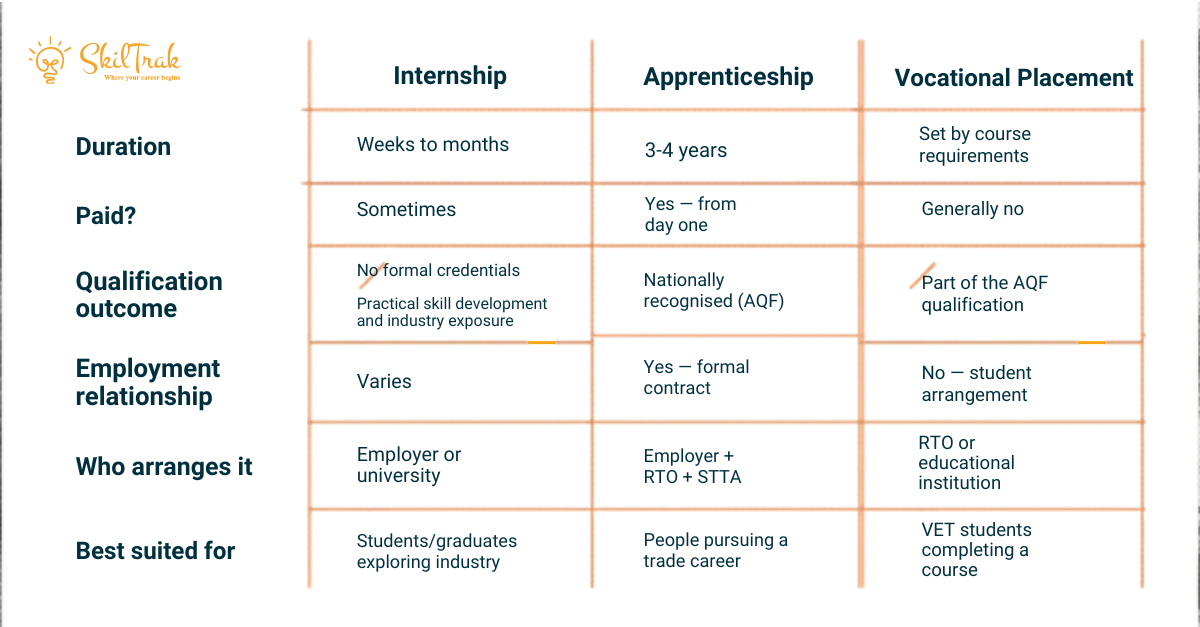
The Question Worth Asking Before Committing
Before accepting or applying for any of these, it's worth knowing exactly what you're stepping into. Ask yourself:
- Am I getting paid, and is that arrangement legally sound?
For apprenticeships, the answer should always be yes. For internships, it depends on the nature of the work. Check the Fair Work Ombudsman's guidelines if you're unsure. Unpaid internships have strict conditions in Australia.
- Will this contribute to a formal qualification?
If building credentials matters to you, an apprenticeship or vocational placement gives you something tangible on paper. An internship, by itself, does not.
- Who is responsible for me while I'm there?
Knowing whether you're covered as an employee or as a student on placement affects your rights and protections significantly.
A Practical Note on Next Steps
If you're exploring apprenticeships, the Australian Apprenticeships Pathways website is a useful starting point. It lists available apprenticeships and traineeships by industry and state.
For vocational placements, speak directly with your RTO or TAFE about the placement requirements specific to your course. They'll have a list of host employers or a coordinator who manages placement arrangements. At SkilTrak, we also offer placements with 50+ RTO partners and many industries where we match students with eligible workplaces to fulfil their placement requirements.
If you are a student looking for placement opportunities, contact our team, and they will answer all your queries.
Share this article
FAQ's
01
Is a vocational placement the same as an internship?
No. A vocational placement is a mandatory part of your VET course that counts toward your qualification. An internship is a separate work experience arrangement that gives you industry exposure but leads to no formal credentials.
02
What is the difference between a traineeship and an apprenticeship?
Both involve a training contract with an employer and an RTO, but apprenticeships are trade-based, in electrical, plumbing, and carpentry, while traineeships cover industries like business, retail, and hospitality.
03
Who organises a vocational placement?
Student RTO or TAFE arranges it. They either arrange the host employer directly or approve one you've found yourself. They can also contact a placement provider like SkilTrak. Individual student can also contact SkilTrak for their placements.
04
Are a placement and an apprenticeship the same?
An apprenticeship is employment where students have a job, earn a wage, and complete a trade qualification over three to four years. A vocational placement is training where you are a student completing mandatory hours required by your course, unpaid, with no employment contract. The key difference is simple: an apprentice is an employee, a placement student is a learner.