 skills
Culinary Career with a Commercial Cookery Apprenticeship
If you love cooking and would like to make that passion into a successful culinary career, then the commercial cookery apprenticeship might be the right way to get there. Maybe you want to be the head chef of a fine dining establishment, or maybe you want to start your own restaurant, or perhaps you just want to master the art of culinary creation. A commercial cookery apprenticeship provides you with the practical experience, industry knowledge, and credentials you need to build a rewarding future.
In this blog, we have broken down all that you ought to know regarding commercial cookery apprenticeship training involved and the certifications, opportunities, and more that result from them. You will emerge at the end with a strong idea of how the path can serve you well for your future life in the constantly evolving culinary sector.
What is a Commercial Cookery Apprenticeship?
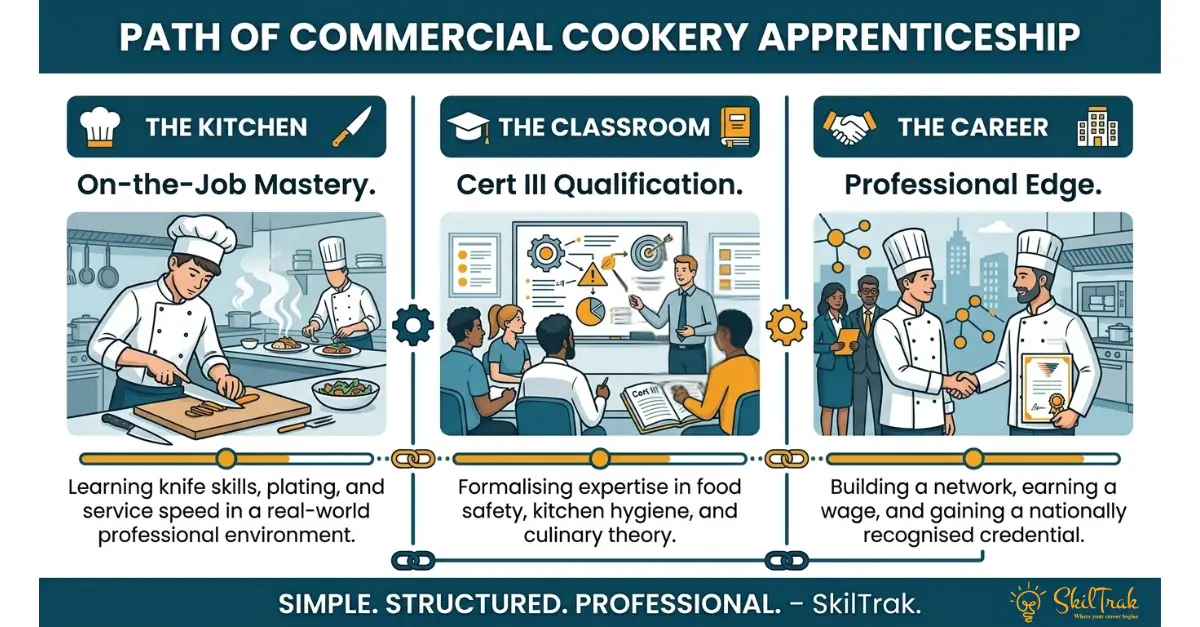
A commercial cookery apprenticeship is a structured training program for the aspiring chef or culinary enthusiast. It combines practical experience in professional kitchens with formal education through institutions such as TAFEs or Registered Training Organisations. This ensures that participants are equipped with theoretical knowledge and practical expertise to face the hospitality industry.
Key Characteristics of a Cookery Apprenticeship
1. Practical Training
Students are taught by professional chefs and trained on various skills such as knife work, food preparation, and high-level plating.
The professional kitchen environment is a setting where students can develop time management and teamwork.
2. Classroom Instruction
Apprentices take classes to understand theoretical knowledge in the areas of food safety, kitchen operations, and culinary techniques.
Courses generally involve qualifications such as Certificate III in Commercial Cookery (Cert 3), which is the basic qualification for chefs in Australia.
3. Career Development
Apprentices earn while they learn, thus making it a cost-effective way of acquiring useful skills.
Rotational learning in different sections of the kitchen, from desserts to grilling, ensures that comprehensive skill development is achieved.
Importance of Apprenticeship in Acquiring Culinary Skills?
Embarking on a chef apprenticeship offers several advantages that set it apart from traditional culinary courses. Here are some of the most compelling reasons to choose this path:
1. Practical Experience
In contrast, commercial cookery apprenticeships drop you directly into the environment of a working kitchen. Here, the knowledge acquired allows immediate practice as one learns how to deal with the reality of the fast pace within the culinary world.
2. Industry Connection
Working under skilled culinary experts is also instrumental in providing connections and relationships with industry members, an excellent starting point in pursuing better prospects or more senior roles in hospitality careers.
3. Earning as one learns
Apprenticeships pay while you are gaining qualifications, which makes them a perfect solution for those who want to avoid student loans and other kinds of financial burdens.
4. Respected Qualifications
Graduates of courses such as Cert 3 in Commercial Cookery are renowned within the hospitality industry. Such qualifications tend to be a prerequisite for positions on higher levels.
5. Opportunities to Specialise
After apprenticeship, you will have many opportunities to specialise in a Garder Manger, Sucier, a Pastry Chef, etc.
How Long Does a Commercial Cookery Apprenticeship Last?
The time for an apprenticeship in commercial cookery will be dependent upon how the courses have been designed to fit an individual's pacing. In broad terms:
The Standard Period. Most students normally complete the qualification within 3-4 years, making it more suitable for a work-and-learn model. Previous students who are working may find access to programs at an accelerated speed.
You will rotate through many kitchen sections on the apprenticeship, so your expertise will reach across a series of culinary techniques and cuisines in this way; you will produce well-rounded graduate professionals ready for a variety of roles. It is a Certificate III in Commercial Cookery.
The Certificate III in Commercial Cookery is one of the basic qualifications for aspiring chefs in Australia. It is often a stepping stone in a culinary career, and it offers a solid base for further training.
What to Expect from the Cert III Program
- Core Units
- Food preparation techniques
- Kitchen hygiene and safety
- Cooking methods (e.g., grilling, frying, baking)
- Team collaboration and communication
- Specialized Skills
- Preparing dishes for dietary requirements
- Managing large-scale events
- Exploring cuisines from around the world
- Work Placement
Practical experience in commercial kitchens helps you hone your skills and gain confidence.
The Cert III qualification is highly regarded and is often a requirement for commis chef, sous chef, or chef de partie positions.
Career Options in Commercial Cookery
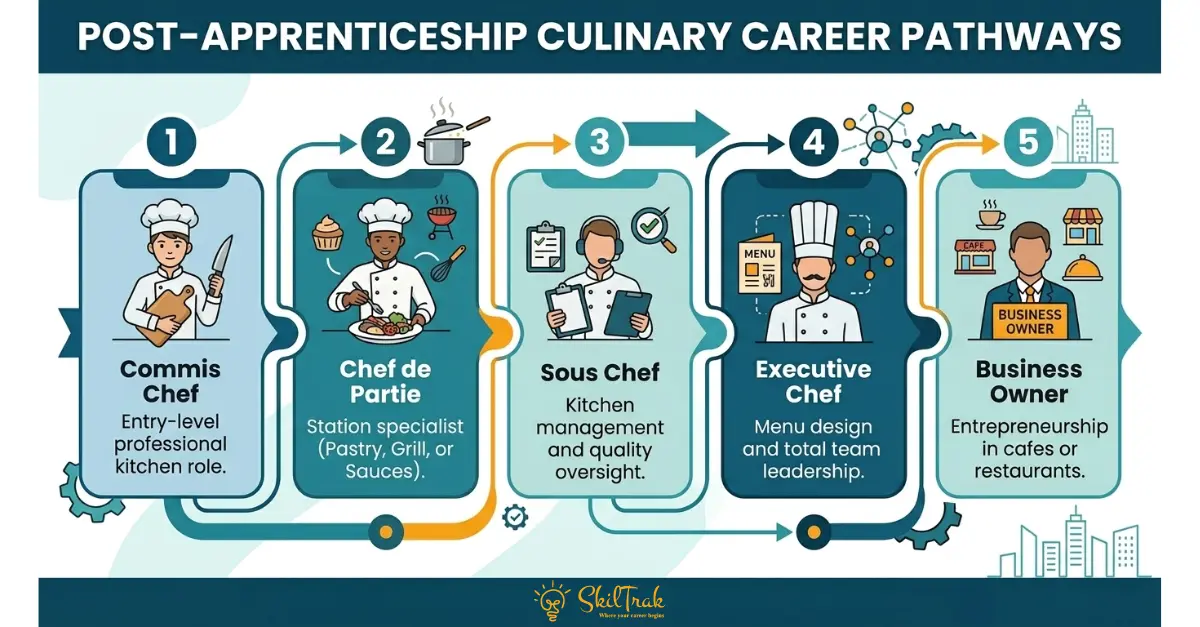
Upon completion of a commercial cookery apprenticeship, you can pursue a range of career options in the culinary industry. Some of the jobs you can consider are:
1. Commis Chef
Begin as an entry-level chef, with on-the-job experience under the direction of more senior staff.
2. Chef de Partie
Work within a particular area of the kitchen, for example, desserts, grilling, or sauces.
3. Sous Chef
Support the head chef in the administration of the kitchen, ensuring that food quality is maintained and that the staff is well managed.
4. Head Chef/Executive Chef
Responsible for the entire kitchen team, menus, and overall dining experience.
5. Entrepreneur
Many chefs use their skills to open their own restaurants, cafes, or catering businesses, combining culinary expertise with entrepreneurial ambitions.
Tips for Success in a Cookery Apprenticeship
Success in a commercial cookery apprenticeship requires dedication, resilience, and a passion for learning. Here are some tips to help you thrive:
1. Stay Curious
Always be looking for new techniques and experimenting with flavours. The world of culinary arts is huge, and continuous learning will keep you ahead.
2. Work Hard
Be prepared to put in long hours and work under pressure. Perseverance and hard work are what take you up the ladder.
3. Build Relationships
Networking with mentors, peers, and industry professionals opens the door to many new opportunities.
4. Embrace Feedback
Constructive criticism is an integral part of growth. Use it as a tool to refine your skills and improve.
5. Practice Self-Care
The culinary industry can be physically and mentally demanding. Prioritise your well-being to sustain your passion and energy.
Why Choose a Cookery Apprenticeship?
Choosing a commercial cookery apprenticeship as your pathway into the culinary industry comes with numerous advantages:
- Real-World Training: Immerse yourself in the daily realities of professional kitchens.
- Flexibility: Tailor your learning experience to suit your career goals, whether it’s fine dining or casual cuisine.
- Recognised Qualifications: Gain certifications that are highly valued by employers.
- Career Progression: Advance to higher roles as you gain experience and expertise
Conclusion
A commercial cookery apprenticeship is more than just a training program; it’s an opportunity to turn your culinary dreams into reality. Apprenticeships, combining on-the-job experience, formal training, and a dose of industry involvement, offer a perfect combination of everything one could want to master the culinary arts with ease. To be a head chef, an owner of an eating house, or even to specialise in the preparation of particular cuisine, these steps offer every tool and experience required to truly excel. Make your first step today toward a fascinating path that merges passion with profession. The world of culinary opportunities awaits you!
Share this article
FAQ's
01
What is the eligibility for a commercial cookery apprenticeship?
Most of the programs ask for a minimum age of 16, basic literacy and numeracy skills, and a passion for cooking. There may also be some that request prior work experience or education in hospitality.
02
How much does a commercial cookery apprenticeship cost?
The cost varies according to the institution and program but commonly covers the Certificate III in Commercial Cookery tuition fees. Most of the programs provide subsidies or payment plans.
03
Will I be able to specialize in a particular cuisine when I'm training?
Yes, during your course you can focus on areas like pastry, international cuisine, or fine dining as per your interests and the course you opt for.
04
What are the highest-paying culinary career paths in Australia?
While traditional restaurant roles are popular, executive and management positions offer the highest returns. Executive Chefs in luxury hotel chains or large-scale venues often earn between $95,000 and $130,000+. Specialised roles in the FIFO (Fly-In-Fly-Out) mining sector also command high premiums, frequently exceeding $120,000 due to remote location allowances.
05
Which culinary skills are currently in highest demand?
Technical mastery is essential, but operational and 'soft' skills are the modern differentiators. Employers prioritise chefs with specialised dietary knowledge (e.g., plant-based or allergen-aware) and financial literacy, such as managing waste and digital inventory. Leadership and the ability to mentor apprentices are also critical during the current labor shortage.