 Student Placement
Best of eLearning and Placement for Students and RTOs
eLearning is training delivered through a digital platform instead of a physical classroom, with videos, assessments, interactive modules, and live webinars, all accessible from wherever a learner happens to be. It's grown from a backup option into one of the main ways training actually gets delivered now, and the numbers show it.
Australia's e-learning market was worth around USD 7.6 billion in 2025, and it's expected to reach USD 19.6 billion by 2034. Globally, the market is on track to cross USD 406 billion in 2026, growing at close to 15% a year. This isn't restricted to a sector any more, but most of the training world is moving this way.
How RTOs Are Actually Using It
For RTOs, eLearning has become the backbone of how theory is being taught. Self-paced modules, instructor-led online sessions, and blended formats that mix both have become the standard. A student doesn't need to sit in a classroom at a fixed time to work through the units that make up a qualification.
Students, for the most part, are genuinely happy with this. Being able to learn from anywhere, fit study around work or family, and move through material without waiting on a scheduled class is a real benefit for them. Assessment has moved with it too. Quizzes, submitted assignments, and progress tracking inside an LMS let an RTO see exactly where a student is up to, and feedback can go back to them without needing a face-to-face session every time.
There's a trade-off too, and it's worth being honest about it. Learning without a classroom also means learning without the structure a classroom naturally provides. There is no one to push the learner through the boring part. Getting feedback on the portal, however well built, still isn't quite the same as a trainer noticing confusion in the room and adjusting right then.
The benefit and the limitation both come from the same thing, distance, and a well-run RTO needs to design around both sides of it on purpose.
Where Courses Actually Get Built
Behind every RTO's eLearning offering is a platform doing the real work, hosting content, tracking progress, managing enrolments, and handling the reporting compliance requires.
- Moodle is still one of the most widely used options in education, RTOs included. It's open-source and highly customisable, and it gives a provider full control over how courses are structured, though it usually takes more setup than a purpose-built alternative would.
- eSkilled takes a more RTO-specific approach, pairing course creation with compliance and reporting built around current RTO Standards, and it supports SCORM-compliant content, so courses built elsewhere can still run inside it properly. Course design itself usually leans on dedicated authoring tools.
- Articulate Storyline, Adobe Captivate, or H5P are common choices, used to build the interactive parts, branching scenarios, and multimedia that a plain document upload could never do on its own.
Picking a platform mostly comes down to how much structure an RTO wants ready-made versus how much it wants to build itself.
The Part Online Learning Can't Finish On Its Own
This is where the limitation actually shows up. A student can complete every module and pass every quiz and still not be ready for the job, because reading or watching something and actually doing it are two different experiences. Retention works the same way. Information that was never applied tends to fade, no matter how well the course was put together.
This is exactly why placement is a required part of so many qualifications, not as a formality, but because it's the part that actually solidifies what was learned. A real environment brings in things no module can fully prepare someone for: an unexpected situation, a real person reacting in a way the scenario never predicted, a task that needs adjusting on the fly.
Working through that is what turns theory into something a person can actually rely on. Online learning builds the foundation. Placement is where that foundation gets tested, used, and properly set.
Why This Matters for RTOs Specifically
For an RTO, they have to show proof of the student work, it's a compliance matter too. Being able to show that students have genuinely applied what they learned, not just completed modules, is part of what RTOs need to evidence.
That means managing placements properly matters just as much as managing the online side, and it comes with the same kind of challenge eLearning already has, tracking progress, gathering evidence, and making sure nothing slips through across potentially hundreds of students at different stages with different host organisations.
This is where a dedicated placement management platform stops being optional. Spreadsheets and email threads can handle a handful of students. They start falling apart well before an RTO reaches real scale.
Why RTOs Need a Placement System
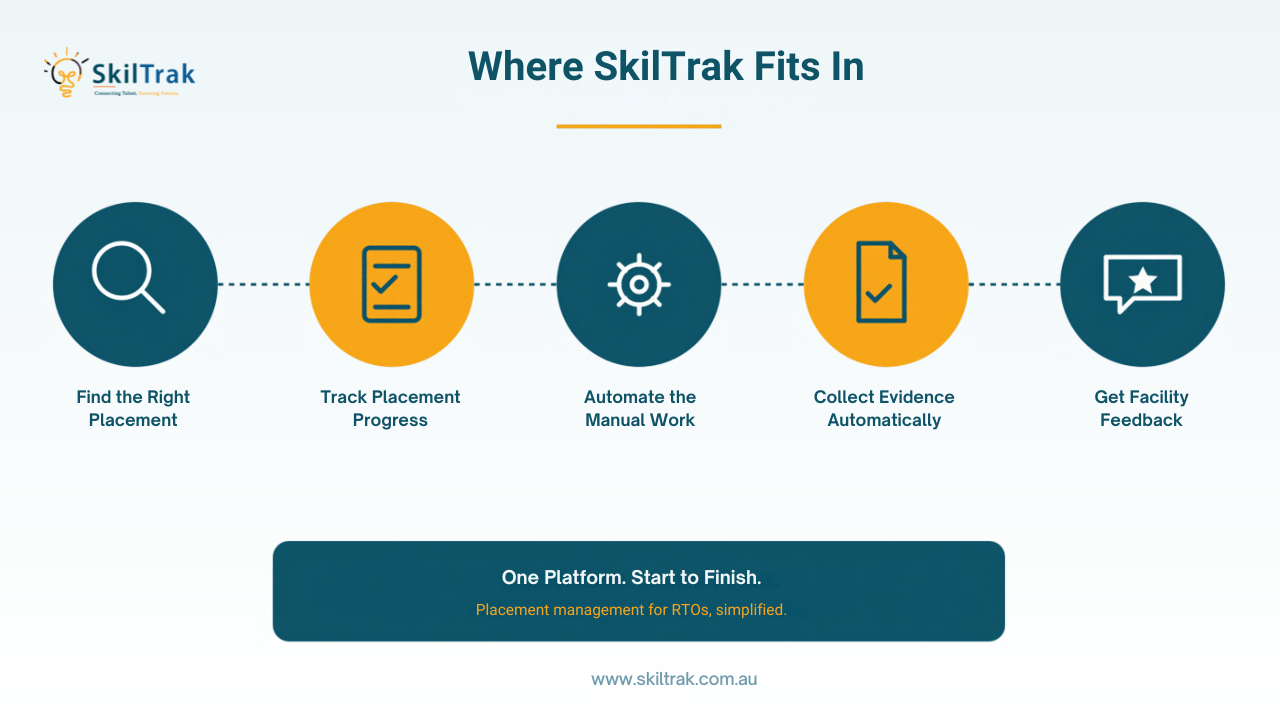
Once a student finishes the online part of their course and is ready for practical experience, SkilTrak handles the placement process from start to finish, finding a suitable host, tracking the placement as it progresses, and managing the evidence that confirms the practical learning.
A lot of the manual work that normally eats up an RTO's time gets automated, so placements don't sit waiting just because someone forgot to follow up or things got delayed. Every student's placement can be tracked individually, progress shows up in the system instead of being scattered across emails, and feedback from the host facility or industry partner comes back through the platform itself, so the RTO ends up with a clear, complete record of how the placement actually went.
Online learning gets a student ready in theory. SkilTrak is built for the part that comes after, making sure the practical side is just as well managed, evidenced, and complete as everything that happened online.
And the best part is that SkilTrak offers a talent pool where partner industries are hiring new employees, so you get to secure a job right after the placement.
Contact us now for placement and cohort management. If you are hesitant, just schedule a meeting and let us understand your requirements.
Share this article