 skills
Why Online Learning Works Best With Practical Training
Online learning is now one of the most common ways Australians study a nationally recognised qualification. You can complete the course from home, on your own schedule, and get the certificate as someone who studied on campus. But online learning by itself doesn't make you job-ready, and neither does practical training on its own. The students who do best treat both as part of the same process.
In this blog, we will discuss how online learning and practical training work together, and why you don’t need to worry about AI taking your job.
How Online Learning Actually Works in Australia
Most Australian qualifications that offer an online option follow a similar structure. You get your course material through a learning portal, work through it at your own pace, and submit assessments as you go. Some courses add live sessions or check-ins with a trainer. Others are fully self-paced.
What surprises a lot of people is how much freedom this gives you. You're not tied to a timetable. If you work shifts, have kids, or live three hours from the nearest campus, that flexibility isn't a nice extra, it's the only reason study is possible at all.
The thing is that nobody is watching over you, whether you are paying attention or not, and this is where the headache comes from. And even if we consider that you are paying attention, another factor comes into play. You learned the theory, but actually retaining that information is crucial, as we are tied up with a lot of things in our day-to-day life. It often gets difficult to remember what you studied while learning online.
The Real Benefits of Online Learning
You study when your brain actually works
Some people think clearly at 5 am, while others have free time after 10 pm. In a classroom, you don't get a choice. Online, you do studying when you're naturally alert makes a genuine difference to how much you retain.
You can go back as many times as you need
Missed something in a live class? Online, you can replay, re-read, and revisit a topic until it clicks. For complex material, this is one of the biggest advantages there is.
It costs less to participate
No commuting, no parking, no rearranging your work roster around fixed class times. For students already juggling a job, those savings add up fast.
You build skills employers quietly value
Managing your own deadlines without supervision is a real skill. Students who finish an online course have already proven they can self-direct, and that shows up later at work.
Where Online Learning Falls Short
Being honest about this matters more than selling the format.
- You can't learn everything from a screen. You can read about supporting someone with limited mobility. You can watch it demonstrated. But the first time you actually do it, with a real person who has their own preferences and reactions, it's a different experience entirely.
- Isolation is real. Studying alone means no one to compare notes with, no quick question to the person sitting beside you, no shared momentum from a group.
- Motivation dips are common. Around the midpoint of most courses, the initial enthusiasm fades, and the finish line still feels far away. Without a timetable acting like a sword hanging over your head, this is where people quietly stall.
None of these are the reasons to avoid online study. They're reasons to plan around it.
Why Practical Training Fills the Gap
In a real work environment, you face different situations and things that no module can prepare you for. Someone has a bad day. Equipment isn't where it should be. A task takes twice as long as you thought it would. You learn to adjust, read a room, and ask the right question at the right time.
You also find out something important about yourself: whether this work actually suits you. Plenty of people discover they love it far more than they expected. Some realise it isn't for them. Both are valuable to learn early rather than late.
And practically speaking, employers want evidence you've done the work. A qualification tells them you studied. Hands-on experience tells them you can do the job.
Why The Combination of Both Wins
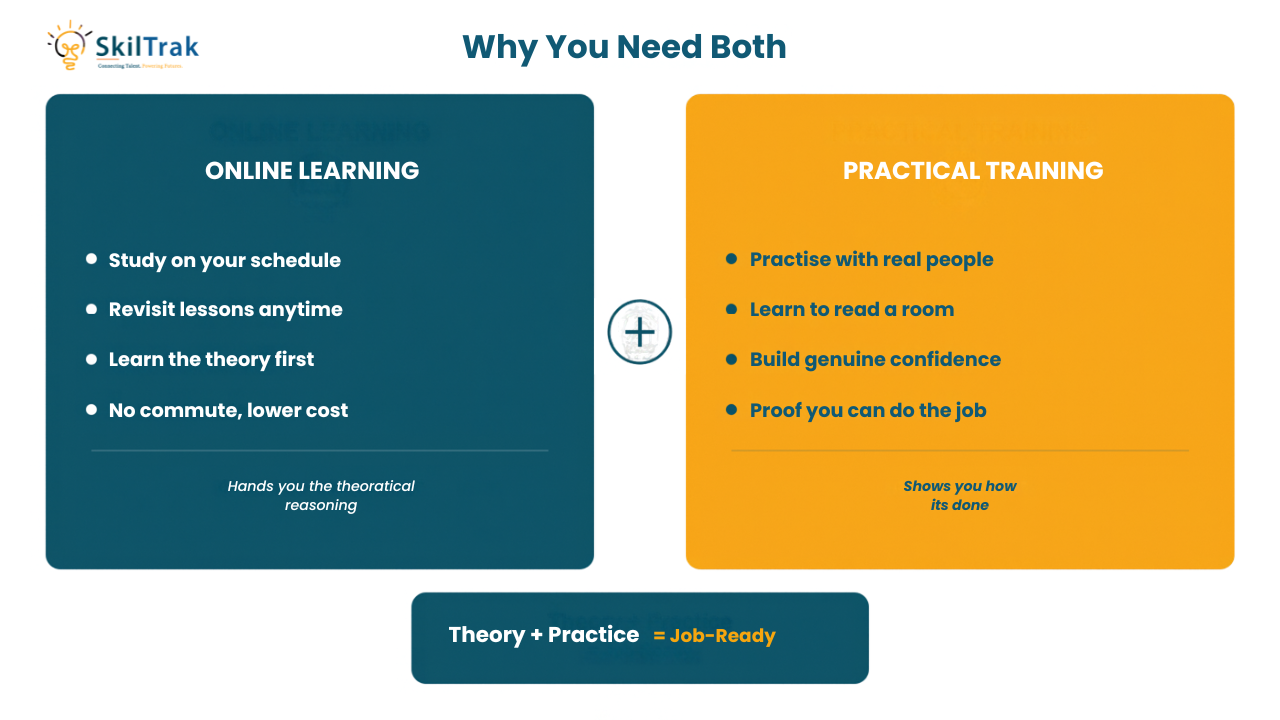
Think of it this way. Online learning gives you the what and the why. Practical training gives you the how. Together they make a complete circle, leaving no ends unattended.
Learn the theory first, and the hands-on work makes sense faster, you're not guessing why you're doing something - you already know. Do the practical work and the theory sticks better, because now it's attached to something real instead of a paragraph on your screen.
This is why most nationally recognised qualifications in Australia are structured this way. It isn't an administrative flex. It's how people genuinely learn skilled work.
Successful Online Learning Strategies That Actually Help
Most study advice is too generic to be useful. These are the ones that consistently make a difference.
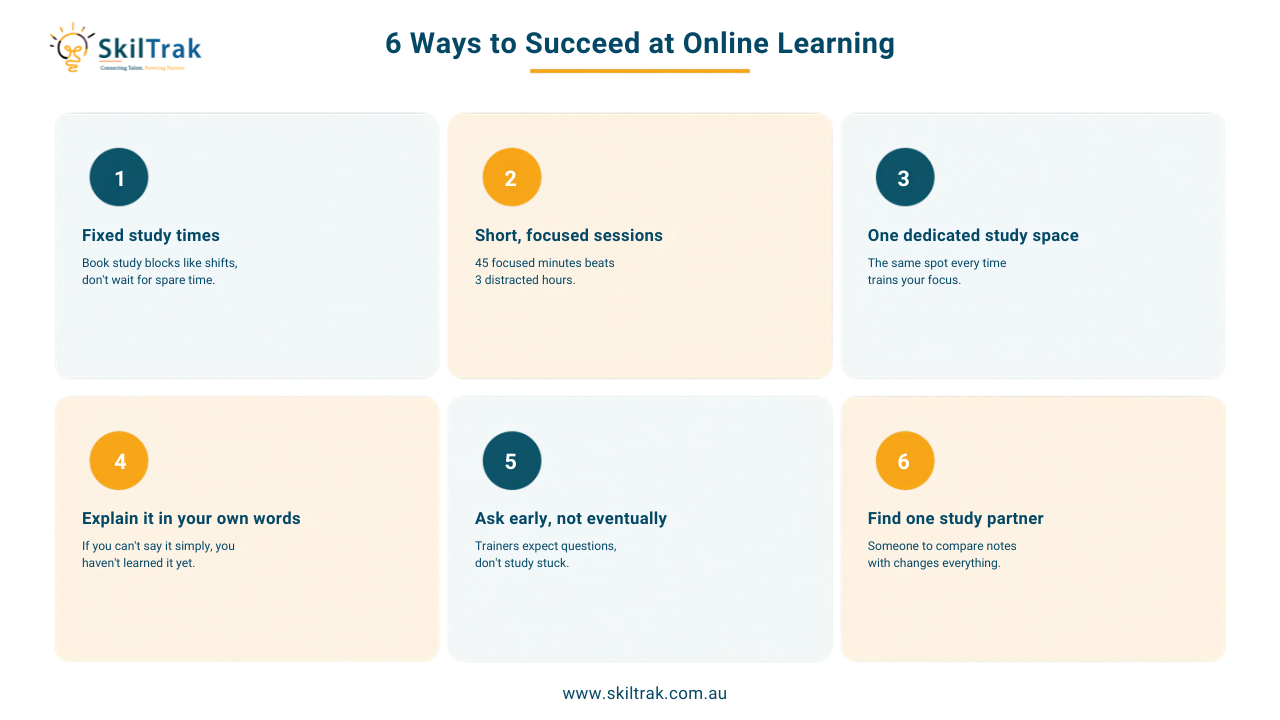
Book your study time like it's a shift
Don't study "when you get a chance," as you won't. Pick specific blocks in your week and schedule your routine. Studying 1 hour daily beats studying 4 hours on a weekend.
Work in shorter sessions than you think you need
Forty-five focused minutes beats three distracted hours. Set a timer, remove your phone from the room, and stop when it goes off. You'll retain more and dread it less.
Have one place where you only study
It doesn't need to be an office just some space in your room works too. The point is that sitting there tells your brain that it's study time.
Write things down in your own words
Copying notes does almost nothing. Explaining a concept in your own words, even badly, forces you to actually understand it. If you can't explain it simply, you haven't learned it yet.
Don't disappear when you're stuck
The most common mistake in online learning is going quiet when something doesn't make sense. Trainers expect questions. Ask early, ask often, and don't wait until an assessment is due.
Find one other person doing the same course
One study partner changes everything. Having someone to compare progress with or complain to, and check in on. Most online courses have a discussion forum, use it to find like-minded people you can study with.
Time Management When You're Studying Around Work
If you're studying while working, the biggest risk isn't the course difficulty. It's burnout, getting stuck between two attention-consuming tasks.
Be realistic about your capacity. Studying 20 hours a week on top of full-time work sounds admirable and usually doesn’t work out most of the time. Six to eight consistent hours will get you further than an ambitious plan you will leave in the end.
Look ahead at your calendar too. If you know December is chaotic at work, plan lighter study that month and make it up in January. Planning for your real life keeps your schedule running.
Getting the Most Out of Hands-On Training
When you reach the practical part of your course, a few habits separate students who get a lot from it from those who just get through it.
- Turn up curious, not just present. Ask why things are done a certain way. Most experienced staff are happy to explain if you seem genuinely interested.
- Write down what you learn that day. Not for assessment, for yourself. Small details fade fast, and they're often the ones that matter later.
- Accept that you'll feel awkward at first. Everyone feels low at first. Nobody expects a student to be smooth in week one. What they notice is whether you're willing to learn or not.
- Treat it as a long interview. The people supervising you know others in the industry. How you show up leaves a strong impression.
Which Format Is Right for You?
There isn't one answer, but there are useful questions.
If you're self-motivated, need flexibility, and can hold yourself accountable, online learning will likely suit you well. If you rely on structure, external deadlines, and the energy of being around other people, a more supported or blended format may be worth looking for.
Most importantly: whichever way you study the theory, the practical component isn't optional in skilled work. It's the part that turns knowledge into capability.
AI Impact on Practical Training
A little tip for those who are afraid: what will happen in the future if AI takes our jobs?
The jobs that are going to survive are those who relay on human capabilities that only humans can do. Currently, it feels like there is a bubble burst of information. We can access any kind of information in just a few steps, but something that will make us stand out is our unique way of thinking and our unique approach.
And practical learning is where it all stems from. Online learning and practical learning are two ends of a circle. This is how I like to put it.
Final Thought
Online learning made education accessible to people who could never have attended a campus. That's a positive change, and it's not going backwards.
But the qualification on paper is only half of it. The other half happens in a real workplace, with real people, doing the work properly for the first time.
Get both right, and you don't just finish your course, you finish it ready.
In VET, these placements are for you to gain hands-on experience, and SkilTrak is here to assist you in completing your placement. Sign up now and match your facility to start your placement.
Share this article
FAQ's
01
What is online learning?
Online learning is studying a course through a digital platform instead of a physical classroom, working through materials, completing assessments, and sometimes joining live sessions, at your own pace and location.
02
Can you learn practical skills online?
Some of it - yes, theory, procedures, and concepts translate well to an online format. But skills that involve working with real people or equipment, like patient care or hands-on tasks, need to be practised in person to actually develop.
03
Do all online courses include practical training?
Most nationally recognised qualifications in hands-on fields do. The online component covers the knowledge side, while a separate practical or work placement component is where that knowledge is applied and assessed in a real setting.
04
Why is online learning hard for some students?
Without a fixed timetable or classmates nearby, motivation and consistency become the student's own responsibility, often harder than the coursework itself.
05
How can I succeed at online learning?
Set fixed study times, work in short focused sessions, and stay in contact with your trainer rather than working through confusion alone.
06
Is online learning as effective as face-to-face learning?
In theory, there's generally no meaningful difference when students stay engaged. For skills that require hands-on practice, in-person or practical components remain essential, which is why most courses combine both.